
短寿命的金属中心激发态引发亚铁细胞色素 c 中的蛋氨酸光解。
Short-lived metal-centered excited state initiates iron-methionine photodissociation in ferrous cytochrome c.
机构信息
PULSE Institute, SLAC National Accelerator Laboratory, Stanford University, Stanford, CA, USA.
Stanford Synchrotron Radiation Lightsource, SLAC National Accelerator Laboratory, Stanford University, Menlo Park, CA, USA.
出版信息
Nat Commun. 2021 Feb 17;12(1):1086. doi: 10.1038/s41467-021-21423-w.
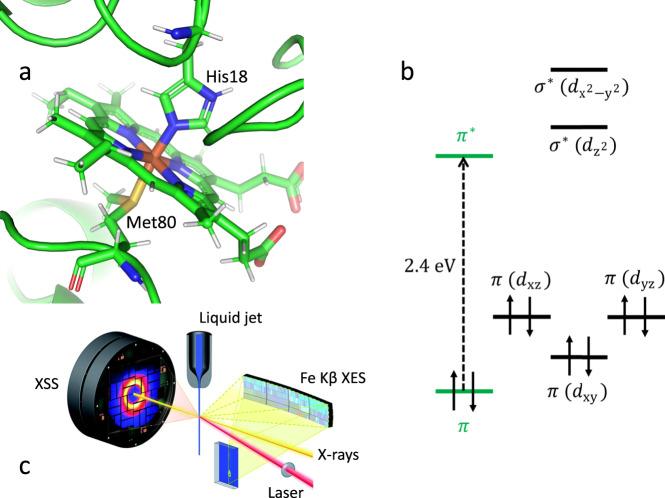
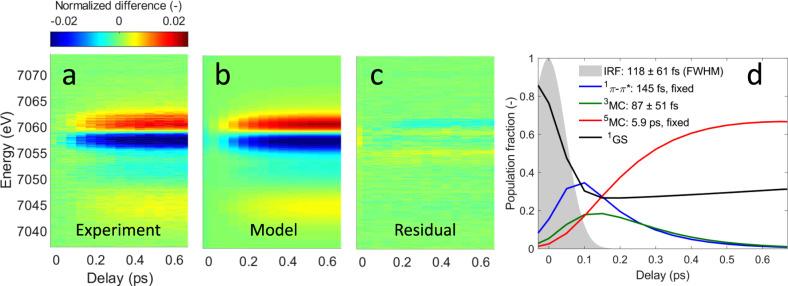
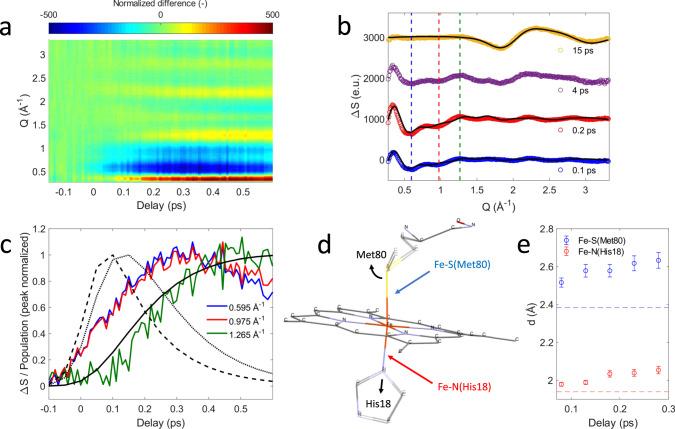
The dynamics of photodissociation and recombination in heme proteins represent an archetypical photochemical reaction widely used to understand the interplay between chemical dynamics and reaction environment. We report a study of the photodissociation mechanism for the Fe(II)-S bond between the heme iron and methionine sulfur of ferrous cytochrome c. This bond dissociation is an essential step in the conversion of cytochrome c from an electron transfer protein to a peroxidase enzyme. We use ultrafast X-ray solution scattering to follow the dynamics of Fe(II)-S bond dissociation and 1s3p (Kβ) X-ray emission spectroscopy to follow the dynamics of the iron charge and spin multiplicity during bond dissociation. From these measurements, we conclude that the formation of a triplet metal-centered excited state with anti-bonding Fe(II)-S interactions triggers the bond dissociation and precedes the formation of the metastable Fe high-spin quintet state.
血红素蛋白中光解和复合的动力学代表了一种典型的光化学反应,广泛用于理解化学动力学和反应环境之间的相互作用。我们报告了亚铁细胞色素 c 中血红素铁和蛋氨酸硫之间的 Fe(II)-S 键光解机制的研究。这种键的解离是细胞色素 c 从电子转移蛋白转化为过氧化物酶的关键步骤。我们使用超快 X 射线溶液散射来跟踪 Fe(II)-S 键解离的动力学,并用 1s3p(Kβ)X 射线发射光谱来跟踪键解离过程中铁电荷和自旋多重态的动力学。通过这些测量,我们得出结论,形成具有反键 Fe(II)-S 相互作用的三重态金属中心激发态触发了键的解离,并先于亚稳态 Fe 高自旋 quintet 态的形成。


 Zotero 插件