
超越酒精氧化酶:甲醇营养型酵母毕赤酵母 Komagataella phaffii 也利用其天然的醇脱氢酶 Adh2 来利用甲醇。
Beyond alcohol oxidase: the methylotrophic yeast Komagataella phaffii utilizes methanol also with its native alcohol dehydrogenase Adh2.
机构信息
Institute of Microbiology and Microbial Biotechnology, Department of Biotechnology, University of Natural Resources and Life Sciences (BOKU), Muthgasse 18, 1190 Vienna, Austria.
CD-Laboratory for Growth-Decoupled Protein Production in Yeast, Department of Biotechnology, University of Natural Resources and Life Sciences, Muthgasse 18, 1190 Vienna, Austria.
出版信息
FEMS Yeast Res. 2021 Mar 18;21(2). doi: 10.1093/femsyr/foab009.
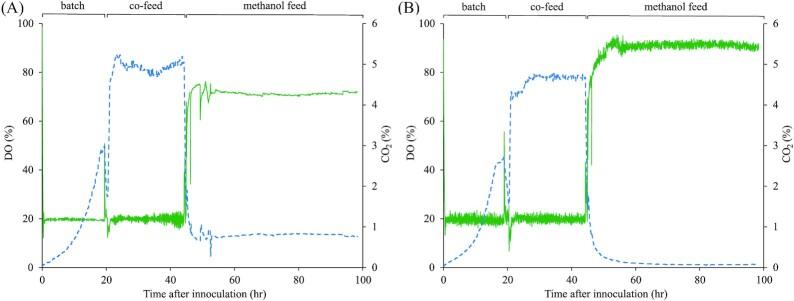
Methylotrophic yeasts are considered to use alcohol oxidases to assimilate methanol, different to bacteria which employ alcohol dehydrogenases with better energy conservation. The yeast Komagataella phaffii carries two genes coding for alcohol oxidase, AOX1 and AOX2. The deletion of the AOX1 leads to the MutS phenotype and the deletion of AOX1 and AOX2 to the Mut- phenotype. The Mut- phenotype is commonly regarded as unable to utilize methanol. In contrast to the literature, we found that the Mut- strain can consume methanol. This ability was based on the promiscuous activity of alcohol dehydrogenase Adh2, an enzyme ubiquitously found in yeast and normally responsible for ethanol consumption and production. Using 13C labeled methanol as substrate we could show that to the largest part methanol is dissimilated to CO2 and a small part is incorporated into metabolites, the biomass, and the secreted recombinant protein. Overexpression of the ADH2 gene in K. phaffii Mut- increased both the specific methanol uptake rate and recombinant protein production, even though the strain was still unable to grow. These findings imply that thermodynamic and kinetic constraints of the dehydrogenase reaction facilitated the evolution towards alcohol oxidase-based methanol metabolism in yeast.
甲醇营养型酵母被认为利用醇氧化酶来同化甲醇,而不同于细菌,细菌利用具有更好能量保存的醇脱氢酶。毕赤酵母(Komagataella phaffii)携带两个编码醇氧化酶的基因,AOX1 和 AOX2。AOX1 的缺失导致 MutS 表型,而 AOX1 和 AOX2 的缺失导致 Mut-表型。Mut-表型通常被认为不能利用甲醇。与文献相反,我们发现 Mut-菌株可以消耗甲醇。这种能力基于醇脱氢酶 Adh2 的混杂活性,该酶在酵母中普遍存在,通常负责乙醇的消耗和生产。使用 13C 标记的甲醇作为底物,我们可以表明甲醇大部分被异化到 CO2 中,一小部分被掺入代谢物、生物量和分泌的重组蛋白中。在 K. phaffii Mut-中过表达 ADH2 基因,即使该菌株仍然无法生长,也提高了甲醇的比摄取率和重组蛋白的产量。这些发现表明,脱氢酶反应的热力学和动力学限制促进了酵母中基于醇氧化酶的甲醇代谢的进化。



 Zotero 插件