
短生育间隔对出生顺序差异导致儿童发育迟缓的影响:来自印度的证据。
Effects of short birth spacing on birth-order differences in child stunting: Evidence from India.
机构信息
Tata-Cornell Institute for Agriculture and Nutrition, Charles H. Dyson School of Applied Economics and Management, Cornell University, Ithaca, NY 14853.
Tata-Cornell Institute for Agriculture and Nutrition, Charles H. Dyson School of Applied Economics and Management, Cornell University, Ithaca, NY 14853
出版信息
Proc Natl Acad Sci U S A. 2021 Feb 23;118(8). doi: 10.1073/pnas.2017834118.
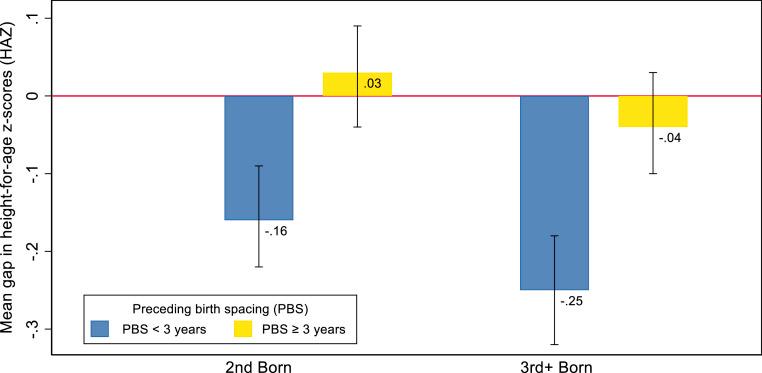
Do firstborn children have a height advantage? Empirical findings have found mostly that, yes, second or higher-order children often lag behind firstborns in height outcomes, especially in developing countries. However, empirical investigations of birth-order effects on child height overlook the potential impact that birth spacing can have. We provide an explanation for the negative birth-order effect on stunting outcomes for young Indian children and show it is driven by short preceding-birth spacing. We find that firstborn children are taller than children of higher birth order: The height-for-age gap for third (or higher)-order children is twice the gap for children second in birth order. However, this pattern is observed when spacing between later-born children and their immediate elder siblings is fewer than 3 y. Interestingly, the firstborn height advantage disappears when later-born children are born at least 3 y after their elder siblings. Thus, our findings indicate that spacing length between children explains differences in height, over birth order. Although India's family planning policy has resulted in a substantial reduction in total fertility, its achievement in spacing subsequent births has been less impressive. In showing that spacing can alleviate or aggravate birth-order effects on attained height, our study fills an evidence gap: Reducing fertility alone may not be sufficient in overcoming negative birth-order effects. To reduce the detrimental effects of birth order on child stunting, policy responses-and therefore research priorities-require a stronger focus on increasing the time period between births.
头胎子女是否具有身高优势?实证研究大多发现,是的,在身高方面,二胎或多胎子女通常落后于头胎子女,尤其是在发展中国家。然而,对出生顺序对儿童身高影响的实证研究忽略了出生间隔可能产生的潜在影响。我们为印度年轻儿童的生长迟缓的出生顺序负效应提供了一种解释,并表明这是由较短的出生前间隔造成的。我们发现头胎子女比二胎及更高胎次的子女更高:第三(或更高)胎子女的身高年龄差距是二胎子女的两倍。然而,只有当后来出生的孩子与他们的直接年长兄弟姐妹之间的间隔少于 3 岁时,才会出现这种模式。有趣的是,当后来出生的孩子至少比他们的年长兄弟姐妹晚出生 3 年时,头胎的身高优势就会消失。因此,我们的研究结果表明,孩子之间的间隔长度可以解释身高差异,而不是出生顺序。尽管印度的计划生育政策导致了总生育率的大幅下降,但在间隔后续生育方面的成效却不那么显著。通过表明间隔可以缓解或加剧出生顺序对获得身高的影响,我们的研究填补了一个证据空白:仅仅降低生育率可能不足以克服出生顺序对儿童生长迟缓的负面影响。为了减少出生顺序对儿童生长迟缓的不利影响,政策反应——因此也是研究重点——需要更加关注增加生育间隔。

 Zotero 插件