
利用光相干断层扫描血管造影评估抗血管内皮生长因子治疗后新生血管性年龄相关性黄斑变性患者的高反射病灶作为炎症生物标志物
Imaging Hyperreflective Foci as an Inflammatory Biomarker after Anti-VEGF Treatment in Neovascular Age-Related Macular Degeneration Patients with Optical Coherence Tomography Angiography.
机构信息
Department of Ophthalmology, Shanghai Tenth People's Hospital, Tongji University School of Medicine, Shanghai, China.
Department of Ophthalmology, Shanghai General Hospital (Shanghai First People's Hospital), Shanghai Jiao Tong University, Shanghai, China.
出版信息
Biomed Res Int. 2021 Feb 3;2021:6648191. doi: 10.1155/2021/6648191. eCollection 2021.
PURPOSE
To investigate the hyperreflective foci (HRF) as an inflammatory biomarker using optical coherence tomography angiography (OCTA) in neovascular age-related macular degeneration (AMD) patients after antivascular endothelial growth factor (anti-VEGF) treatment and its association with the retinal microcapillary density.
METHODS
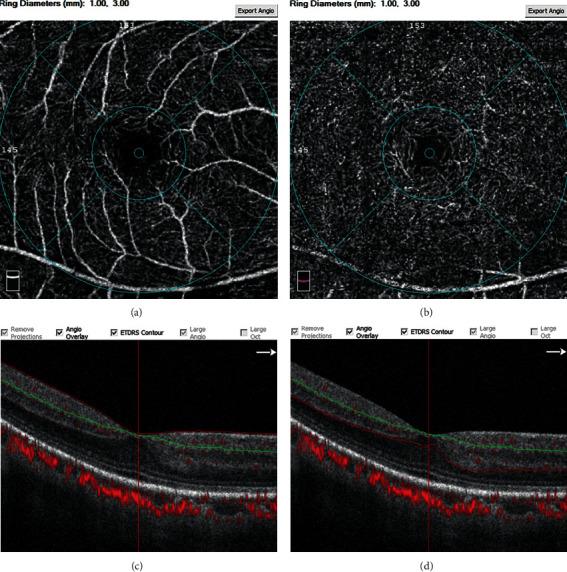
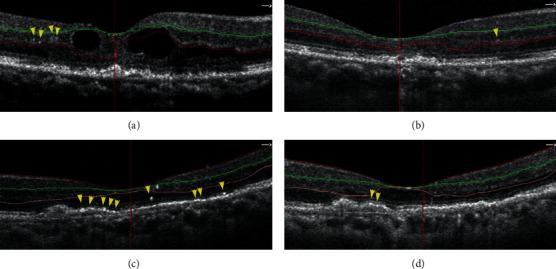
Twenty-five eyes from 25 patients with neovascular AMD were included in the study. All eyes were imaged with OCTA at baseline (M0) and after 3 consecutive injections (M3; injection performed each month) of anti-VEGF. The number of HRF in the superficial capillary plexus (SCP), deep capillary plexus (DCP), and outer retina was counted. The vascular density of the fovea, parafovea, and the whole macula, as well as the area of the foveal avascular zone (FAZ), was measured.
RESULTS
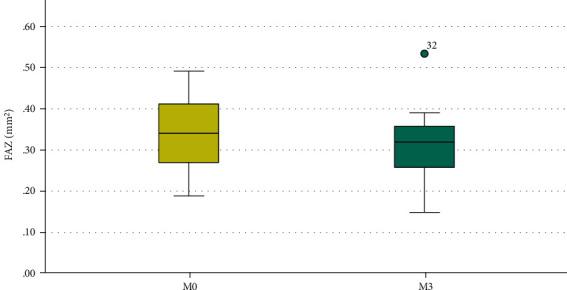
The mean interval between baseline and follow-up with OCTA was 93.08 ± 5.00 (range, 85-101) days. Compared with the baseline, the number of HRF significantly decreased in DCP (7.52 ± 3.06 vs. 3.76 ± 1.48, < 0.01) and outer retina (12.04 ± 4.91 vs. 5.88 ± 3.32, < 0.01) after treatment. There was no significant difference for HRF number in the SCP, the vascular density (containing foveal, parafoveal, and whole macular), and FAZ area before and after treatments.
CONCLUSION
The number of HRF in DCP and outer retina might serve as an inflammatory biomarker in patients with neovascular AMD. The reduced HRF possibly represents the alleviation of inflammation after anti-VEGF treatment in patients with AMD.
目的
使用光相干断层扫描血管造影术(OCTA)研究血管内皮生长因子(anti-VEGF)治疗后新生血管性年龄相关性黄斑变性(AMD)患者的高反射焦点(HRF)作为炎症生物标志物及其与视网膜毛细血管密度的关系。
方法
本研究纳入 25 例 25 只眼的新生血管性 AMD 患者。所有患者均在基线(M0)和连续 3 次抗 VEGF 注射后(M3;每月注射一次)进行 OCTA 成像。在浅层毛细血管丛(SCP)、深层毛细血管丛(DCP)和外视网膜中计数 HRF 的数量。测量黄斑中心凹、旁中心凹和整个黄斑的血管密度以及中心凹无血管区(FAZ)的面积。
结果
OCTA 基线与随访之间的平均间隔为 93.08 ± 5.00(范围,85-101)天。与基线相比,DCP(7.52 ± 3.06 对 3.76 ± 1.48, < 0.01)和外视网膜(12.04 ± 4.91 对 5.88 ± 3.32, < 0.01)的 HRF 数量在治疗后显著减少。治疗前后 SCP、血管密度(包含中心凹、旁中心凹和整个黄斑)和 FAZ 面积的 HRF 数量无显著差异。
结论
DCP 和外视网膜中的 HRF 数量可能是新生血管性 AMD 患者的炎症生物标志物。HRF 的减少可能代表 AMD 患者抗 VEGF 治疗后炎症的缓解。
 Zotero 插件