
夜光网络中新冠病毒感染与检测的时空演变:美国与中国的比较分析
Spatiotemporal evolution of COVID-19 infection and detection within night light networks: comparative analysis of USA and China.
作者信息
Small Christopher, Sousa Daniel
机构信息
Lamont Doherty Earth Observatory, Columbia University, Palisades, NY 10964 USA.
Jet Propulsion Laboratory, California Institute of Technology, Pasadena, CA 91109 USA.
出版信息
Appl Netw Sci. 2021;6(1):10. doi: 10.1007/s41109-020-00345-4. Epub 2021 Feb 11.
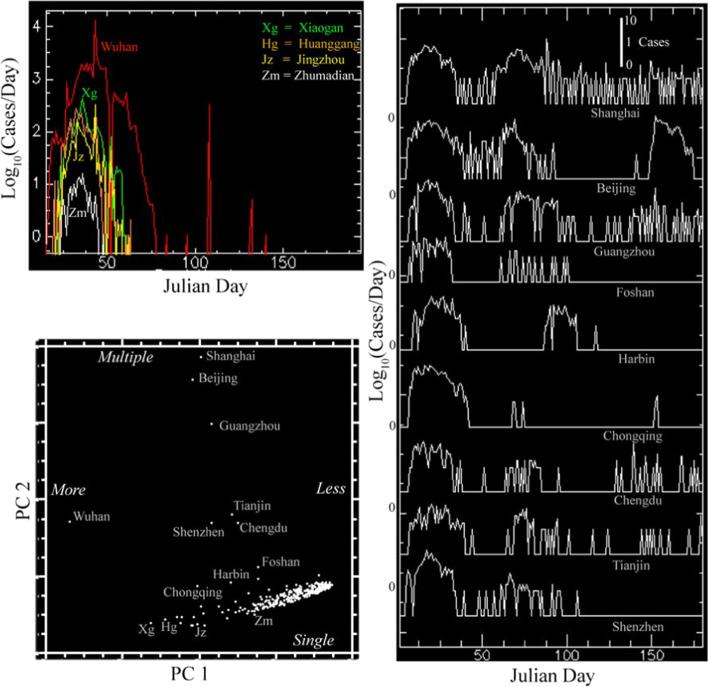
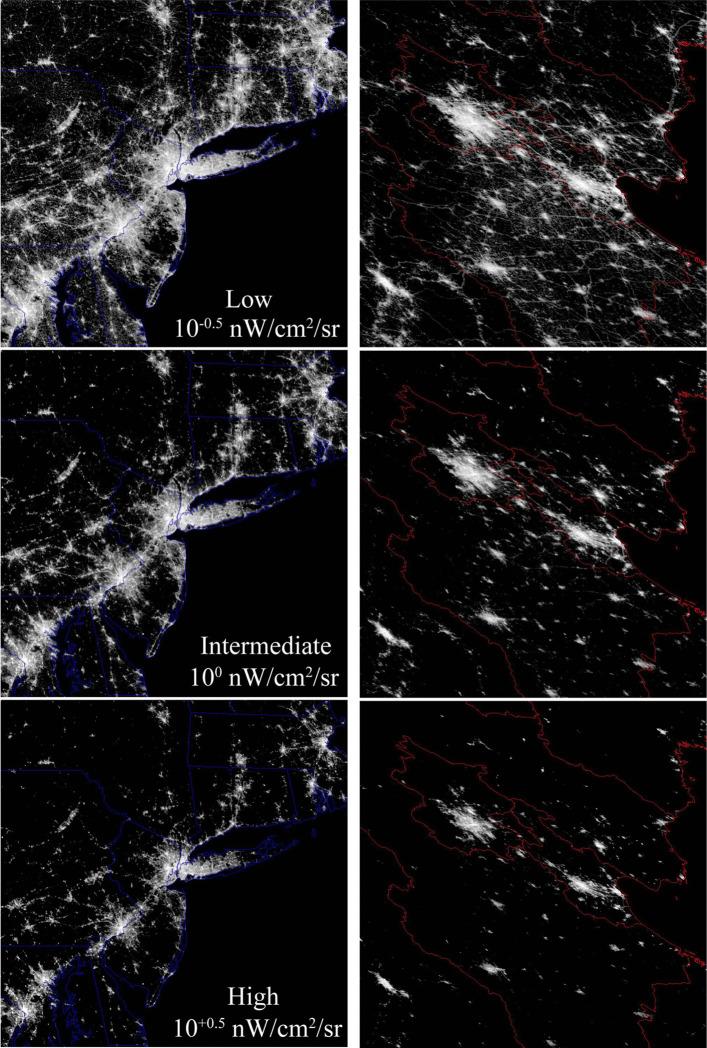
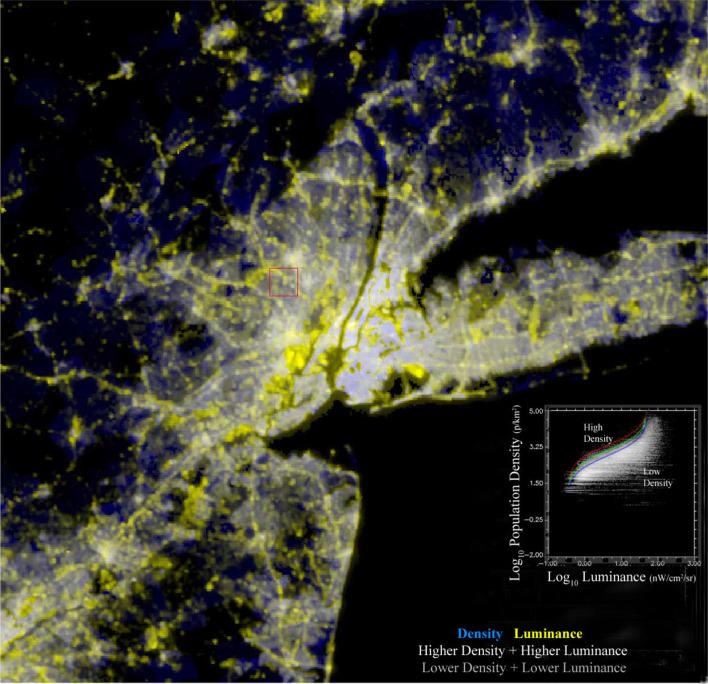
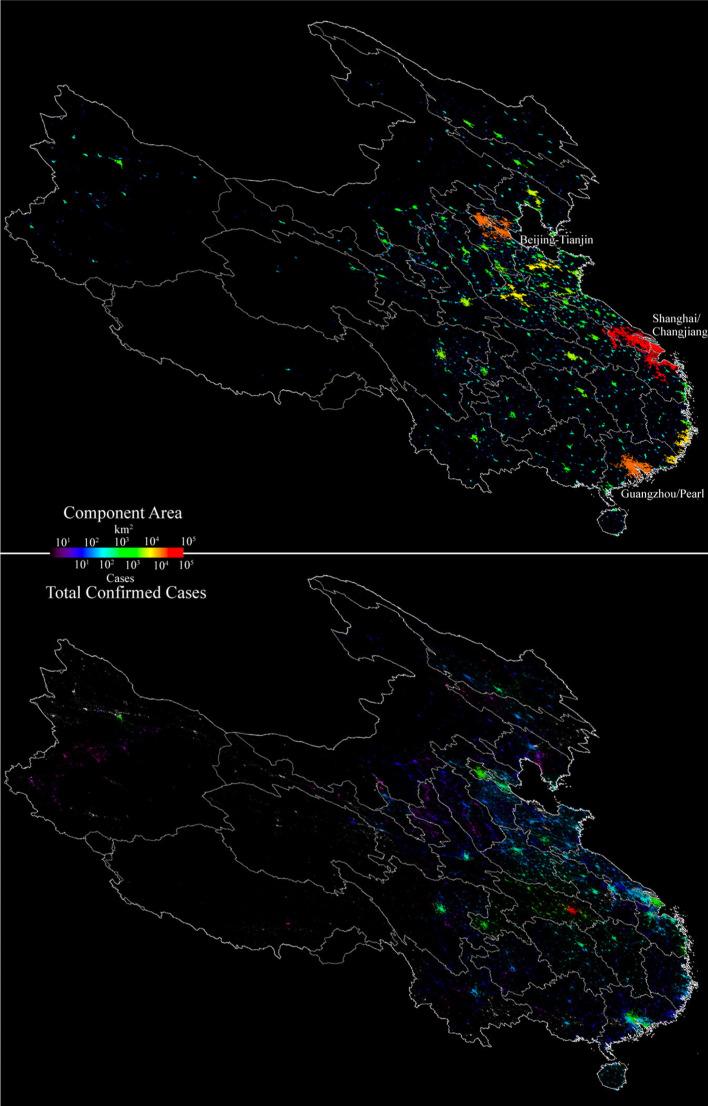
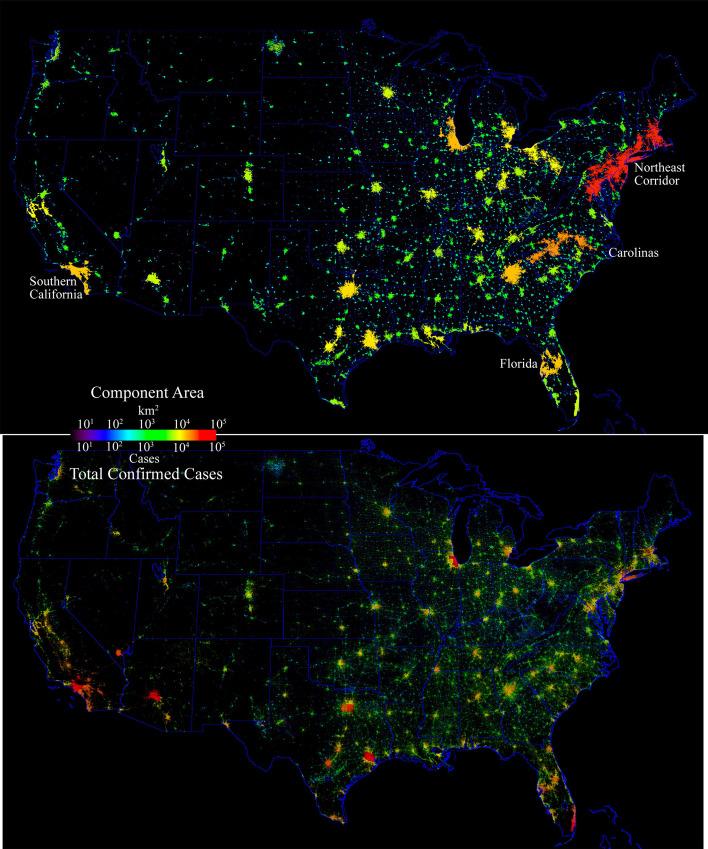
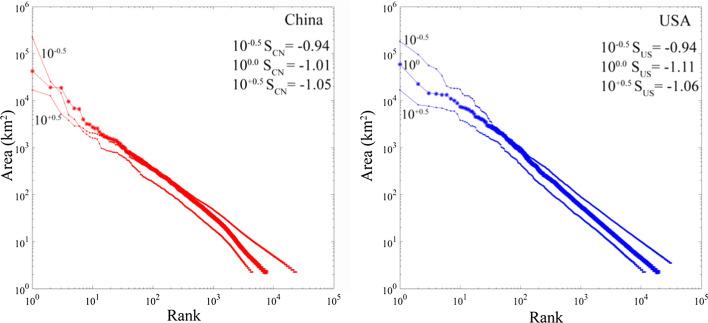
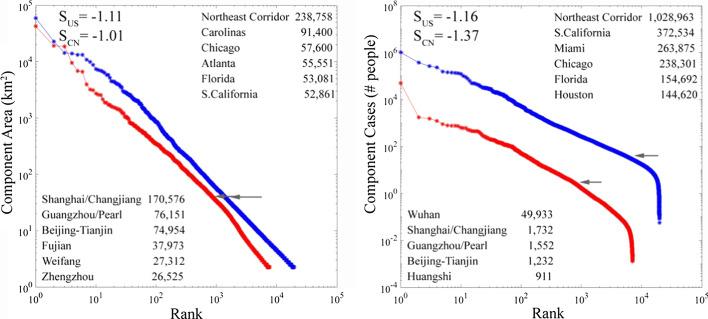
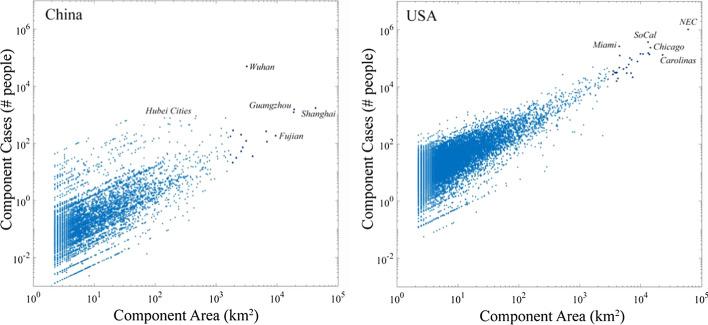
The spatial distribution of population affects disease transmission, especially when shelter in place orders restrict mobility for a large fraction of the population. The spatial network structure of settlements therefore imposes a fundamental constraint on the spatial distribution of the population through which a communicable disease can spread. In this analysis we use the spatial network structure of lighted development as a proxy for the distribution of ambient population to compare the spatiotemporal evolution of COVID-19 confirmed cases in the USA and China. The Visible Infrared Imaging Radiometer Suite (VIIRS) Day/Night Band sensor on the NASA/NOAA Suomi satellite has been imaging night light at ~ 700 m resolution globally since 2012. Comparisons with sub-kilometer resolution census observations in different countries across different levels of development indicate that night light luminance scales with population density over ~ 3 orders of magnitude. However, VIIRS' constant ~ 700 m resolution can provide a more detailed representation of population distribution in peri-urban and rural areas where aggregated census blocks lack comparable spatial detail. By varying the low luminance threshold of VIIRS-derived night light, we depict spatial networks of lighted development of varying degrees of connectivity within which populations are distributed. The resulting size distributions of spatial network components (connected clusters of nodes) vary with degree of connectivity, but maintain consistent scaling over a wide range (5 × to 10 × in area & number) of network sizes. At continental scales, spatial network rank-size distributions obtained from VIIRS night light brightness are well-described by power laws with exponents near -2 (slopes near -1) for a wide range of low luminance thresholds. The largest components (10 to 10 km) represent spatially contiguous agglomerations of urban, suburban and periurban development, while the smallest components represent isolated rural settlements. Projecting county and city-level numbers of confirmed cases of COVID-19 for the USA and China (respectively) onto the corresponding spatial networks of lighted development allows the spatiotemporal evolution of the epidemic (infection and detection) to be quantified as propagation within networks of varying connectivity. Results for China show rapid nucleation and diffusion in January 2020 followed by rapid decreases in new cases in February. While most of the largest cities in China showed new confirmed cases approaching zero before the end of February, most of these cities also showed distinct second waves of cases in March or April. Whereas new cases in Wuhan did not approach zero until mid-March, as of December 2020 it has not yet experienced a second wave of cases. In contrast, the results for the USA show a wide range of trajectories, with an abrupt transition from slow increases in confirmed cases in a small number of network components in January and February, to rapid geographic dispersion to a larger number of components shortly before mobility reductions occurred in March. Results indicate that while most of the upper tail of the network had been exposed by the end of March, the lower tail of the component size distribution has only shown steep increases since mid-June.
人口的空间分布会影响疾病传播,尤其是当就地避难令限制了很大一部分人口的流动时。因此,定居点的空间网络结构对传染病可能传播的人口空间分布施加了根本性限制。在本分析中,我们使用灯光发展的空间网络结构作为周围人口分布的代理,以比较美国和中国新冠肺炎确诊病例的时空演变。自2012年以来,美国国家航空航天局/美国国家海洋和大气管理局苏梅卫星上的可见红外成像辐射计套件(VIIRS)日夜波段传感器一直在全球以约700米的分辨率对夜光进行成像。与不同发展水平的不同国家亚公里分辨率的人口普查观测结果比较表明,夜光亮度与人口密度在约3个数量级上成比例。然而,VIIRS恒定的约700米分辨率可以更详细地呈现城乡结合部和农村地区的人口分布情况,而在这些地区,汇总的人口普查街区缺乏可比的空间细节。通过改变VIIRS夜光的低亮度阈值,我们描绘了不同连接程度的灯光发展空间网络,人口分布在这些网络中。由此产生的空间网络组件(节点的连接集群)的大小分布随连接程度而变化,但在很宽的网络大小范围(面积和数量为5倍至10倍)内保持一致的比例关系。在大陆尺度上,从VIIRS夜光亮度获得的空间网络秩-规模分布可以用幂律很好地描述,对于广泛的低亮度阈值,指数接近-2(斜率接近-1)。最大的组件(10至10千米)代表城市、郊区和城乡结合部发展在空间上连续的集聚,而最小的组件代表孤立的农村定居点。将美国和中国(分别)的县和市级新冠肺炎确诊病例数投影到相应的灯光发展空间网络上,可以将疫情(感染和检测)的时空演变量化为在不同连接程度网络中的传播。中国的结果显示,2020年1月病例迅速成核并扩散,随后2月新病例迅速减少。虽然中国大多数大城市在2月底前新确诊病例接近零,但其中大多数城市在3月或4月也出现了明显的第二波病例。而武汉的新病例直到3月中旬才接近零,截至2020年12月,该市尚未经历第二波病例。相比之下,美国的结果显示出广泛的轨迹,从1月和2月少数网络组件中确诊病例的缓慢增加,到3月出行减少前不久迅速向更多组件的地理扩散,出现了突然转变。结果表明,虽然到3月底网络的大部分上尾已经暴露,但组件大小分布的下尾自6月中旬以来才显示出急剧增加。



 Zotero 插件