
与儿科重症监护病房(PICU)反复入院相关的资源与成本
Resources and Costs Associated With Repeated Admissions to PICUs.
作者信息
Kane Jason M, Hall Matt, Cecil Cara, Montgomery Vicki L, Rakes Lauren C, Rogerson Colin, Stockwell Jana A, Slain Katherine N, Goodman Denise M
机构信息
University of Chicago, Department of Pediatrics, Section of Critical Care Medicine, Comer Children's Hospital, Chicago, IL.
Children's Hospital Association, Lenexa, KS.
出版信息
Crit Care Explor. 2021 Feb 17;3(2):e0347. doi: 10.1097/CCE.0000000000000347. eCollection 2021 Feb.
OBJECTIVE
To determine the costs and hospital resource use from all PICU patients readmitted with a PICU stay within 12 months of hospital index discharge.
DESIGN
Cross-sectional, retrospective cohort study using Pediatric Health Information System.
SETTING
Fifty-two tertiary children's hospitals.
SUBJECTS
Pediatric patients under 18 years old admitted to the PICU from January 1, 2016, to December 31, 2017.
INTERVENTIONS
None.
MEASUREMENTS AND MAIN RESULTS
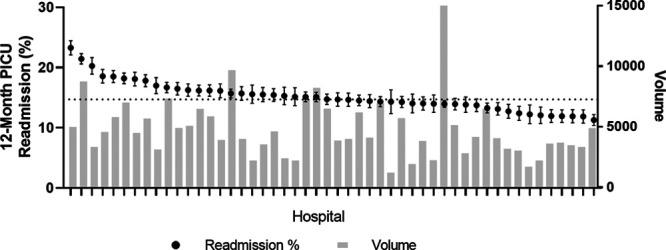
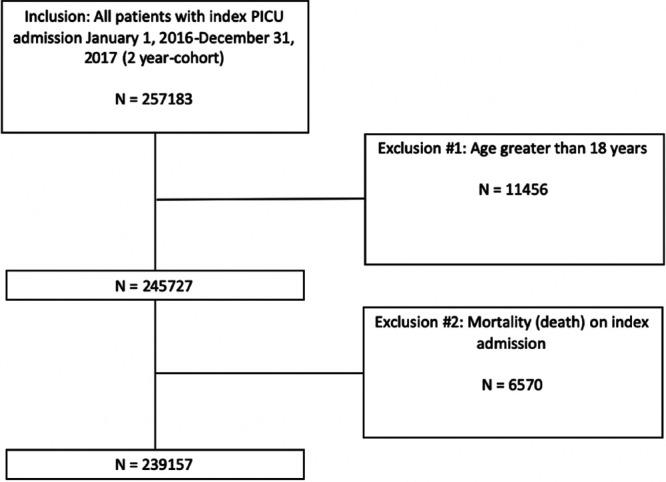
Patient characteristics and costs of care were compared between those with readmission requiring PICU care and those with only a single PICU admission per annum. In this 2-year cohort, there were 239,157 index PICU patients of which 36,970 (15.5%) were readmitted and required PICU care during the 12 months following index admission. The total hospital cost for all index admissions and readmissions was $17.3 billion, of which 21.5% ($3.71 billion) were incurred during a readmission stay involving care in the PICU; of the 3,459,079 hospital days, 20.3% (702,200) were readmission days including those where PICU care was required. Of the readmitted patients, 11,703 (30.0%) received only PICU care, accounting for $662 million in costs and 110,215 PICU days. Although 43.6% of all costs were associated with patients who required readmission, these patients only accounted for 15.5% of the index patients and 28% of index hospitalization expenditures. More patients in the readmitted group had chronic complex conditions at index discharge compared with those not readmitted (83.9% vs 54.9%; < 0.001). Compared with those discharged directly to home without home healthcare, patients discharged to a skilled nursing facility had 18% lower odds of readmission (odds ratio 0.82 [95% CI, 0.75-0.89]; < 0.001) and those discharged home with home healthcare had 43% higher odds of readmission (odds ratio, 1.43 [95% CI, 1.36-1.51]; < 0.001).
CONCLUSIONS
Repeated admissions with PICU care resulted in significant direct medical costs and resource use for U.S. children's hospitals.
目的
确定在医院首次出院后12个月内再次入住儿科重症监护病房(PICU)的所有PICU患者的费用及医院资源使用情况。
设计
使用儿科健康信息系统进行的横断面回顾性队列研究。
地点
52家三级儿童医院。
研究对象
2016年1月1日至2017年12月31日期间入住PICU的18岁以下儿科患者。
干预措施
无。
测量指标及主要结果
比较了再次入住需要PICU护理的患者与每年仅入住一次PICU的患者的特征及护理费用。在这个为期2年的队列中,共有239,157例首次入住PICU的患者,其中36,970例(15.5%)在首次入院后的12个月内再次入住并需要PICU护理。所有首次入院和再次入院的总医院费用为173亿美元,其中21.5%(37.1亿美元)发生在再次入住期间的PICU护理中;在3,459,079个住院日中,20.3%(702,200个)是再次入院日,包括需要PICU护理的日子。在再次入院的患者中,11,703例(30.0%)仅接受了PICU护理,费用为6.62亿美元,PICU住院日为110,215天。尽管所有费用的43.6%与需要再次入院的患者相关,但这些患者仅占首次入院患者的15.5%,占首次住院支出的28%。与未再次入院的患者相比,再次入院组中更多患者在首次出院时患有慢性复杂疾病(83.9%对54.9%;P<0.001)。与直接出院回家且没有家庭医疗护理的患者相比,出院到专业护理机构的患者再次入院的几率低18%(优势比0.82[95%CI,0.75-0.89];P<0.001),而出院回家并接受家庭医疗护理的患者再次入院的几率高43%(优势比1.43[95%CI,1.36-1.51];P<0.001)。
结论
再次入住PICU护理给美国儿童医院带来了巨大的直接医疗成本和资源使用。
 Zotero 插件