
评估在医疗保险受益人群中使用新批准的肿瘤药物相关的结局。
Assessment of Outcomes Associated With the Use of Newly Approved Oncology Drugs in Medicare Beneficiaries.
机构信息
Gynecologic Medical Oncology Service, Department of Medicine, Memorial Sloan Kettering Cancer Center, New York, New York.
Center for Health Policy and Outcomes, Memorial Sloan Kettering Cancer Center, New York, New York.
出版信息
JAMA Netw Open. 2021 Feb 1;4(2):e210030. doi: 10.1001/jamanetworkopen.2021.0030.
IMPORTANCE
A lack of generalizability of pivotal cancer clinical trial data to treatment of older adults with Medicare could affect therapeutic decision-making in clinical practice.
OBJECTIVE
To evaluate the differences in survival, duration of therapy, and treatment patterns between clinical trial patients and older adults with Medicare receiving cancer drugs for metastatic solid cancers in usual practice.
DESIGN, SETTING, AND PARTICIPANTS: This retrospective cohort study, performed from May 1, 2018, to August 30, 2020, used the linked Surveillance, Epidemiology, and End Results (SEER) program and Medicare database to examine sequential US Food and Drug Administration (FDA)-approved cancer drug indications (2008-2013) for locally advanced or metastatic solid tumors to assess whether pivotal trials reflect the outcomes of Medicare patients with cancer treated in usual practice.
EXPOSURES
Treatment with FDA-approved cancer drugs for metastatic solid cancers in pivotal clinical trials and in the SEER-Medicare database.
MAIN OUTCOMES AND MEASURES
Overall survival, duration of treatment, and dose reductions among trial participants and treated Medicare patients.
RESULTS
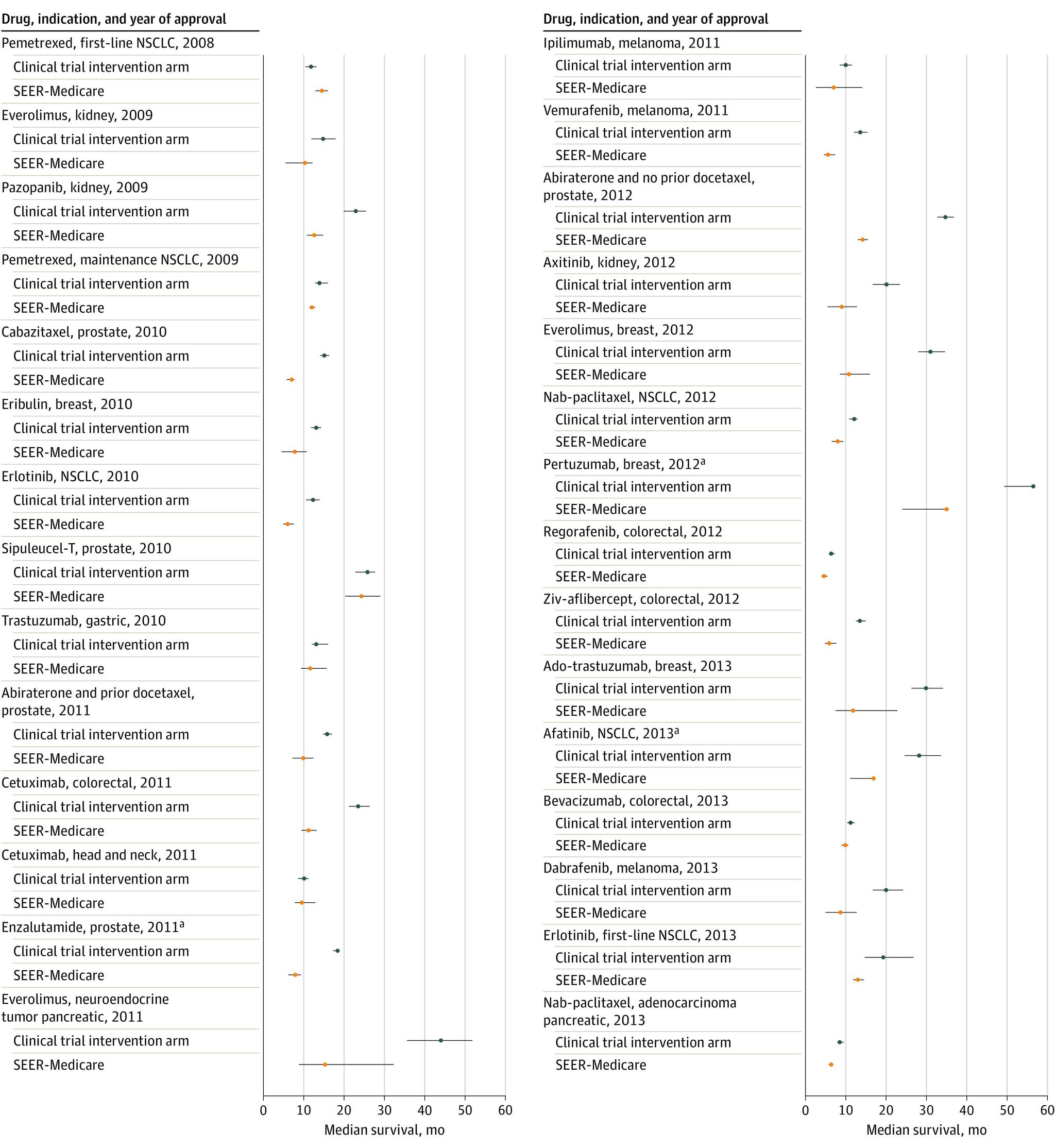
A total of 11 828 trial participants (mean age, 61.8 years; 6718 [56.8%] male; and 7605 [64.3%] White) and 9178 SEER-Medicare patients (mean age, 72.7 years; 4800 [52.3%] male; and 7437 [81.0% White]) were compared. Twenty-nine indications for 22 cancer drugs were included. Median overall survival among Medicare patients was shorter than among patients in the clinical trial intervention arm for 28 of 29 indications (median difference, -6.3 months; range, -28.7 to 2.7 months). Median duration of therapy among Medicare patients was shorter for 23 of the 27 indications with data available (median difference, -1.9 months; range, -12.4 to 1.4 months). For 9 indications, there was information available regarding dose reductions in the package insert or trial publication. In all but 1 instance, dose reductions or single prescriptions were more common in the Medicare population compared with dose reductions among the clinical trial patients; for example, in the Medicare patients, 600 of 1032 (58.1%) received dose reduction or a single prescription and 172 of 1032 (16.7%) received a single prescription vs 734 of 3416 (21.5%) in the trial intervention arm. The exception was afatinib for non-small cell lung cancer: 34 of 71 (47.9%) received dose reduction or a single prescription and 15 of 71 (21.1%) received a single prescription among the Medicare patients vs 120 of 230 (52.2%) receiving dose reductions among the trial intervention group.
CONCLUSIONS AND RELEVANCE
In this cohort study, patients receiving Medicare who were treated with FDA-approved cancer drugs did not live as long as treated clinical trial participants and commonly received treatment modifications. This study suggests that cancer clinical data relevant to newly approved drugs lack generalizability to Medicare beneficiaries with cancer; therefore, these agents should be used with caution.
重要性
关键性癌症临床试验数据在治疗老年医疗保险患者方面缺乏普遍性,可能会影响临床实践中的治疗决策。
目的
评估临床试验患者和接受医疗保险的老年癌症患者在接受转移性实体瘤药物治疗方面在生存、治疗持续时间和治疗模式方面的差异。
设计、地点和参与者:这项回顾性队列研究于 2018 年 5 月 1 日至 2020 年 8 月 30 日进行,使用了链接的监测、流行病学和最终结果(SEER)计划和医疗保险数据库,以评估美国食品和药物管理局(FDA)批准的用于局部晚期或转移性实体肿瘤的连续癌症药物适应症(2008-2013 年),以评估关键性试验是否反映了医疗保险癌症患者在常规实践中的治疗结果。
暴露情况
在关键性临床试验和 SEER-医疗保险数据库中接受 FDA 批准的转移性实体瘤药物治疗。
主要结果和措施
试验参与者和接受治疗的医疗保险患者的总生存、治疗持续时间和剂量减少。
结果
共比较了 11828 名试验参与者(平均年龄 61.8 岁;6718 名[56.8%]男性;7605 名[64.3%]白人)和 9178 名 SEER-医疗保险患者(平均年龄 72.7 岁;4800 名[52.3%]男性;7437 名[81.0%]白人)。纳入了 22 种癌症药物的 29 种适应症。在 29 种适应症中,有 28 种(中位数差异-6.3 个月;范围-28.7 至 2.7 个月)医疗保险患者的总体中位生存期短于临床试验干预组的患者。在有数据的 27 种适应症中,有 23 种(中位数差异-1.9 个月;范围-12.4 至 1.4 个月)医疗保险患者的治疗持续时间更短。对于 9 种适应症,在包装说明书或试验出版物中可获得关于剂量减少的信息。除 1 种情况外,与临床试验患者的剂量减少相比,医疗保险患者中剂量减少或单次处方更为常见;例如,在医疗保险患者中,1032 名中有 600 名(58.1%)接受了剂量减少或单次处方,而 1032 名中有 172 名(16.7%)接受了单次处方,而 3416 名中有 172 名(16.7%)接受了单次处方。唯一的例外是阿法替尼治疗非小细胞肺癌:71 名患者中有 34 名(47.9%)接受了剂量减少或单次处方,而 71 名患者中有 15 名(21.1%)接受了单次处方,而在试验干预组中有 120 名(52.2%)接受了剂量减少。
结论和相关性
在这项队列研究中,接受医疗保险的接受 FDA 批准的癌症药物治疗的患者的生存期不如接受治疗的临床试验参与者长,并且经常接受治疗调整。这项研究表明,与新批准药物相关的癌症临床数据缺乏普遍性,适用于医疗保险的癌症患者;因此,应谨慎使用这些药物。

 Zotero 插件