
肌肉注射和皮下注射聚乙二醇化干扰素β-1a的生物等效性:一项在健康志愿者中进行的I期开放标签交叉研究的结果。
Bioequivalence of intramuscular and subcutaneous peginterferon beta-1a: results of a phase I, open-label crossover study in healthy volunteers.
作者信息
Zhao Yuan, Chen Kun, Ramia Nancy, Sahu Sangeeta, Kumar Achint, Naylor Maria L, Zhu Li, Naik Himanshu, Butts Cherié L
机构信息
Biogen, Cambridge, MA, USA.
Biogen, 225 Binney St., Cambridge, MA 02142, USA.
出版信息
Ther Adv Neurol Disord. 2021 Jan 22;14:1756286420975227. doi: 10.1177/1756286420975227. eCollection 2021.
BACKGROUND
Peginterferon beta-1a administered every 2 weeks subcutaneous (SC) injection is approved to treat adult patients with relapsing-remitting multiple sclerosis (RRMS) and relapsing forms of multiple sclerosis (RMS). However, associated injection site reactions (ISRs) can lead to treatment discontinuation. Prior studies with interferon beta-1a reported a lower frequency of ISRs with intramuscular (IM) administration than with SC administration. IM administration of peginterferon beta-1a may therefore represent a useful alternative treatment option.
METHODS
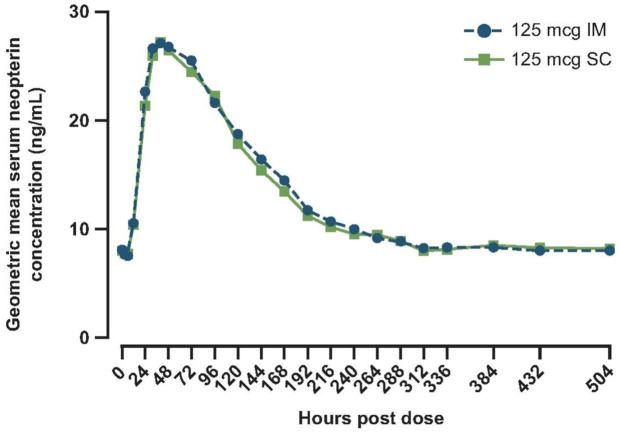
A phase I, open-label, two-period crossover study randomized healthy volunteers to receive a single dose of peginterferon beta-1a 125 mcg administered IM followed by a single 125 mcg dose administered SC after a 28-day washout or vice versa. Blood samples were collected up to 504 h post dose to determine pharmacokinetic (PK) and pharmacodynamic (PD) profiles. The primary endpoint was assessment of bioequivalence based on maximum serum concentration (C) and area under the curve from time zero extrapolated to infinity (AUC). Other PK parameters, as well as PD (serum neopterin) and safety profiles, were also evaluated.
RESULTS
The study enrolled 136 participants. Bioequivalence of IM and SC peginterferon beta-1a was established for both C ([least squares (LS)] mean IM/SC ratio: 1.083 [90% confidence interval (CI), 0.975-1.203]) and AUC (LS mean IM/SC ratio: 1.089 [90% CI, 1.020-1.162]). Other PK and PD parameters were similar between administration routes, although moderate to high inter-subject variability was observed for IM and SC. Safety profiles were generally balanced between IM and SC administration. ISRs occurred at a lower frequency with IM [14.4% (95% CI, 8.89-21.56%)] than with SC [32.1% (95% CI, 24.29-40.70%)] administration ( = 0.0005).
CONCLUSIONS
These results demonstrate bioequivalence between peginterferon beta-1a IM and SC and support the consideration of IM injection of peginterferon beta-1a as a viable treatment option in patients with RRMS and RMS.
背景
每2周皮下(SC)注射一次聚乙二醇化干扰素β-1a已被批准用于治疗复发缓解型多发性硬化症(RRMS)和复发型多发性硬化症(RMS)的成年患者。然而,相关的注射部位反应(ISR)可能导致治疗中断。先前关于干扰素β-1a的研究报告称,肌内(IM)给药的ISR频率低于SC给药。因此,聚乙二醇化干扰素β-1a的IM给药可能是一种有用的替代治疗选择。
方法
一项I期、开放标签、两阶段交叉研究将健康志愿者随机分组,使其接受单剂量125微克聚乙二醇化干扰素β-1a的IM给药,在28天的洗脱期后再接受单剂量125微克的SC给药,或者反之。在给药后长达504小时采集血样,以确定药代动力学(PK)和药效学(PD)特征。主要终点是基于最大血清浓度(C)和从零时间外推至无穷大的曲线下面积(AUC)评估生物等效性。还评估了其他PK参数以及PD(血清新蝶呤)和安全性特征。
结果
该研究招募了136名参与者。对于C([最小二乘法(LS)]平均IM/SC比值:1.083 [90%置信区间(CI),0.975 - 1.203])和AUC(LS平均IM/SC比值:1.089 [90% CI,1.020 - 1.162]),均确立了IM和SC聚乙二醇化干扰素β-1a的生物等效性。尽管观察到IM和SC给药存在中度至高度的个体间变异性,但不同给药途径之间的其他PK和PD参数相似。IM和SC给药的安全性特征总体上是平衡的。IM给药的ISR发生率[14.4%(95% CI,8.89 - 21.56%)]低于SC给药[32.1%(95% CI,24.29 - 40.70%)](P = 0.0005)。
结论
这些结果证明了聚乙二醇化干扰素β-1a的IM和SC给药之间具有生物等效性,并支持将聚乙二醇化干扰素β-1a的IM注射作为RRMS和RMS患者的一种可行治疗选择。


 Zotero 插件