
气道紧密连接作为病毒感染的靶点。
Airway tight junctions as targets of viral infections.
机构信息
Cleveland Clinic Lerner College of Medicine of Case Western Reserve University, Cleveland, OH, USA.
Department of Inflammation and Immunity, Lerner Research Institute, Cleveland, Ohio, USA.
出版信息
Tissue Barriers. 2021 Apr 3;9(2):1883965. doi: 10.1080/21688370.2021.1883965. Epub 2021 Feb 26.
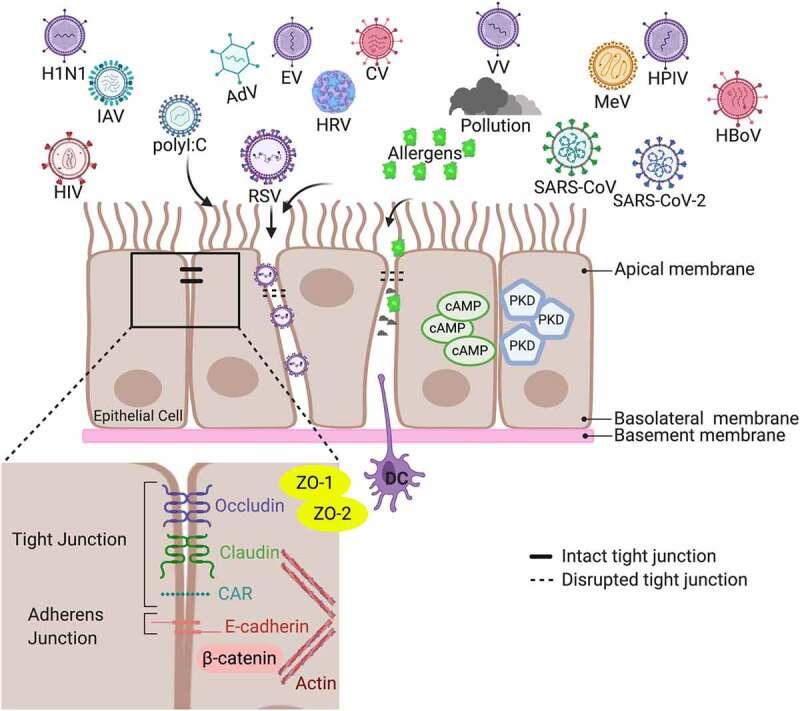
The apical junctional complexes (AJCs) of airway epithelial cells are a key component of the innate immune system by creating barriers to pathogens, inhaled allergens, and environmental particles. AJCs form between adjacent cells and consist of tight junctions (TJs) and adherens junctions (AJs). Respiratory viruses have been shown to target various components of the AJCs, leading to airway epithelial barrier dysfunction by different mechanisms. Virus-induced epithelial permeability may allow for allergens and bacterial pathogens to subsequently invade. In this review, we discuss the pathophysiologic mechanisms leading to disruption of AJCs and the potential ensuing ramifications. We focus on the following viruses that affect the pulmonary system: respiratory syncytial virus, rhinovirus, influenza viruses, immunodeficiency virus, and other viruses such as coxsackievirus, adenovirus, coronaviruses, measles, parainfluenza virus, bocavirus, and vaccinia virus. Understanding the mechanisms by which viruses target the AJC and impair barrier function may help design therapeutic innovations to treat these infections.
气道上皮细胞的顶端连接复合体 (AJC) 通过形成对病原体、吸入性过敏原和环境颗粒的屏障,成为先天免疫系统的关键组成部分。AJC 形成于相邻细胞之间,由紧密连接 (TJ) 和黏附连接 (AJ) 组成。研究表明,呼吸道病毒针对 AJC 的各种成分,通过不同的机制导致气道上皮屏障功能障碍。病毒诱导的上皮通透性可能允许过敏原和细菌病原体随后入侵。在这篇综述中,我们讨论了导致 AJC 破坏的病理生理机制及其潜在的后果。我们重点关注以下影响肺部系统的病毒:呼吸道合胞病毒、鼻病毒、流感病毒、免疫缺陷病毒以及其他病毒,如柯萨奇病毒、腺病毒、冠状病毒、麻疹、副流感病毒、博卡病毒和牛痘病毒。了解病毒靶向 AJC 并损害屏障功能的机制可能有助于设计治疗这些感染的创新疗法。
 Zotero 插件