
在发情期刺激埃塔瓦等级多胎母羊的卵泡生长和发育时,确实饲喂了不同多不饱和脂肪酸的催情补饲物。
Stimulation of follicle growth and development during estrus in Ettawa Grade does fed a flushing supplement of different polyunsaturated fatty acids.
作者信息
Nugroho Prasetyo, Wiryawan Komang Gede, Astuti Dewi Apri, Manalu Wasmen
机构信息
Graduate School of Nutrition and Feed Science, Faculty of Animal Science, IPB University, Jalan Agatis, Kampus IPB Dramaga, Bogor 16680, Indonesia.
Department of Livestock and Animal Health Services of Central Java Province, Jalan Jenderal Gatot Subroto, Tarubudaya, Ungaran 50517, Indonesia.
出版信息
Vet World. 2021 Jan;14(1):11-22. doi: 10.14202/vetworld.2021.11-22. Epub 2021 Jan 5.
BACKGROUND AND AIM
Flushing with the manipulation of fatty acids, particularly polyunsaturated fatty acids, like linoleic and α-linolenic acids in the ration, is a strategy to raise the nutritional status of the female mammals to improve ovarian function and follicle development. This study was designed to investigate the effectiveness of flushing supplementation with different types of polyunsaturated and saturated fatty acids in stimulating follicle growth and development during estrus in Ettawa Grade does with a low initial body condition score (BCS ≤2).
MATERIALS AND METHODS
Eighteen Ettawa Grade does in the second parity, with an average body weight of 32.11±2.19 kg, were divided into three groups according to the fatty acid supplemented to their ration: (i) About 2.8% lauric acid flushing (group); (ii) 2.8% linoleic acid flushing (LA group); and (iii) 2.8% α-linolenic acid flushing (ALA group). The ration was formulated to be isocaloric (total digestible nutrient = 77%) and isonitrogenous (crude protein = 15%). The experiment was conducted for 35 days; that is, 14 days for acclimatization and synchronization of the estrous cycle and 21 days for fatty acid flushing until the appearance of the next estrus. A completely randomized design was applied.
RESULTS
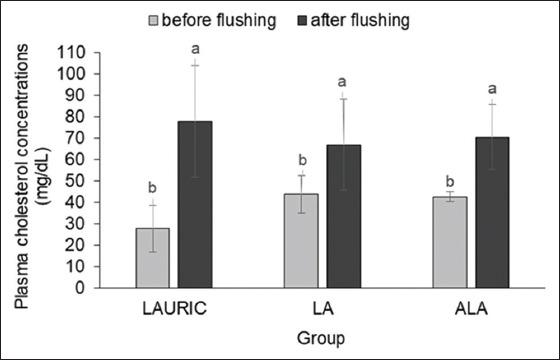
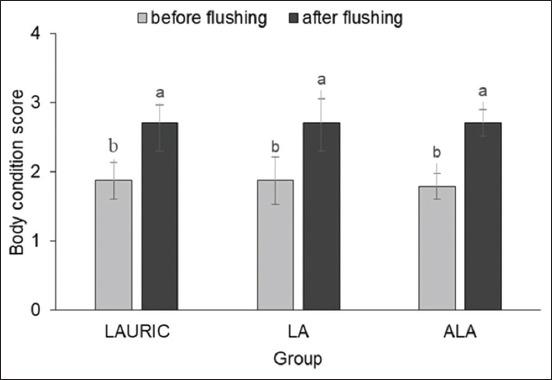
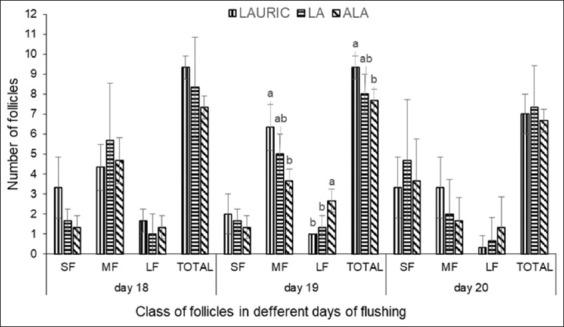
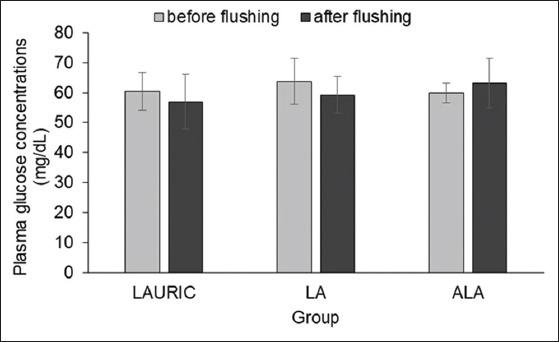
According to the results, none of the different fatty acids in the ration affected the nutrient intakes, BCSs, average daily gains, and plasma glucose, cholesterol, and progesterone concentrations of the three groups of does. However, the BCSs (by 0.8-0.9) and the plasma cholesterol concentrations were higher after fatty acid flushing for 21 days than before the flushing period. The ALA group had the highest number of large-sized preovulatory follicles, whereas the LAURIC group had the highest plasma estradiol concentration during estrus. All three groups had similar plasma progesterone concentrations during estrus after fatty acid flushing.
CONCLUSION
Flushing supplementation with 2.8% ALA from flaxseed oil gave the best results in terms of stimulating the highest number of large-sized preovulatory follicles in Ettawa Grade does.
背景与目的
通过在日粮中添加脂肪酸,特别是多不饱和脂肪酸,如亚油酸和α-亚麻酸,来提高雌性哺乳动物的营养状况,从而改善卵巢功能和卵泡发育,这是一种策略。本研究旨在调查在初始体况评分较低(体况评分≤2)的埃塔瓦山羊母羊发情期,补充不同类型的多不饱和脂肪酸和饱和脂肪酸进行催情补饲对刺激卵泡生长和发育的有效性。
材料与方法
18只第二胎的埃塔瓦山羊母羊,平均体重32.11±2.19千克,根据日粮中添加的脂肪酸分为三组:(i)约2.8%月桂酸催情补饲组;(ii)2.8%亚油酸催情补饲组(LA组);(iii)2.8%α-亚麻酸催情补饲组(ALA组)。日粮配方为等热量(总可消化养分=77%)和等氮量(粗蛋白=15%)。实验进行35天;即14天用于适应和同步发情周期,21天用于脂肪酸催情补饲直至下次发情出现。采用完全随机设计。
结果
根据结果,日粮中不同脂肪酸均未影响三组母羊的养分摄入量、体况评分、平均日增重以及血浆葡萄糖、胆固醇和孕酮浓度。然而,脂肪酸催情补饲21天后的体况评分(提高0.8 - 0.9)和血浆胆固醇浓度高于催情补饲前。ALA组排卵前大卵泡数量最多,而月桂酸组发情期血浆雌二醇浓度最高。脂肪酸催情补饲后,三组母羊发情期的血浆孕酮浓度相似。
结论
就刺激埃塔瓦山羊母羊排卵前大卵泡数量最多而言,用2.8%亚麻籽油中的α-亚麻酸进行催情补饲效果最佳。


 Zotero 插件