
2019年冠状病毒病封锁对运动员主观活力的影响:复原力和自主目标动机的保护作用。
The Impact of Coronavirus Disease 2019 Lockdown on Athletes' Subjective Vitality: The Protective Role of Resilience and Autonomous Goal Motives.
作者信息
Martínez-González Natalia, Atienza Francisco L, Tomás Inés, Duda Joan L, Balaguer Isabel
机构信息
Department of Social Psychology, Faculty of Psychology, University of Valencia, Valencia, Spain.
Department of Personality, Evaluation and Psychological Treatment, Faculty of Psychology, University of Valencia, Valencia, Spain.
出版信息
Front Psychol. 2021 Feb 10;11:612825. doi: 10.3389/fpsyg.2020.612825. eCollection 2020.
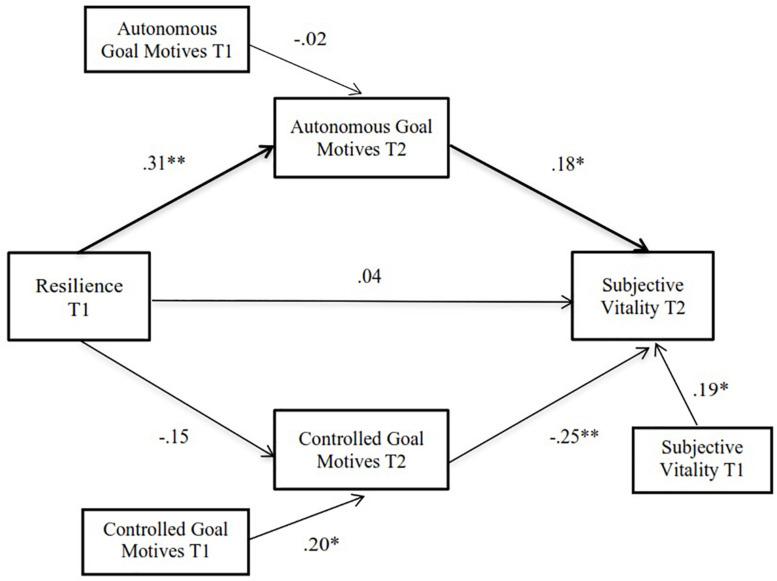
The lockdown resulting from coronavirus disease 2019 (COVID-19) has had a huge impact on peoples' health. In sport specifically, athletes have had to deal with frustration of their objectives and changes in their usual training routines. The challenging and disruptive situation could hold implications for their well-being. This study examined the effect of the COVID-19 lockdown on changes in athletes' reported eudaimonic well-being (subjective vitality) and goal motives (autonomous and controlled) over time (i.e., pre-lockdown and during lockdown). The relationship of resilience to changes in subjective vitality was also determined, and changes in athletes' goal motives were examined as potential mediators. Participants were 127 Spanish university athletes aged between 18 and 34 years ( = 21.14; = 2.77). Approximately 4 months before the start of the lockdown in Spain (T1), athletes responded to a questionnaire assessing their resilience, goal motives, and subjective vitality. Around 6 months later into the lockdown period (T2), athletes' goal motives and subjective vitality were assessed again. Growth modeling using hierarchical linear models revealed a significant decrease of autonomous goal motives and subjective vitality during the lockdown, but athletes did not show change over time in controlled goal motives. Path analysis, adjusting T2 measures for their corresponding T1 measures, showed that resilience significantly predicted changes in athletes' autonomous goal motives, which then accounted for changes in subjective vitality. The indirect effect was significant. Resilience did not predict changes in athletes' controlled goal motives. However, changes in controlled goal motives negatively predicted changes in subjective vitality during lockdown. The findings suggest negative impacts of the COVID-19 lockdown on athletes' goal motives and eudaimonic well-being. Results also support the hypothesized mediational role of autonomous goal motives in the relationship between resilience and subjective vitality during the lockdown. As such, findings confirm the relevance of resilience to a key feature of athletes' eudaimonic well-being and the importance of enhancing their autonomous goal striving.
2019冠状病毒病(COVID-19)导致的封锁对人们的健康产生了巨大影响。特别是在体育领域,运动员不得不应对目标受挫以及日常训练安排的变化。这种具有挑战性和破坏性的情况可能会对他们的幸福感产生影响。本研究考察了COVID-19封锁对运动员报告的幸福安康感(主观活力)和目标动机(自主和受控)随时间变化(即封锁前和封锁期间)的影响。还确定了复原力与主观活力变化之间的关系,并将运动员目标动机的变化作为潜在中介因素进行了考察。参与者为127名年龄在18至34岁之间的西班牙大学生运动员(平均年龄 = 21.14岁;标准差 = 2.77)。在西班牙封锁开始前约4个月(T1),运动员回答了一份问卷,评估他们的复原力、目标动机和主观活力。在封锁期约6个月后(T2),再次评估运动员的目标动机和主观活力。使用分层线性模型进行的增长建模显示,封锁期间自主目标动机和主观活力显著下降,但运动员的受控目标动机没有随时间变化。路径分析通过对T2测量值进行相应T1测量值的调整,结果表明复原力显著预测了运动员自主目标动机的变化,而自主目标动机的变化又解释了主观活力的变化。间接效应显著。复原力并未预测运动员受控目标动机的变化。然而,受控目标动机的变化在封锁期间对主观活力的变化产生了负向预测作用。研究结果表明COVID-19封锁对运动员的目标动机和幸福安康感有负面影响。结果还支持了自主目标动机在封锁期间复原力与主观活力关系中的假设中介作用。因此,研究结果证实了复原力与运动员幸福安康感的一个关键特征的相关性,以及增强他们自主目标追求的重要性。
 Zotero 插件