
肥胖和多囊卵巢综合征青少年代谢疾病的种族和民族差异
Racial and Ethnic Differences in Metabolic Disease in Adolescents With Obesity and Polycystic Ovary Syndrome.
作者信息
Andrisse Stanley, Garcia-Reyes Yesenia, Pyle Laura, Kelsey Megan M, Nadeau Kristen J, Cree-Green Melanie
机构信息
Howard University College of Medicine, Physiology and Biophysics, Baltimore, Maryland, USA.
Johns Hopkins Medicine, Pediatric Endocrinology, Baltimore, Maryland, USA.
出版信息
J Endocr Soc. 2021 Feb 2;5(4):bvab008. doi: 10.1210/jendso/bvab008. eCollection 2021 Apr 1.
CONTEXT
Polycystic ovary syndrome (PCOS) is common and associated with metabolic syndrome. In the general population, metabolic disease varies by race and ethnicity.
OBJECTIVE
This work aimed to examine in depth the interaction of race and ethnicity with PCOS-related metabolic disease in adolescent youth.
METHODS
A secondary analysis was conducted of data from girls (age 12-21 years) with overweight or obesity (> 90 body mass index [BMI] percentile) and PCOS. Measurements included fasting hormone and metabolic measures, a 2-hour oral glucose tolerance test (OGTT), and magnetic resonance imaging for hepatic fat. Groups were categorized by race or ethnicity.
RESULTS
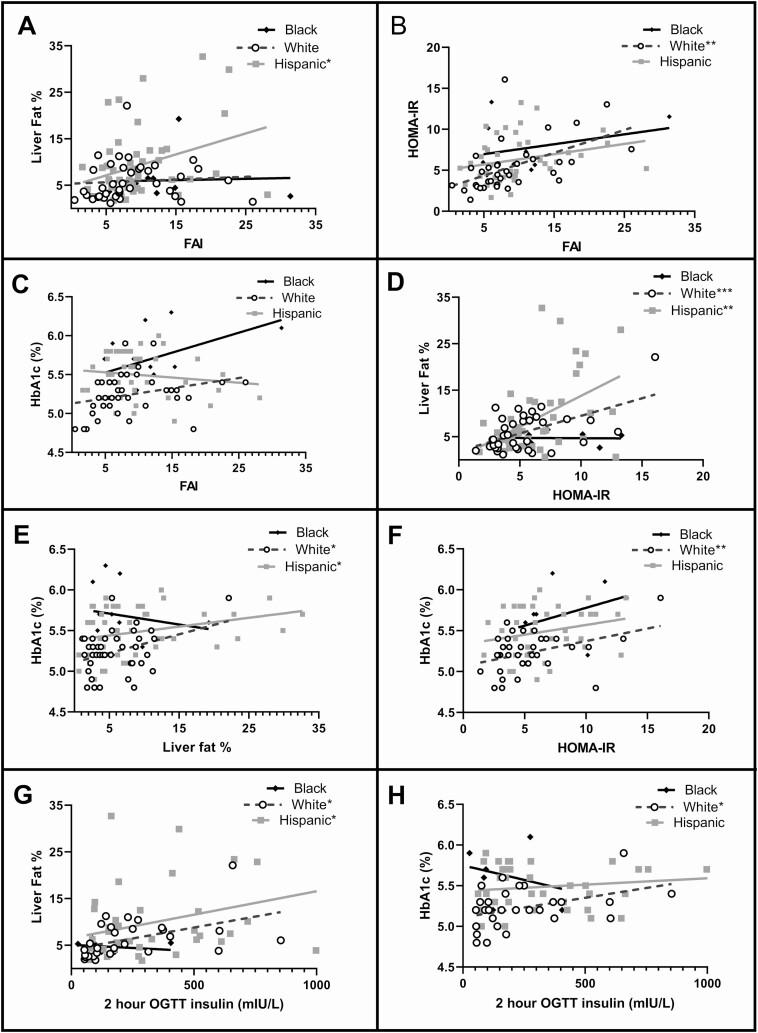
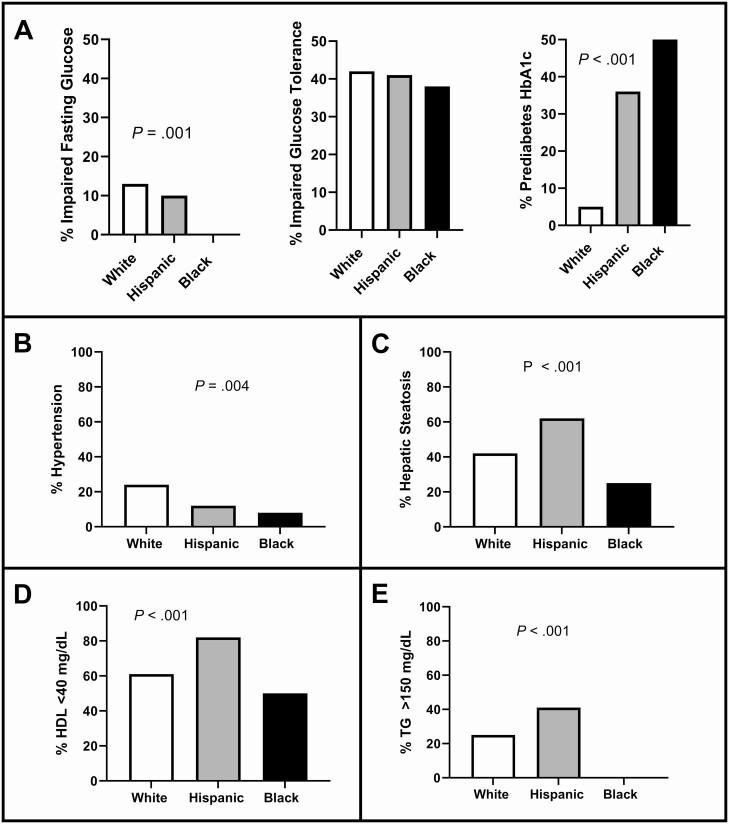
Participants included 39 non-Hispanic White (NHW, age 15.7 ± 0.2 years; BMI 97.7 ± 0.2 percentile), 50 Hispanic (HW, 15.2 ± 0.3 years; 97.9 ± 0.3 percentile), and 12 non-Hispanic Black (NHB, 16.0 ± 0.6 years; 98.6 ± 0.4 percentile) adolescents. Hepatic markers of insulin resistance were worse in NHW, including lower sex hormone-binding globulin and higher triglycerides over high-density lipoprotein cholesterol (TGs/HDL-C) ratio ( = .002 overall, HW vs NHB [ = .009] vs NHW [ = 0.020]), although homeostasis model assessment of estimated insulin resistance was worst in NHB ( = .010 overall, NHW vs NHB = .014). Fasting and 2-hour OGTT glucose were not different between groups, although glycated hemoglobin A (HbA) was lowest in NHW (overall < .001, NHW 5.2 ± 0.3 vs HW 5.5 ± 0.3 < .001 vs 5.7 ± 0.4%, < .001). The frequency of hepatic steatosis (HW 62%, NHW 42%, NHB 25%, = .032); low HDL-C < 40 mg/dL (HW 82%, NHW 61%, NHB 50%, < .001) and prediabetes HbA 5.7% to 6.4% (NHB 50%, HW 36%, NHW 5%, < .001) were different between the groups.
CONCLUSION
Adolescents with PCOS appear to show similar racial and ethnic variation to the general population in terms of metabolic disease components.
背景
多囊卵巢综合征(PCOS)很常见,且与代谢综合征相关。在一般人群中,代谢疾病因种族和民族而异。
目的
本研究旨在深入探讨青少年中种族和民族与PCOS相关代谢疾病之间的相互作用。
方法
对超重或肥胖(体重指数[BMI]百分位数>90)且患有PCOS的12至21岁女孩的数据进行二次分析。测量指标包括空腹激素和代谢指标、2小时口服葡萄糖耐量试验(OGTT)以及肝脏脂肪的磁共振成像。根据种族或民族对组进行分类。
结果
参与者包括39名非西班牙裔白人(NHW组,年龄15.7±0.2岁;BMI 97.7±0.2百分位数)、50名西班牙裔(HW组,15.2±0.3岁;97.9±0.3百分位数)和12名非西班牙裔黑人(NHB组,16.0±0.6岁;98.6±0.4百分位数)青少年。NHW组的胰岛素抵抗肝脏标志物更差,包括较低的性激素结合球蛋白和较高的甘油三酯与高密度脂蛋白胆固醇比值(TGs/HDL-C)(总体P = 0.002,HW组与NHB组比较[P = 0.009]与NHW组比较[P = 0.020]),尽管稳态模型评估的估计胰岛素抵抗在NHB组中最差(总体P = 0.010,NHW组与NHB组比较P = 0.014)。各组间空腹和2小时OGTT血糖无差异,尽管糖化血红蛋白A(HbA)在NHW组中最低(总体P<0.001,NHW组5.2±0.3 vs HW组5.5±0.3,P<0.001 vs 5.7±0.4%,P<0.001)。肝脏脂肪变性的频率(HW组62%,NHW组42%,NHB组25%,P = 0.032);低高密度脂蛋白胆固醇<40mg/dL(HW组82%,NHW组61%,NHB组50%,P<0.001)以及糖尿病前期HbA 5.7%至6.4%(NHB组50%,HW组36%,NHW组5%,P<0.001)在各组间存在差异。
结论
患有PCOS的青少年在代谢疾病组成方面似乎与一般人群表现出相似的种族和民族差异。

 Zotero 插件