
壶腹癌患者手术切除后淋巴结转移的预后价值
Prognostic value of the lymph node metastasis in patients with ampulla of Vater cancer after surgical resection.
作者信息
Lee Jeong Woo, Choi Sae Byeol, Lim Tae Wan, Kim Wan Joon, Park Pyoungjae, Kim Wan Bae
机构信息
Department of Surgery, Korea University College of Medicine, Seoul, Korea.
出版信息
Ann Hepatobiliary Pancreat Surg. 2021 Feb 28;25(1):90-96. doi: 10.14701/ahbps.2021.25.1.90.
BACKGROUNDS/AIMS: Patients with Ampulla of Vater cancer have a better prognosis than those with other periampullary cancers. This study aimed to determine the prognostic impact of lymph node metastasis on survival in patients with ampulla of Vater cancer after surgical resection.
METHODS
From 1991 to 2016, we retrospectively reviewed data on 104 patients with ampulla of Vater cancer who had received pancreaticoduodenectomy. Clinicopathologic factors such as lymph node ratio (LNR) and number of metastatic lymph nodes that influence survival were statistically analyzed.
RESULTS
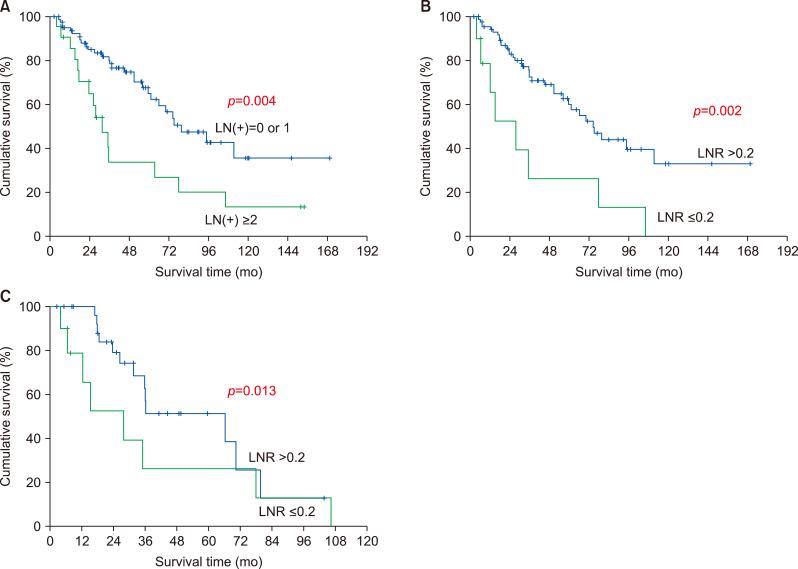
5-year survival rate after resection was 57.8%. Mean number of retrieved and metastatic lymph nodes was 13 and 0.95, respectively. In patients with lymph node metastasis, the median number of metastatic lymph nodes and was 1, and the mean LNR was 0.18. LNR >0.2 was a significant prognostic factor for overall survival. Patients with 0 or 1 metastatic lymph nodes had better survival than those with ≥2 metastatic lymph nodes. Univariate analysis revealed that histologic differentiation of tumor, lymph node metastasis, and T stage were significant prognostic factors for overall survival. Multivariate analysis revealed that tumor differentiation and number of metastatic lymph nodes were independent prognostic factors for survival.
CONCLUSIONS
Pancreaticoduodenectomy is an appropriate surgical procedure with acceptable long-term survival for ampulla of Vater cancer. Patients with LNR >0.2 and ≥2 positive lymph node metastasis had a poor survival. Tumor differentiation and ≥2 metastatic lymph nodes were independent significant prognostic factors for overall survival. Curative resection with lymph node dissection might control lymph node spread and enhance survival outcomes.
背景/目的: Vater壶腹癌患者的预后优于其他壶腹周围癌患者。本研究旨在确定手术切除后淋巴结转移对Vater壶腹癌患者生存的预后影响。
方法
1991年至2016年,我们回顾性分析了104例行胰十二指肠切除术的Vater壶腹癌患者的数据。对影响生存的临床病理因素如淋巴结比率(LNR)和转移淋巴结数量进行统计学分析。
结果
切除术后5年生存率为57.8%。平均获取及转移淋巴结数量分别为13个和0.95个。有淋巴结转移的患者,转移淋巴结中位数为1个,平均LNR为0.18。LNR>0.2是总生存的显著预后因素。有0个或1个转移淋巴结的患者比有≥2个转移淋巴结的患者生存更好。单因素分析显示肿瘤组织学分化、淋巴结转移和T分期是总生存的显著预后因素。多因素分析显示肿瘤分化和转移淋巴结数量是生存的独立预后因素。
结论
胰十二指肠切除术是Vater壶腹癌合适的手术方式,长期生存可接受。LNR>0.2且有≥2个阳性淋巴结转移的患者生存较差。肿瘤分化和≥2个转移淋巴结是总生存的独立显著预后因素。行淋巴结清扫的根治性切除可能控制淋巴结扩散并提高生存结局。

 Zotero 插件