
急性 COVID-19 患者的动脉僵硬度及其与临床结局的潜在关联。
Arterial stiffness in acute COVID-19 and potential associations with clinical outcome.
机构信息
From the, Department of Emergency Medicine, Medical University of Vienna, Vienna, Austria.
Department of Pulmonology, Clinic Penzing, Vienna Health Care Group, Vienna, Austria.
出版信息
J Intern Med. 2021 Aug;290(2):437-443. doi: 10.1111/joim.13275. Epub 2021 Mar 21.
BACKGROUND
Coronavirus disease 2019 (COVID-19) interferes with the vascular endothelium. It is not known whether COVID-19 additionally affects arterial stiffness.
METHODS
This case-control study compared brachial-ankle pulse wave (baPWV) and carotid-femoral pulse wave velocities (cfPWV) of acutely ill patients with and without COVID-19.
RESULTS
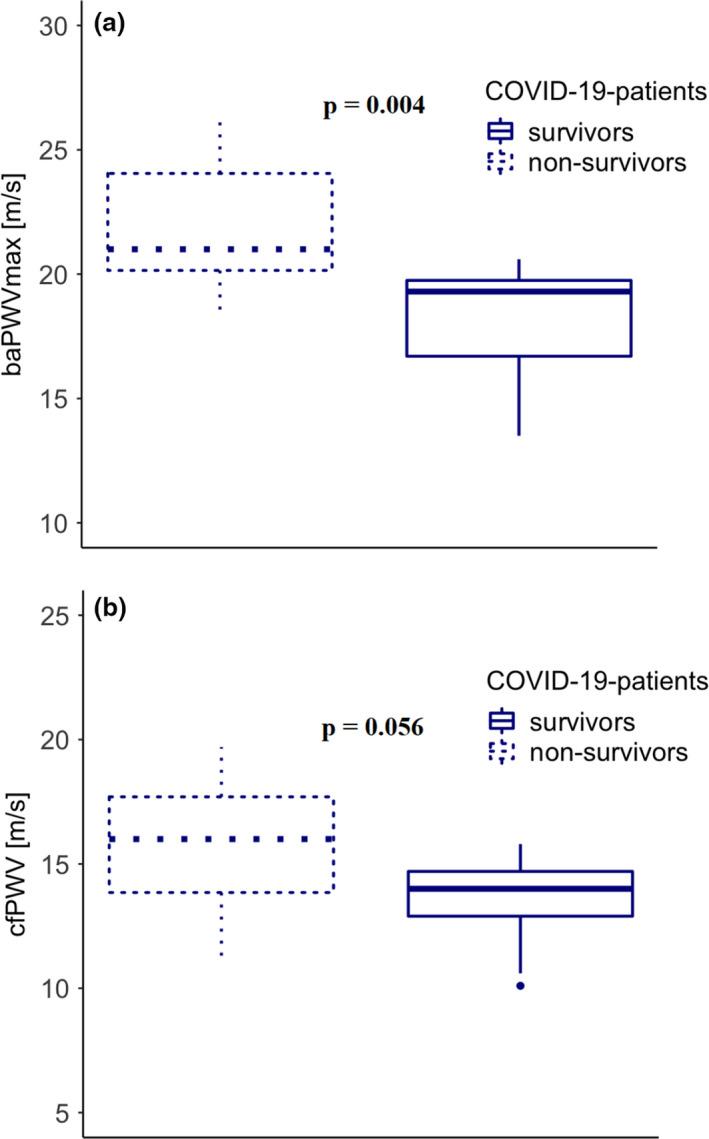
Twenty-two COVID-19 patients (50% females, 77 [67-84] years) were compared with 22 age- and sex-matched controls. In COVID-19 patients, baPWV (19.9 [18.4-21.0] vs. 16.0 [14.2-20.4], P = 0.02) and cfPWV (14.3 [13.4-16.0] vs. 11.0 [9.5-14.6], P = 0.01) were higher than in the controls. In multiple regression analysis, COVID-19 was independently associated with higher cfPWV (β = 3.164, P = 0.004) and baPWV (β = 3.532, P = 0.003). PWV values were higher in nonsurvivors. In survivors, PWV correlated with length of hospital stay.
CONCLUSION
COVID-19 appears to be related to an enhanced PWV reflecting an increase in arterial stiffness. Higher PWV might be related to an increased length of hospital stay and mortality.
背景
2019 年冠状病毒病(COVID-19)会影响血管内皮。目前尚不清楚 COVID-19 是否会进一步影响动脉僵硬度。
方法
本病例对照研究比较了急性发病的 COVID-19 患者与无 COVID-19 患者的肱踝脉搏波速度(baPWV)和颈股脉搏波速度(cfPWV)。
结果
22 例 COVID-19 患者(女性占 50%,77[67-84]岁)与 22 名年龄和性别匹配的对照者进行了比较。在 COVID-19 患者中,baPWV(19.9[18.4-21.0]比 16.0[14.2-20.4],P=0.02)和 cfPWV(14.3[13.4-16.0]比 11.0[9.5-14.6],P=0.01)均高于对照组。多元回归分析显示,COVID-19 与 cfPWV 升高独立相关(β=3.164,P=0.004)和 baPWV 升高独立相关(β=3.532,P=0.003)。在幸存者中,PWV 与住院时间相关。
结论
COVID-19 似乎与 PWV 升高有关,反映了动脉僵硬度的增加。较高的 PWV 可能与住院时间延长和死亡率增加有关。

 Zotero 插件