
情绪性进食在不同进食障碍中的表现及体重、限制和暴食的作用。
Emotional eating across different eating disorders and the role of body mass, restriction, and binge eating.
机构信息
Department of Psychology, Centre for Cognitive Neuroscience, Paris-Lodron-University of Salzburg, Salzburg, Austria.
Schoen Clinic Roseneck, Prien am Chiemsee, Germany.
出版信息
Int J Eat Disord. 2021 May;54(5):773-784. doi: 10.1002/eat.23477. Epub 2021 Mar 3.
OBJECTIVE
Different subtypes of eating disorders (ED) show dysfunctional eating behaviors such as overeating and/or restriction in response to emotions. Yet, systematic comparisons of all major EDs on emotional eating patterns are lacking. Furthermore, emotional eating correlates with body mass index (BMI), which also differs between EDs and thus confounds this comparison.
METHOD
Interview-diagnosed female ED patients (n = 204) with restrictive (AN-R) or binge-purge anorexia nervosa (AN-BP), bulimia nervosa (BN), or binge-eating disorder (BED) completed a questionnaire assessing "negative emotional eating" (sadness, anger, anxiety) and "happiness eating." ED groups were compared to BMI-matched healthy controls (HCs; n = 172 ranging from underweight to obesity) to exclude BMI as a confound.
RESULTS
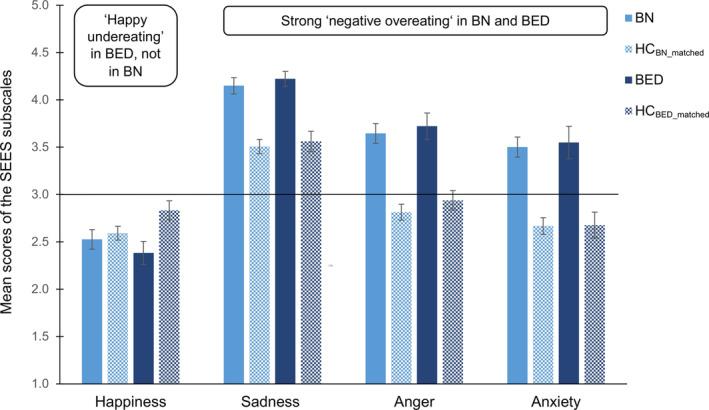
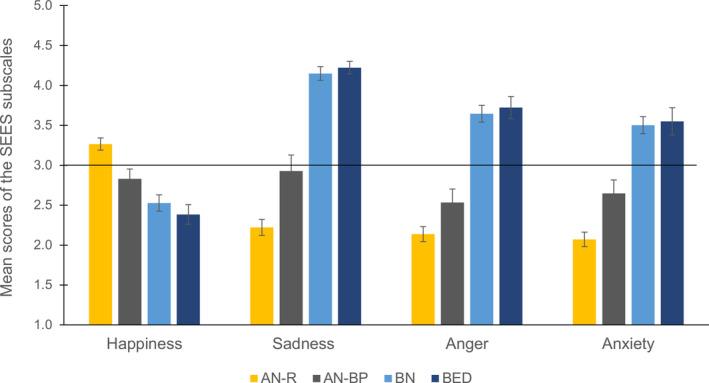
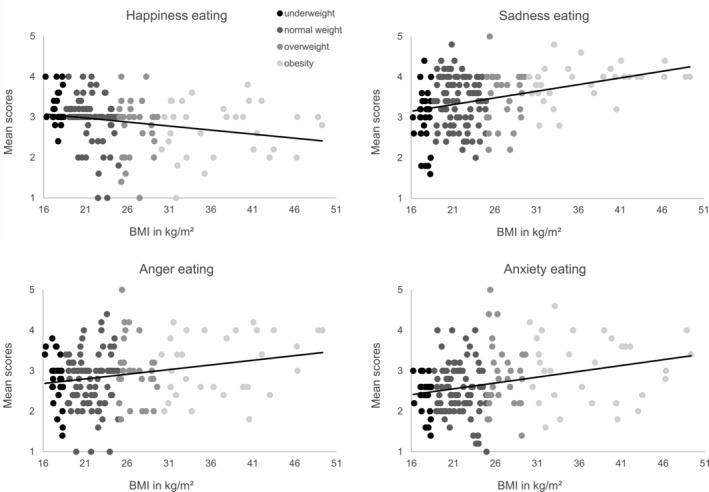
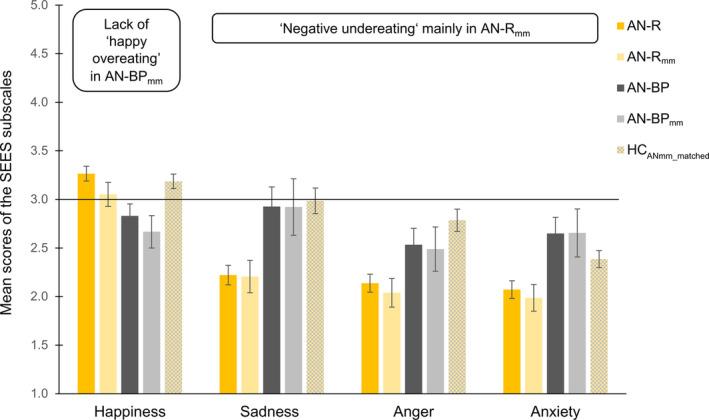
Within HCs, higher BMI was associated with higher negative emotional eating and lower happiness eating. AN-R reported the lowest degree of negative emotional eating relative to other EDs and BMI-matched HCs, and the highest degree of happiness eating relative to other EDs. The BN and BED groups showed higher negative emotional eating compared to BMI-matched HCs. Patients with AN-BP occupied an intermediate position between AN-R and BN/BED and reported less happiness eating compared to BMI-matched HCs.
DISCUSSION
Negative emotional and happiness eating patterns differ across EDs. BMI-independent emotional eating patterns distinguish ED subgroups and might be related to the occurrence of binge eating versus restriction. Hence, different types of emotional eating can represent fruitful targets for tailored psychotherapeutic interventions. While BN and BED might be treated with similar approaches, AN-BP and AN-R would need specific treatment modules.
目的
不同类型的饮食障碍(ED)表现出功能失调的进食行为,如情绪化进食过量和/或限制进食。然而,目前缺乏对所有主要 ED 进行情绪性进食模式的系统比较。此外,情绪性进食与身体质量指数(BMI)相关,而 ED 之间的 BMI 也存在差异,这会混淆这种比较。
方法
接受访谈诊断的女性 ED 患者(n=204),包括限制型(AN-R)或暴食-清除型神经性厌食症(AN-BP)、贪食症(BN)或暴食障碍(BED),完成了一份问卷,评估“负性情绪性进食”(悲伤、愤怒、焦虑)和“快乐进食”。将 ED 组与 BMI 匹配的健康对照组(HCs;n=172,体重从消瘦到肥胖)进行比较,以排除 BMI 作为混杂因素。
结果
在 HCs 中,BMI 越高,负性情绪性进食越高,快乐进食越低。与其他 ED 和 BMI 匹配的 HCs 相比,AN-R 报告的负性情绪性进食程度最低,而快乐进食程度最高。BN 和 BED 组与 BMI 匹配的 HCs 相比,负性情绪性进食程度更高。AN-BP 患者位于 AN-R 和 BN/BED 之间,与 BMI 匹配的 HCs 相比,其快乐进食程度较低。
讨论
不同 ED 之间的负性情绪和快乐进食模式存在差异。BMI 独立的情绪性进食模式可区分 ED 亚组,可能与暴食与限制的发生有关。因此,不同类型的情绪性进食可能是有针对性的心理治疗干预的有价值的目标。虽然 BN 和 BED 可能采用类似的方法进行治疗,但 AN-BP 和 AN-R 需要特定的治疗模块。
 Zotero 插件