
微生物的代谢工程生产多功能非蛋白氨基酸:γ-氨基丁酸和δ-氨基乙酰丙酸。
Metabolic engineering of microorganisms for the production of multifunctional non-protein amino acids: γ-aminobutyric acid and δ-aminolevulinic acid.
机构信息
State Key Laboratory of Agrobiotechnology and Key Laboratory of Soil Microbiology, Ministry of Agriculture, College of Biological Sciences, China Agricultural University, No.2 Yuanmingyuan West Road, Haidian District, Beijing, 100193, China.
Departamento de Microbiología, Escuela Nacional de Ciencias Biológicas, Instituto Politécnico Nacional, Mexico City, 11340, Mexico.
出版信息
Microb Biotechnol. 2021 Nov;14(6):2279-2290. doi: 10.1111/1751-7915.13783. Epub 2021 Mar 6.
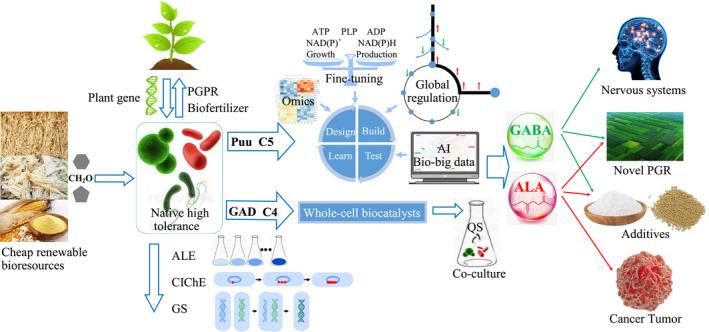
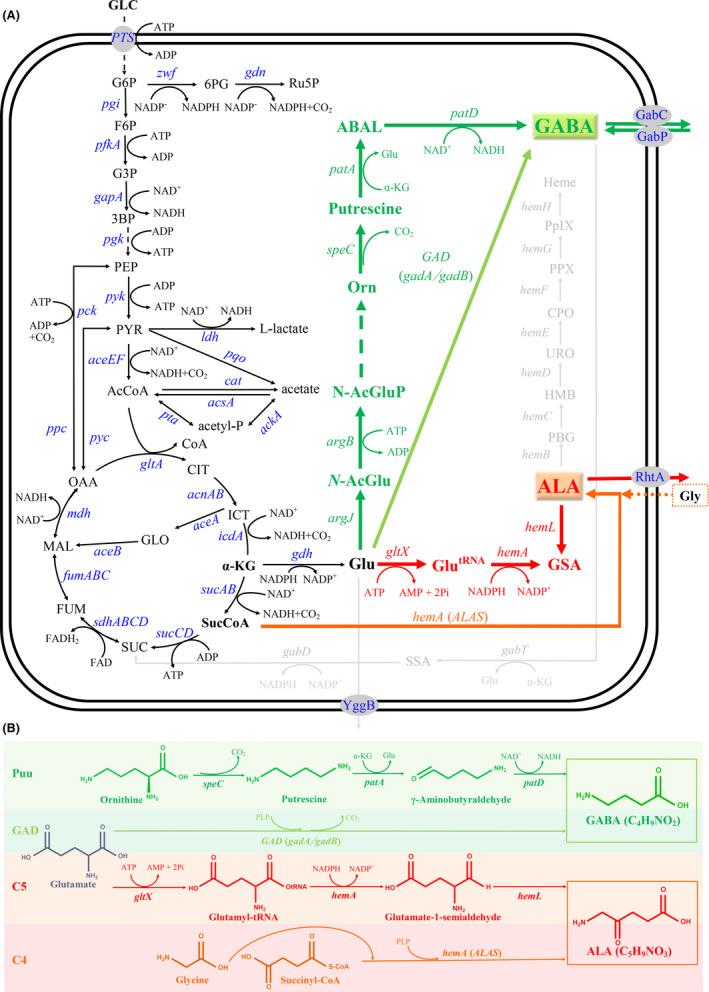
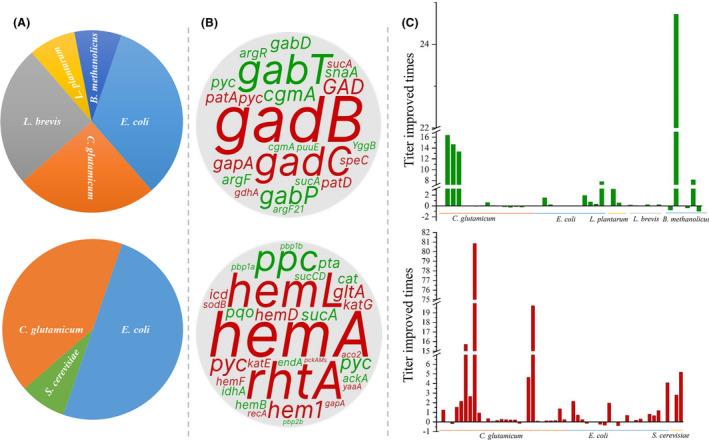
Gamma-aminobutyric acid (GABA) and delta-aminolevulinic acid (ALA), playing important roles in agriculture, medicine and other fields, are multifunctional non-protein amino acids with similar and comparable properties and biosynthesis pathways. Recently, microbial synthesis has become an inevitable trend to produce GABA and ALA due to its green and sustainable characteristics. In addition, the development of metabolic engineering and synthetic biology has continuously accelerated and increased the GABA and ALA yield in microorganisms. Here, focusing on the current trends in metabolic engineering strategies for microbial synthesis of GABA and ALA, we analysed and compared the efficiency of various metabolic strategies in detail. Moreover, we provide the insights to meet challenges of realizing industrially competitive strains and highlight the future perspectives of GABA and ALA production.
γ-氨基丁酸(GABA)和δ-氨基乙酰丙酸(ALA)在农业、医学等领域发挥着重要作用,它们是多功能的非蛋白氨基酸,具有相似且可比的性质和生物合成途径。由于其绿色可持续的特点,微生物合成已成为生产 GABA 和 ALA 的必然趋势。此外,代谢工程和合成生物学的发展不断加速并提高了微生物中 GABA 和 ALA 的产量。在这里,我们专注于微生物合成 GABA 和 ALA 的代谢工程策略的当前趋势,详细分析和比较了各种代谢策略的效率。此外,我们提供了应对实现工业竞争力菌株挑战的见解,并强调了 GABA 和 ALA 生产的未来前景。
 Zotero 插件