
以调查和预后为基础的人群验证:对具有局灶性、负向和非进行性症状的非共识性短暂性脑缺血发作的诊断。
Diagnosis of non-consensus transient ischaemic attacks with focal, negative, and non-progressive symptoms: population-based validation by investigation and prognosis.
机构信息
Wolfson Centre for the Prevention of Stroke and Dementia, Nuffield Department of Clinical Neuroscience, John Radcliffe Hospital, University of Oxford, Oxford, UK.
Wolfson Centre for the Prevention of Stroke and Dementia, Nuffield Department of Clinical Neuroscience, John Radcliffe Hospital, University of Oxford, Oxford, UK.
出版信息
Lancet. 2021 Mar 6;397(10277):902-912. doi: 10.1016/S0140-6736(20)31961-9.
BACKGROUND
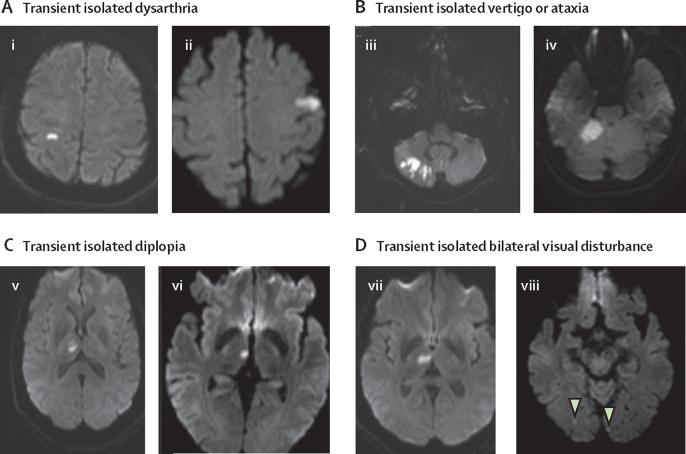
Diagnosis of transient ischaemic attacks (TIAs) can be difficult. There is consensus on classic symptoms (eg, motor weakness, dysphasia, hemianopia, monocular visual loss) but no consensus on several monosymptomatic events with sudden-onset, non-progressive, focal negative symptoms (eg, isolated diplopia, dysarthria, vertigo, ataxia, sensory loss, and bilateral visual disturbance), with much variation in investigation and treatment.
METHODS
We prospectively ascertained and investigated all strokes and sudden onset transient neurological symptoms in a population of 92 728 people (no age restrictions) from Oxfordshire, UK, who sought medical attention at nine primary care practices or at the John Radcliffe Hospital, Oxford, UK (Oxford Vascular Study). Patients classified at baseline with minor ischaemic stroke (National Institutes of Health Stroke Score <5), classic TIA, or non-consensus TIA were treated according to secondary prevention guidelines. Risks of stroke (7-day, 90-day, and 10-year risks) and risks of all major vascular events (from the time of first event, and from the time of seeking medical attention) were established by face-to-face follow-up visits and were compared with the risk expected from age and sex-specific stroke incidence in the underlying study population.
FINDINGS
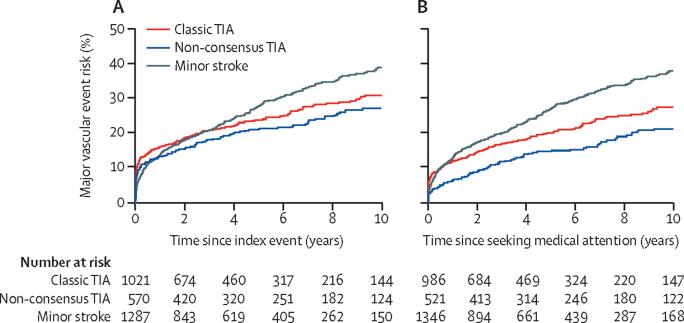
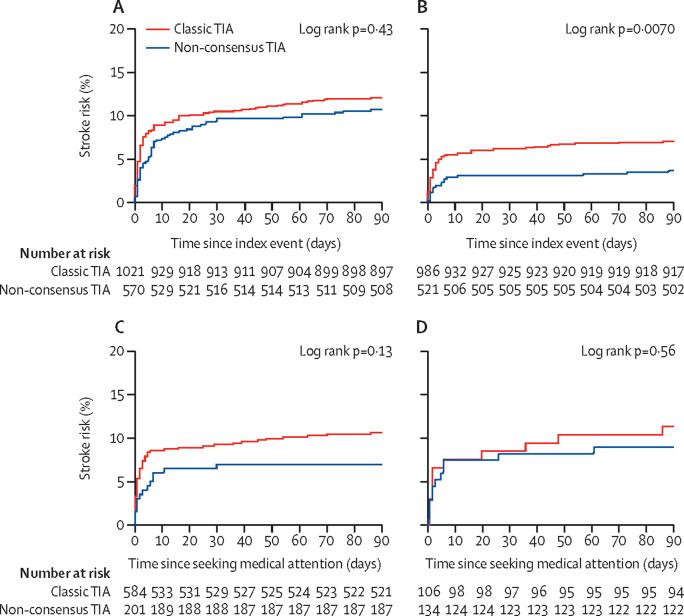
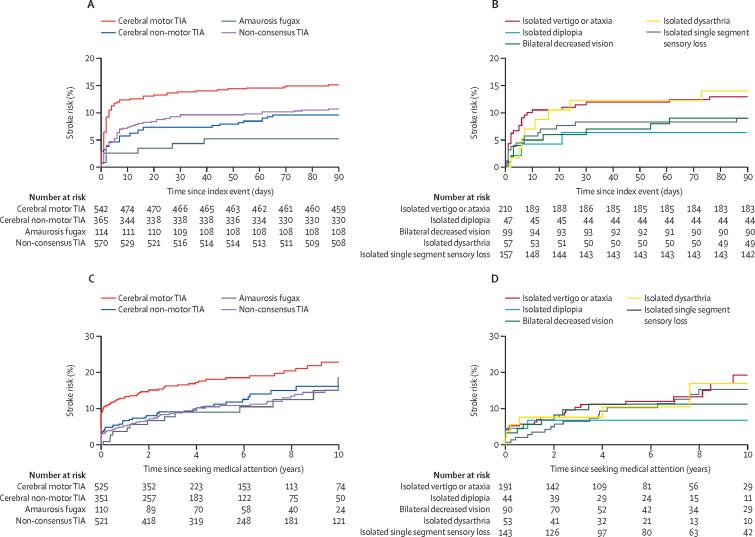
Between April 1, 2002, and March 31, 2018, 2878 patients were identified with minor ischaemic stroke (n=1287), classic TIA (n=1021), or non-consensus TIA (n=570). Follow-up was to Oct 1, 2018 (median 5·2 [IQR 2·6-9·2] years). 577 first recurrent strokes after the index event occurred during 17 009 person-years of follow-up. 90-day stroke risk from time of the index event after a non-consensus TIA was similar to that after classic TIA (10·6% [95% CI 7·8-12·9] vs 11·6% [95% CI 9·6-13·6]; hazard ratio 0·87, 95% CI 0·64-1·19; p=0·43), and higher than after amaurosis fugax (4·3% [95% CI 0·6-8·0]; p=0·042). However, patients with non-consensus TIA were less likely to seek medical attention on the day of the event than were those with classic TIA (336 of 570 [59%] vs 768 of 1021 [75%]; odds ratio [OR] 0·47, 95% CI 0·38-0·59; p<0·0001) and were more likely to have recurrent strokes before seeking attention (45 of 570 [8%] vs 47 of 1021 [5%]; OR 1·77, 95% CI 1·16-2·71; p=0·007). After excluding such recurrent strokes, 7-day stroke risk after seeking attention for non-consensus TIA (2·9% [95% CI 1·5-4·3]) was still considerably higher than the expected background risk (relative risk [RR] 203, 95% CI 113-334), particularly if the patient sought attention on the day of the index event (5·0% [2·1-7·9]; RR 300, 137-569). 10-year risk of all major vascular events was similar for non-consensus and classic TIAs (27·1% [95% CI 22·8-31·4] vs 30·9% [27·2-33·7]; p=0·12). Baseline prevalence of atrial fibrillation, patent foramen ovale, and arterial stenoses were also similar for non-consensus TIA and classic TIA, although stenoses in the posterior circulation were more frequent with non-consensus TIA (OR 2·21, 95% CI 1·59-3·08; p<0·0001).
INTERPRETATION
Patients with non-consensus TIA are at high early and long-term risk of stroke and have cardiovascular pathological findings on investigation similar to those of classic TIA. Designation of non-consensus TIAs as definite cerebrovascular events will increase overall TIA diagnoses by about 50%.
FUNDING
Wellcome Trust, National Institute for Health Research Oxford Biomedical Research Centre, Wolfson Foundation, Masonic Charitable Foundation, and British Heart Foundation.
背景
短暂性脑缺血发作(TIA)的诊断可能较为困难。对于经典症状(例如,运动无力、构音障碍、偏盲、单眼视力丧失),人们已达成共识,但对于一些具有突发性、非进行性、局灶性负性症状的单一症状事件,例如孤立性复视、构音障碍、眩晕、共济失调、感觉丧失和双侧视觉障碍,目前仍未达成共识,而且其调查和治疗方法差异很大。
方法
我们前瞻性地确定了英国牛津郡 92728 名(无年龄限制)人群中的所有中风和突发性短暂性神经系统症状,并对他们进行了调查,这些患者在 9 家初级保健诊所或牛津约翰拉德克利夫医院(牛津血管研究)寻求医疗。根据二级预防指南,对基线时诊断为轻度缺血性中风(国家卫生研究院中风评分<5)、经典 TIA 或非共识 TIA 的患者进行治疗。通过面对面随访确定了(7 天、90 天和 10 年)的中风风险和所有主要血管事件风险(从首次发病时间和从寻求医疗时间开始),并与基础研究人群中按年龄和性别划分的中风发病率预期风险进行了比较。
结果
2002 年 4 月 1 日至 2018 年 3 月 31 日期间,我们共发现 2878 例轻度缺血性中风(n=1287)、经典 TIA(n=1021)或非共识 TIA(n=570)患者。随访截止至 2018 年 10 月 1 日(中位数 5.2[IQR 2.6-9.2]年)。在 17009 人年的随访期间,有 577 例首次复发性中风发生在索引事件之后。非共识 TIA 后 90 天的中风风险与经典 TIA 后相似(10.6%[95%CI 7.8-12.9] vs 11.6%[95%CI 9.6-13.6];危险比 0.87,95%CI 0.64-1.19;p=0.43),高于一过性黑矇(4.3%[95%CI 0.6-8.0];p=0.042)。然而,与经典 TIA 患者相比,非共识 TIA 患者在事件当天寻求医疗的可能性较小(570 例中有 336 例[59%] vs 1021 例中有 768 例[75%];比值比[OR] 0.47,95%CI 0.38-0.59;p<0.0001),并且在寻求治疗前更有可能发生复发性中风(570 例中有 45 例[8%] vs 1021 例中有 47 例[5%];OR 1.77,95%CI 1.16-2.71;p=0.007)。在排除这些复发性中风后,非共识 TIA 后寻求治疗的 7 天中风风险(2.9%[95%CI 1.5-4.3])仍然明显高于预期的背景风险(相对风险[RR] 203,95%CI 113-334),特别是如果患者在索引事件当天寻求治疗(5.0%[2.1-7.9];RR 300,137-569)。非共识和经典 TIA 的 10 年主要血管事件风险相似(27.1%[95%CI 22.8-31.4] vs 30.9%[27.2-33.7];p=0.12)。非共识 TIA 和经典 TIA 的心房颤动、卵圆孔未闭和动脉狭窄的基线患病率也相似,尽管后循环中的狭窄更常见(OR 2.21,95%CI 1.59-3.08;p<0.0001)。
结论
非共识 TIA 患者具有较高的早期和长期中风风险,并且在调查中发现的心血管病理表现与经典 TIA 相似。将非共识 TIA 指定为明确的脑血管事件将使整体 TIA 诊断增加约 50%。
资金来源
惠康信托基金、英国国家卫生研究院牛津生物医学研究中心、沃尔夫森基金会、共济会慈善基金会和英国心脏基金会。
 Zotero 插件