
婴儿期频繁使用保湿霜与食物过敏发展的关联。
Association of frequent moisturizer use in early infancy with the development of food allergy.
机构信息
Population Health Research Institute, St George's, University of London, London, United Kingdom.
Paediatric Allergy Research Group, Department of Women and Children's Health, School of Life Course Sciences, King's College London, London, United Kingdom.
出版信息
J Allergy Clin Immunol. 2021 Mar;147(3):967-976.e1. doi: 10.1016/j.jaci.2020.10.044.
BACKGROUND
Food allergy is thought to develop through transcutaneous sensitization, especially in the presence of skin barrier impairment and inflammation. Regular moisturizer application to infant skin could potentially promote transcutaneous sensitization and the development of food allergy.
OBJECTIVES
We tested this hypothesis in the Enquiring About Tolerance (EAT) study population.
METHODS
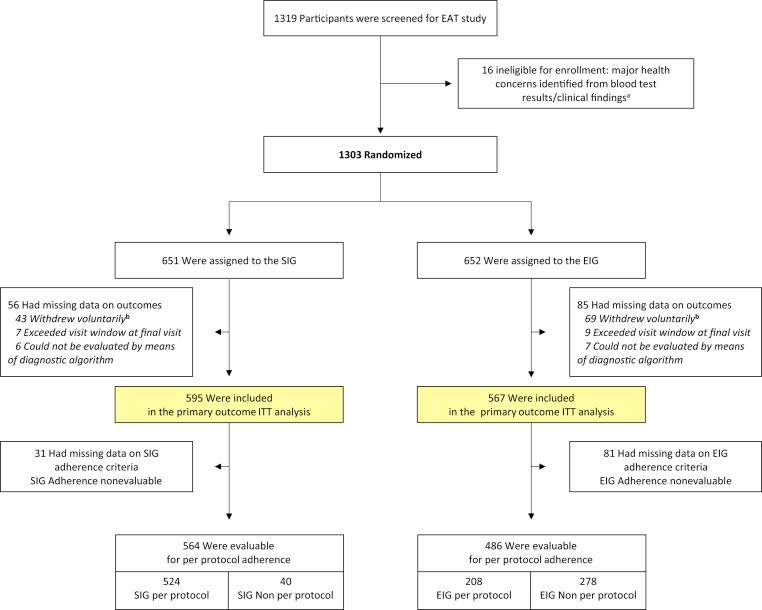
The EAT study was a population-based randomized clinical trial conducted from January 15, 2008, to August 31, 2015, and recruited 1303 exclusively breastfed 3-month-old infants and their families from England and Wales. At enrollment at 3 months, families completed a questionnaire that included questions about frequency and type of moisturizer applied, use of corticosteroid creams, and parental report of dry skin or eczema. Infants were examined for visible eczema at the enrollment visit.
RESULTS
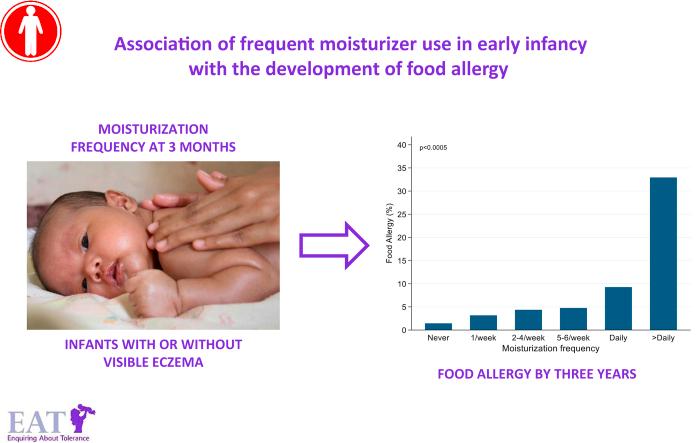
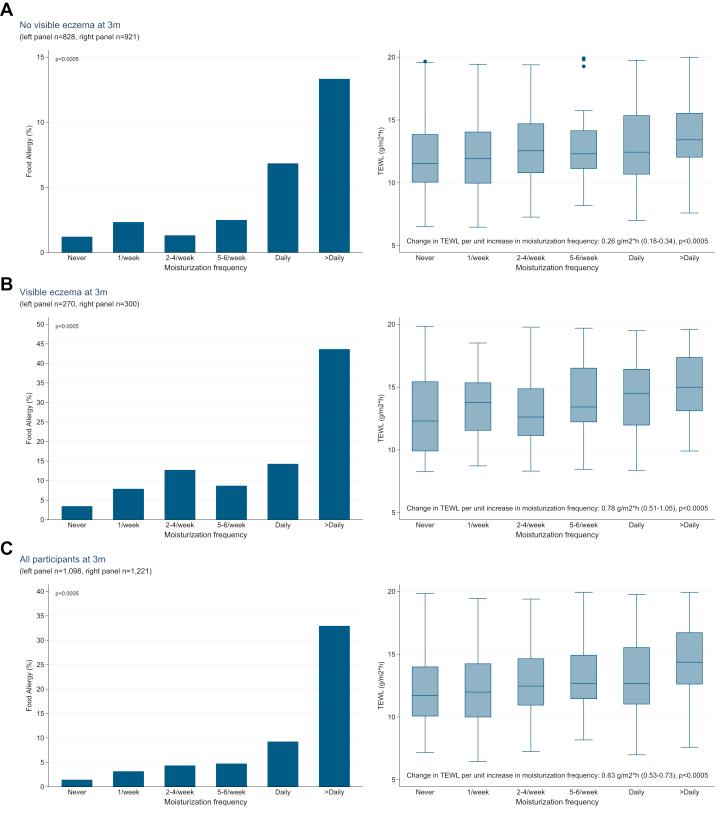
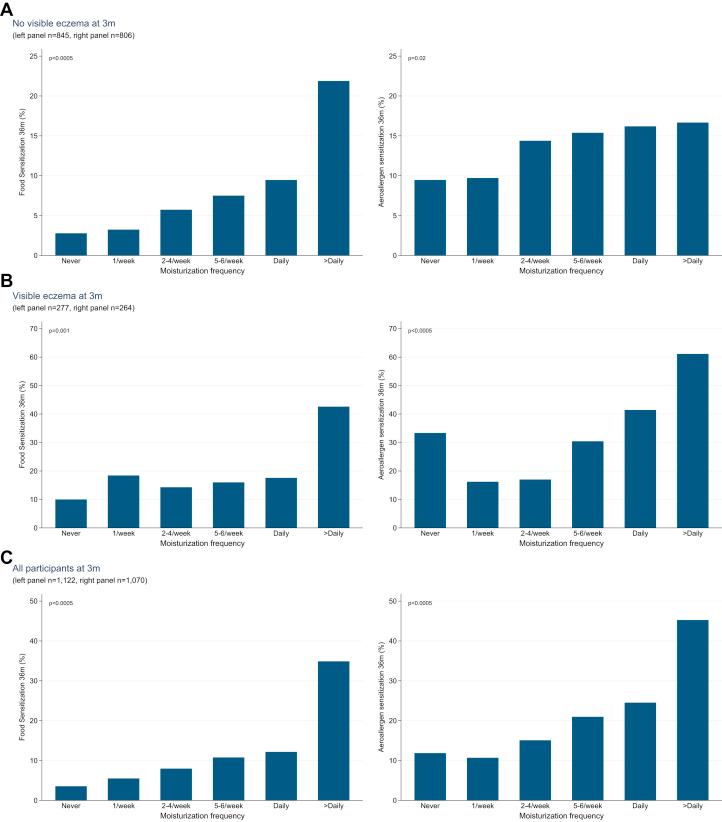
A statistically significant dose-response relationship was observed between parent-reported moisturization frequency at 3 months of age and the subsequent development of food allergy. Each additional moisturization per week was associated with an adjusted odds ratio of 1.20 (95% CI, 1.13-1.27; P < .0005) for developing food allergy. For infants with no visible eczema at the enrollment visit, the corresponding adjusted odds ratio was 1.18 (95% CI, 1.07-1.30; P = .001) and for those with eczema at the enrollment visit, 1.20 (95% CI, 1.11-1.31; P < .0005). Moisturizer frequency showed similar dose-response relationships with the development of both food and aeroallergen sensitization at 36 months.
CONCLUSIONS
These findings support the notion that regular application of moisturizers to the skin of young infants may promote the development of food allergy through transcutaneous sensitization.
背景
食物过敏被认为是通过经皮致敏发展而来的,尤其是在皮肤屏障受损和炎症的情况下。定期给婴儿皮肤涂抹保湿霜可能会促进经皮致敏和食物过敏的发展。
目的
我们在 Enquiring About Tolerance(EAT)研究人群中检验了这一假设。
方法
EAT 研究是一项基于人群的随机临床试验,于 2008 年 1 月 15 日至 2015 年 8 月 31 日进行,从英格兰和威尔士招募了 1303 名仅接受母乳喂养的 3 个月大的婴儿及其家庭。在 3 个月时进行入组时,家庭完成了一份问卷,其中包括关于保湿霜使用频率和类型、皮质类固醇乳膏使用情况以及父母报告的皮肤干燥或湿疹的问题。在入组时对婴儿进行了可见湿疹检查。
结果
在 3 个月时父母报告的保湿频率与随后发生食物过敏之间观察到了具有统计学意义的剂量反应关系。每周额外保湿一次与调整后的食物过敏发病比值比为 1.20(95%CI,1.13-1.27;P<0.0005)。对于在入组时没有可见湿疹的婴儿,调整后的比值比为 1.18(95%CI,1.07-1.30;P=0.001),而对于入组时已有湿疹的婴儿,调整后的比值比为 1.20(95%CI,1.11-1.31;P<0.0005)。在 36 个月时,保湿频率与食物和空气过敏原致敏的发展也呈现出类似的剂量反应关系。
结论
这些发现支持了这样一种观点,即定期给婴幼儿皮肤涂抹保湿霜可能会通过经皮致敏促进食物过敏的发展。


 Zotero 插件