
替加环素联合阿奇霉素对中国一名患者的多重耐药菌生物被膜的影响
Effects of Tigecycline Combined with Azithromycin Against Biofilms of Multidrug-Resistant Isolates from a Patient in China.
作者信息
Yue ChengCheng, Shen WeiHua, Hu LiFen, Liu YanYan, Zheng YaHong, Ye Ying, Zhang Yuhao, Li JiaBin
机构信息
Department of Infectious Diseases, The First Affiliated Hospital of Anhui Medical University, Hefei, People's Republic of China.
Department of Special Clinic, The First Affiliated Hospital of Anhui Medical University, Hefei, Anhui, People's Republic of China.
出版信息
Infect Drug Resist. 2021 Feb 26;14:775-786. doi: 10.2147/IDR.S298274. eCollection 2021.
PURPOSE
Our aim was to investigate in vitro biofilm formation by and the effects of antibacterial agents used to prevent biofilm formation.
METHODS
Two trimethoprim/sulfamethoxazole-resistant strains were isolated from the pleural effusion of a patient with cancer. The minimum inhibitory concentrations (MICs) of amikacin, azithromycin, cefoperazone/sulbactam, and tigecycline were determined. The checkerboard method was used to determine the fractional inhibitory concentration indices (FICIs). A crystal violet biofilm assay and confocal laser scanning microscopy (CLSM) were used to observe biofilm formation. In vitro effects of azithromycin combined with tigecycline on biofilms of strains were tested.
RESULTS
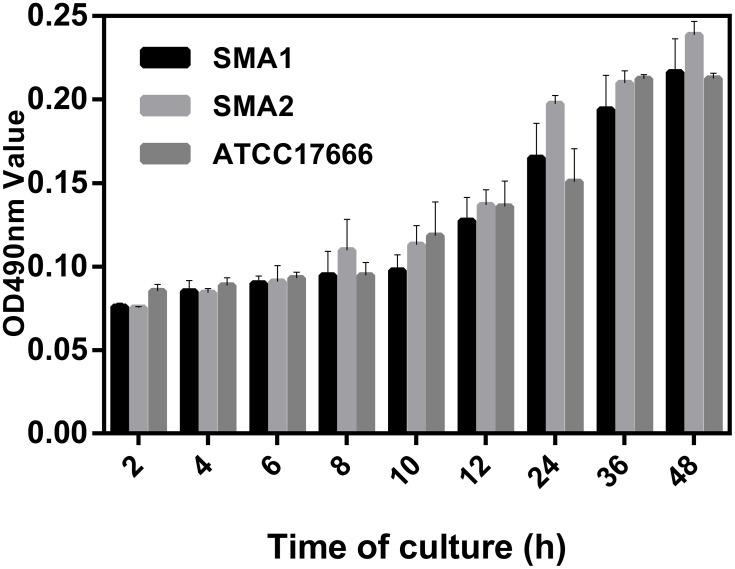
The two isolates were confirmed to produce strong biofilms. Crystal violet biofilm assay and CLSM analysis of biofilm were in the initial adhesive stage after 2 h incubation. Biofilm was in the exponential phase of growth at 12 h and reached maximal growth at 36-48 h. Compared with tigecycline or azithromycin alone, the combination of tigecycline and azithromycin increased the inhibiting effect biofilm biomass after incubation for 12 h. Compared with the control group, in almost all strains treated with tigecycline and azithromycin, the biofilm was significantly suppressed significance (P<0.001). We found that 2x MIC azithromycin combined with 1x MIC tigecycline had the best inhibiting effect against the biofilm, the biofilm inhibition rates of three strains were all over 60%, the biofilm thickness was inhibited from 36.00 ± 4.00 μm to 8.00 μm, from 40.00 μm to 6.67± 2.31 μm, and from 32.00 μm to 13.33 ± 2.31 μm in SMA1, SMA2 and ATCC17666, respectively.
CONCLUSION
Azithromycin combined with tigecycline inhibited biofilm formation by . Our study provides an experimental basis for a possible optimal treatment strategy for biofilm-related infections.
目的
我们的目的是研究[具体细菌名称未给出]的体外生物膜形成情况以及用于预防生物膜形成的抗菌剂的效果。
方法
从一名癌症患者的胸腔积液中分离出两株对甲氧苄啶/磺胺甲恶唑耐药的[具体细菌名称未给出]菌株。测定了阿米卡星、阿奇霉素、头孢哌酮/舒巴坦和替加环素的最低抑菌浓度(MICs)。采用棋盘法测定部分抑菌浓度指数(FICIs)。使用结晶紫生物膜测定法和共聚焦激光扫描显微镜(CLSM)观察生物膜形成。测试了阿奇霉素与替加环素联合对[具体细菌名称未给出]菌株生物膜的体外作用。
结果
确认这两株[具体细菌名称未给出]分离株能产生强大的生物膜。[具体细菌名称未给出]生物膜的结晶紫生物膜测定法和CLSM分析显示,孵育2小时后处于初始黏附阶段。生物膜在12小时处于生长指数期,在36 - 48小时达到最大生长。与单独使用替加环素或阿奇霉素相比,替加环素和阿奇霉素联合使用在孵育12小时后增强了对[具体细菌名称未给出]生物膜生物量的抑制作用。与对照组相比,在几乎所有用替加环素和阿奇霉素处理的菌株中,生物膜均受到显著抑制(P<0.001)。我们发现2倍MIC的阿奇霉素与1倍MIC的替加环素联合对生物膜具有最佳抑制效果,三株菌株的生物膜抑制率均超过60% , SMA1、SMA2和ATCC17666菌株的生物膜厚度分别从36.00±4.00μm抑制至8.00μm、从40.00μm抑制至6.67±2.31μm、从32.00μm抑制至13.33±2.31μm。
结论
阿奇霉素与替加环素联合抑制了[具体细菌名称未给出]的生物膜形成。我们的研究为[具体细菌名称未给出]生物膜相关感染可能的最佳治疗策略提供了实验依据。



 Zotero 插件