
干扰素α时代后高危(IIC-IV期)恶性黑色素瘤的辅助治疗:一项系统评价和荟萃分析
Adjuvant Therapy of High-Risk (Stages IIC-IV) Malignant Melanoma in the Post Interferon-Alpha Era: A Systematic Review and Meta-Analysis.
作者信息
Christofyllakis Konstantinos, Pföhler Claudia, Bewarder Moritz, Müller Cornelia S L, Thurner Lorenz, Rixecker Torben, Vogt Thomas, Stilgenbauer Stephan, Yordanova Krista, Kaddu-Mulindwa Dominic
机构信息
Department of Hematology, Oncology, Clinical Immunology and Rheumatology, Medical School, University of Saarland, Homburg, Germany.
Department of Dermatology, Venerology and Allergology, Medical School, University of Saarland, Homburg, Germany.
出版信息
Front Oncol. 2021 Feb 18;10:637161. doi: 10.3389/fonc.2020.637161. eCollection 2020.
INTRODUCTION
Multiple agents are approved in the adjuvant setting of completely resected high-risk (stages IIC-IV) malignant melanoma. Subgroups may benefit differently depending on the agent used. We performed a systematic review and meta-analysis to evaluate the efficiency and tolerability of available options in the post interferon era across following subgroups: patient age, stage, ulceration status, lymph node involvement, BRAF status.
METHODS
The PubMed and Cochrane Library databases were searched without restriction in year of publication in June and September 2020. Data were extracted according to the PRISMA Guidelines from two authors independently and were pooled according to the random-effects model. The predefined primary outcome was recurrence-free survival (RFS). Post-data extraction it was noted that one trial (BRIM8) reported disease-free survival which was defined in the exact same way as RFS.
RESULTS
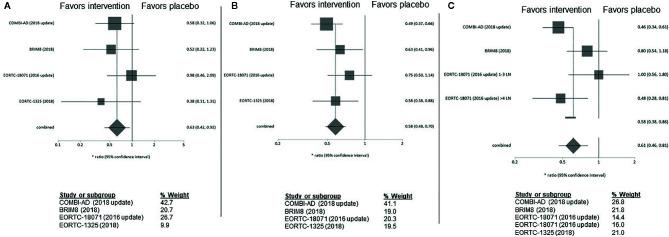
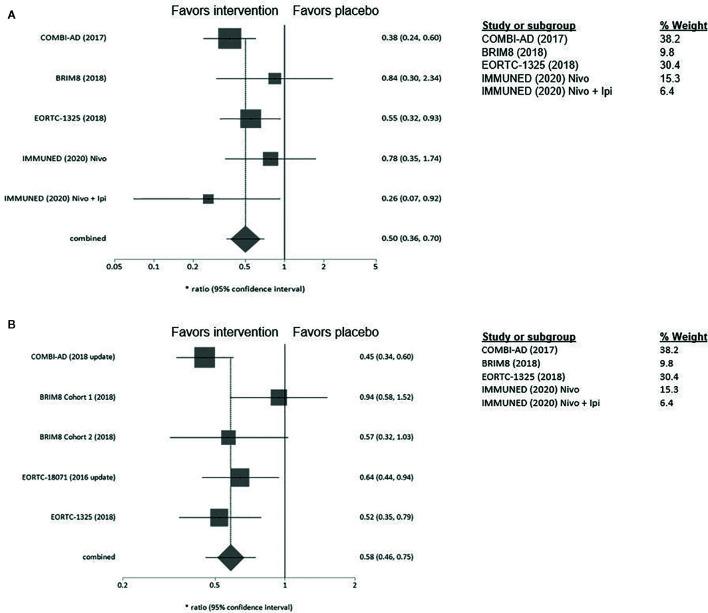
Five prospective randomized placebo-controlled trials were included in the meta-analysis. The drug regimens included ipilimumab, pembrolizumab, nivolumab, nivolumab/ipilimumab, vemurafenib, and dabrafenib/trametinib. Adjuvant treatment was associated with a higher RFS than placebo (HR 0.57; 95% CI= 0.45-0.71). Nivolumab/ipilimumab in stage IV malignant melanoma was associated with the highest RFS benefit (HR 0.23; 97.5% CI= 0.12-0.45), followed by dabrafenib/trametinib in stage III BRAF-mutant melanoma (HR 0.49; 95% CI= 0.40-0.59). The presence of a BRAF mutation was associated with higher RFS rates (HR 0.30; 95% CI= 0.11-0.78) compared to the wildtype group (HR 0.60; 95% CI= 0.44-0.81). Patient age did not influence outcomes (≥65: HR 0.50; 95% CI= 0.36-0.70, <65: HR 0.58; 95% CI= 0.46-0.75). Immune checkpoint inhibitor monotherapy was associated with lower RFS in non-ulcerated melanoma. Patients with stage IIIA benefited equally from adjuvant treatment as those with stage IIIB/C. Nivolumab/ipilimumab and ipilimumab monotherapy were associated with higher toxicity.
CONCLUSION
Adjuvant therapy should not be withheld on account of advanced age or stage IIIA alone. The presence of a BRAF mutation is prognostically favorable in terms of RFS. BRAF/MEK inhibitors should be preferred in the adjuvant treatment of BRAF-mutant non-ulcerated melanoma.
引言
多种药物被批准用于完全切除的高危(II C-IV期)恶性黑色素瘤的辅助治疗。根据所使用的药物不同,亚组可能会有不同的获益。我们进行了一项系统评价和荟萃分析,以评估干扰素时代之后,在以下亚组中可用治疗方案的有效性和耐受性:患者年龄、分期、溃疡状态、淋巴结受累情况、BRAF状态。
方法
在2020年6月和9月对PubMed和Cochrane图书馆数据库进行了无出版年份限制的检索。根据PRISMA指南,由两位作者独立提取数据,并根据随机效应模型进行汇总。预定义的主要结局是无复发生存期(RFS)。数据提取后发现,一项试验(BRIM8)报告了无病生存期,其定义与RFS完全相同。
结果
五项前瞻性随机安慰剂对照试验纳入了荟萃分析。药物方案包括伊匹木单抗、帕博利珠单抗、纳武利尤单抗、纳武利尤单抗/伊匹木单抗、维莫非尼和达拉非尼/曲美替尼。辅助治疗与比安慰剂更高的RFS相关(HR 0.57;95%CI = 0.45 - 0.71)。IV期恶性黑色素瘤中的纳武利尤单抗/伊匹木单抗与最高的RFS获益相关(HR 0.23;97.5%CI = 0.12 - 0.45),其次是III期BRAF突变黑色素瘤中的达拉非尼/曲美替尼(HR 0.49;95%CI = 0.40 - 0.59)。与野生型组(HR 0.60;95%CI = 0.44 - 0.81)相比,BRAF突变的存在与更高的RFS率相关(HR 0.30;95%CI = 0.11 - 0.78)。患者年龄不影响结局(≥65岁:HR 0.50;95%CI = 0.36 - 0.70,<65岁:HR 0.58;95%CI = 0.46 - 0.75)。免疫检查点抑制剂单药治疗在无溃疡黑色素瘤中与较低的RFS相关。IIIA期患者与IIIB/C期患者从辅助治疗中获益相同。纳武利尤单抗/伊匹木单抗和伊匹木单抗单药治疗与更高的毒性相关。
结论
不应仅因年龄较大或IIIA期而不给予辅助治疗。就RFS而言,BRAF突变的存在预后良好。在BRAF突变的无溃疡黑色素瘤的辅助治疗中,应首选BRAF/MEK抑制剂。



 Zotero 插件