
COVID-19 后 3 个月的神经学结果和生活质量:一项前瞻性观察队列研究。
Neurological outcome and quality of life 3 months after COVID-19: A prospective observational cohort study.
机构信息
Department of Neurology, Medical University of Innsbruck, Innsbruck, Austria.
Department of Internal Medicine II, Medical University of Innsbruck, Innsbruck, Austria.
出版信息
Eur J Neurol. 2021 Oct;28(10):3348-3359. doi: 10.1111/ene.14803. Epub 2021 May 3.
BACKGROUND AND PURPOSE
To assess neurological manifestations and health-related quality of life (QoL) 3 months after COVID-19.
METHODS
In this prospective, multicenter, observational cohort study we systematically evaluated neurological signs and diseases by detailed neurological examination and a predefined test battery assessing smelling disorders (16-item Sniffin Sticks test), cognitive deficits (Montreal Cognitive Assessment), QoL (36-item Short Form), and mental health (Hospital Anxiety and Depression Scale, Posttraumatic Stress Disorder Checklist-5) 3 months after disease onset.
RESULTS
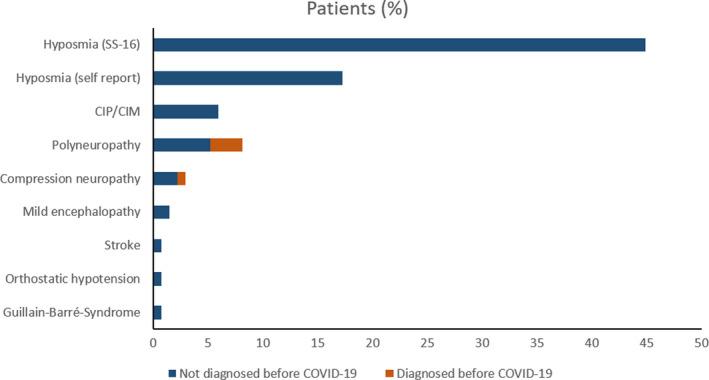
Of 135 consecutive COVID-19 patients, 31 (23%) required intensive care unit (ICU) care (severe), 72 (53%) were admitted to the regular ward (moderate), and 32 (24%) underwent outpatient care (mild) during acute disease. At the 3-month follow-up, 20 patients (15%) presented with one or more neurological syndromes that were not evident before COVID-19. These included polyneuro/myopathy (n = 17, 13%) with one patient presenting with Guillain-Barré syndrome, mild encephalopathy (n = 2, 2%), parkinsonism (n = 1, 1%), orthostatic hypotension (n = 1, 1%), and ischemic stroke (n = 1, 1%). Objective testing revealed hyposmia/anosmia in 57/127 (45%) patients at the 3-month follow-up. Self-reported hyposmia/anosmia was lower (17%) at 3 months, however, improved when compared to the acute disease phase (44%; p < 0.001). At follow-up, cognitive deficits were apparent in 23%, and QoL was impaired in 31%. Assessment of mental health revealed symptoms of depression, anxiety, and posttraumatic stress disorders in 11%, 25%, and 11%, respectively.
CONCLUSIONS
Despite recovery from the acute infection, neurological symptoms were prevalent at the 3-month follow-up. Above all, smelling disorders were persistent in a large proportion of patients.
背景与目的
评估 COVID-19 后 3 个月的神经系统表现和健康相关生活质量(QoL)。
方法
在这项前瞻性、多中心、观察性队列研究中,我们通过详细的神经系统检查和预先确定的测试套件系统地评估了神经系统体征和疾病,该测试套件评估嗅觉障碍(16 项嗅棒测试)、认知缺陷(蒙特利尔认知评估)、QoL(36 项简短表单)和心理健康(医院焦虑和抑郁量表、创伤后应激障碍检查表-5),这些评估在疾病发作后 3 个月进行。
结果
在连续的 135 例 COVID-19 患者中,31 例(23%)需要重症监护病房(ICU)治疗(严重),72 例(53%)入住普通病房(中度),32 例(24%)在急性疾病期间接受门诊治疗(轻度)。在 3 个月的随访中,20 例(15%)患者出现了 COVID-19 之前没有出现的一种或多种神经系统综合征。这些包括多发性神经病/肌病(n=17,13%),其中 1 例患者出现格林-巴利综合征,轻度脑病(n=2,2%),帕金森病(n=1,1%),体位性低血压(n=1,1%)和缺血性中风(n=1,1%)。客观测试显示,3 个月时 57/127(45%)患者存在嗅觉减退/丧失。3 个月时自我报告的嗅觉减退/丧失较低(17%),但与急性疾病期相比有所改善(44%;p<0.001)。在随访时,23%的患者出现认知缺陷,31%的患者 QoL 受损。对心理健康的评估显示,分别有 11%、25%和 11%的患者出现抑郁、焦虑和创伤后应激障碍症状。
结论
尽管急性感染已康复,但在 3 个月的随访时仍存在神经系统症状。尤其是,嗅觉障碍在很大一部分患者中持续存在。
 Zotero 插件