
纳米生物技术在新冠疫情中用于严重急性呼吸综合征冠状病毒2感染早期诊断的应用
Application of Nanobiotechnology for Early Diagnosis of SARS-CoV-2 Infection in the COVID-19 Pandemic.
作者信息
Sheervalilou Roghayeh, Shirvaliloo Milad, Sargazi Saman, Shirvalilou Sakine, Shahraki Omolbanin, Pilehvar-Soltanahmadi Younes, Sarhadi Alireza, Nazarlou Ziba, Ghaznavi Habib, Khoei Samideh
机构信息
Pharmacology Research Center, Zahedan University of Medical Sciences, Zahedan, 9816743463, Iran.
Faculty of Medicine, Tabriz University of Medical Sciences, Tabriz, 5166614766, Iran.
出版信息
Appl Microbiol Biotechnol. 2021 Apr;105(7):2615-2624. doi: 10.1007/s00253-021-11197-y. Epub 2021 Mar 12.
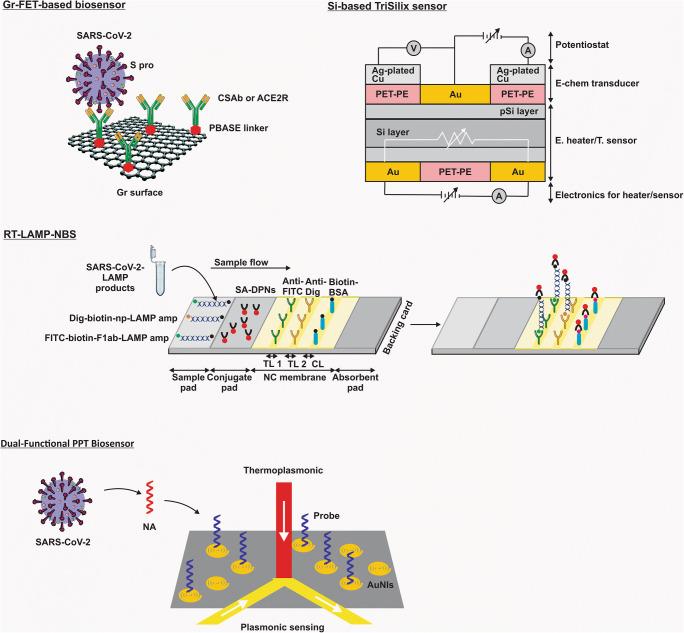
A most discussed topic of the new decade, COVID-19 is an infectious disease caused by the recently discovered SARS-CoV-2. With an exceedingly high transmission rate, COVID-19 has affected almost all the countries in the world. Absent any vaccine or specific treatment, the humanity is left with nothing but the legacy method of quarantine. However, quarantine can only be effective when combined with early diagnosis of suspected cases. With their high sensitivity and unmatched specificity, biosensors have become an area of interest for development of novel diagnostic methods. Compared to the more traditional diagnostics, nanobiotechnology introduces biosensors as different diagnostics with greater versatility in application. Today, a growing number of analytes are being accurately identified by these nanoscopic sensing machines. Several reports of validated application with real samples further strengthen this idea. As of recent, there has been a rise in the number of studies on portable biosensors. Despite the slow progression, certain devices with embedded biosensors have managed to be of diagnostic value in several countries. The perceptible increase in development of mobile platforms has revolutionized the healthcare delivery system in the new millennium. The present article reviews the most recent advancements in development of diagnostic nanobiosensors and their application in the clinical fields. KEY POINTS: • There is no specific treatment for highly transmissible SARS-CoV-2. • Early diagnosis is critical for control of pandemic. • Highly sensitive/specific nanobiosensors are emerging assets against COVID-19.
作为新十年中讨论最多的话题之一,新冠病毒病(COVID-19)是一种由最近发现的严重急性呼吸综合征冠状病毒2(SARS-CoV-2)引起的传染病。新冠病毒病传播率极高,几乎影响了世界上所有国家。由于没有疫苗或特效治疗方法,人类只能依靠传统的隔离方法。然而,只有结合疑似病例的早期诊断,隔离才会有效。生物传感器因其高灵敏度和无与伦比的特异性,已成为新型诊断方法开发的一个研究热点。与更传统的诊断方法相比,纳米生物技术引入的生物传感器是一种应用更具通用性的不同诊断方法。如今,越来越多的分析物正被这些纳米级传感设备准确识别。几份关于实际样本验证应用的报告进一步强化了这一观点。最近,便携式生物传感器的研究数量有所增加。尽管进展缓慢,但某些嵌入生物传感器的设备已在一些国家具备诊断价值。移动平台发展的显著增长在新千年彻底改变了医疗服务体系。本文综述了诊断性纳米生物传感器开发的最新进展及其在临床领域的应用。要点:• 对于高传播性的SARS-CoV-2没有特效治疗方法。• 早期诊断对于控制疫情至关重要。• 高灵敏度/特异性的纳米生物传感器是对抗新冠病毒病的新兴利器。

 Zotero 插件