
饮食模式与成年人炎症生物标志物的关联:观察性研究的系统评价。
Dietary patterns and associations with biomarkers of inflammation in adults: a systematic review of observational studies.
机构信息
Institute for Physical Activity and Nutrition, School of Exercise and Nutrition Sciences, Deakin University, Geelong, VIC, 3220, Australia.
出版信息
Nutr J. 2021 Mar 12;20(1):24. doi: 10.1186/s12937-021-00674-9.
BACKGROUND
Evidence indicates that low-grade inflammation is involved in manychronic diseases of ageing. Modifiable lifestyle factors including dietcan affect low-grade inflammation. Dietary patterns allow assessment of the complex interactions of food nutrients and health and may be associated with inflammatory status. This systematic review aimed to summarises current evidence from observational studies for associations between dietary patterns and inflammatory biomarkers in the general adult population. This review followed the PRISMA guidelines.
METHODS
We conducted a systematic search in Embase, CINAHL Complete, Global Health and MEDLINE complete databases. Search terms included terms for diet ("dietary patterns", "diet scores") and inflammation ("inflammation", "c-reactive protein", "interleukin").
RESULTS
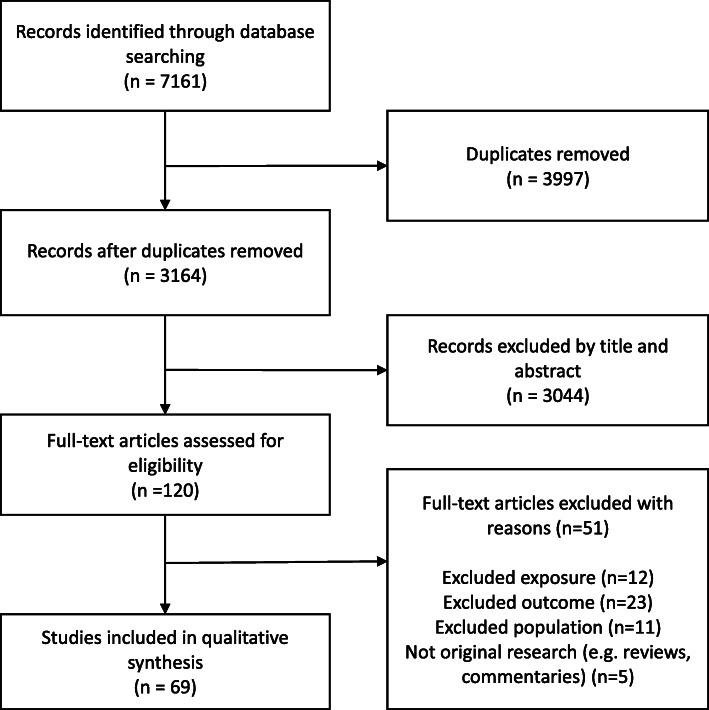
The search produced 7161 records. Duplicates were removed leaving 3164 for screening. There were 69 studies included (60 cross-sectional, 9 longitudinal). Papers included studies that were: 1) observational studies; 2) conducted in community-dwelling adults over 18 years of age; 3) assessed dietary patterns; 4) measured specified biomarkers of inflammation and 5) published in English. Dietary patterns were assessed using diet scores (n = 45), data-driven approaches (n = 22), both a data-driven approach and diet score (n = 2). The most frequently assessed biomarkers were CRP (n = 64) and/or IL-6 (n = 22). Cross-sectionally the majority of analyses reported an association between higher diet scores (mostly Mediterranean and anti-inflammatory diet scores) and lower inflammatory markers with 82 significant associations from 133 analyses. Only 22 of 145 cross-sectional analyses using data-driven approaches reported an association between a dietary patterns and lower inflammatory markers; the majority reported no association. Evidence of an association between dietary patterns and inflammatory markers longitudinally is limited, with the majority reporting no association.
CONCLUSIONS
Adherence to healthy, Mediterranean and anti-inflammatory dietary scores, appear to be associated with lower inflammatory status cross-sectionally. Future research could focus on longitudinal studies using a potential outcomes approach in the data analysis.
TRIAL REGISTRATION
PROSPERO Registration Number CRD42019114501 .
背景
有证据表明,低度炎症与许多衰老相关的慢性疾病有关。可改变的生活方式因素,包括饮食,可以影响低度炎症。饮食模式可以评估食物营养与健康之间的复杂相互作用,并且可能与炎症状态有关。本系统评价旨在总结观察性研究中关于一般成年人群中饮食模式与炎症生物标志物之间关系的现有证据。本综述遵循 PRISMA 指南。
方法
我们在 Embase、CINAHL Complete、全球健康和 MEDLINE complete 数据库中进行了系统搜索。搜索术语包括饮食相关术语(“饮食模式”、“饮食评分”)和炎症相关术语(“炎症”、“C 反应蛋白”、“白细胞介素”)。
结果
搜索产生了 7161 条记录。删除重复项后,留下 3164 条进行筛选。共有 69 项研究入选(60 项横断面研究,9 项纵向研究)。入选的论文包括:1)观察性研究;2)在 18 岁以上的社区居民中进行;3)评估饮食模式;4)测量特定的炎症生物标志物;5)用英文发表。饮食模式使用饮食评分(n=45)、数据驱动方法(n=22)、数据驱动方法和饮食评分(n=2)进行评估。最常评估的生物标志物是 CRP(n=64)和/或 IL-6(n=22)。横断面研究中,大多数分析报告称,较高的饮食评分(主要是地中海饮食和抗炎饮食评分)与较低的炎症标志物之间存在关联,在 133 项分析中有 82 项有显著关联。在使用数据驱动方法的 145 项横断面分析中,只有 22 项报告了饮食模式与较低的炎症标志物之间存在关联,大多数报告没有关联。饮食模式与炎症标志物纵向关联的证据有限,大多数报告没有关联。
结论
健康的、地中海饮食和抗炎饮食评分的依从性,似乎与炎症状态的横断面较低有关。未来的研究可以集中在使用数据分析中的潜在结果方法的纵向研究上。
试验注册
PROSPERO 注册号 CRD42019114501。
 Zotero 插件