
结直肠团队在支持非结直肠团队以改善临床结局和遵守结直肠切除术加速康复外科指南方面的作用:一项队列研究。
Role for colorectal teams to support non-colorectal teams to improve clinical outcomes and adherence to ERAS guidelines for segmental colectomy: a cohort study.
机构信息
Department of Surgical Sciences, Dunedin Medical Campus, Otago Medical School, University of Otago, PO Box 56, Dunedin, 9054, New Zealand.
Department of Preventive and Social Medicine, Dunedin Medical Campus, Otago Medical School, University of Otago, Dunedin, New Zealand.
出版信息
BMC Surg. 2021 Mar 16;21(1):132. doi: 10.1186/s12893-021-01149-8.
BACKGROUND
To identify whether compliance with Enhanced Recovery After Surgery (ERAS) Society recommendations is associated with length of stay (LOS) in a New Zealand hospital for patients undergoing segmental colectomy in mixed acute and elective general surgery wards.
METHODS
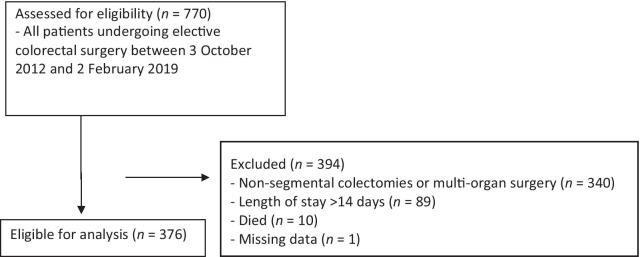
Consecutive elective colorectal surgeries (n = 770) between October 2012 and February 2019 were audited. Patients with non-segmental colectomies, multi-organ surgeries, LOS > 14 days, and those who died were excluded. Logistic regression was used to determine the relationship between patient demographics, compliance with ERAS guidelines, and suboptimal LOS (> 4 days).
RESULTS
Analysis included 376 patients. Age, surgery prior to 2014, surgical approach, non-colorectal surgical team, operation type, and complications were significantly associated with suboptimal LOS. Non-compliance with ERAS recommendations for laparoscopy [OR 8.9, 95% CI (4.52, 19.67)], removal of indwelling catheters (IDC) [OR 3.14, 95% CI (1.85, 5.51)], use of abdominal drains [OR 4.27, 95% CI (0.99, 18.35)], and removal of PCA [OR 8.71, 95% CI (1.78, 157.27)], were associated with suboptimal LOS (univariable analysis). Multivariable analysis showed that age, surgical team, late removal of IDC, and open approach were independent predictors of suboptimal LOS.
CONCLUSIONS
Non-compliance with ERAS guidelines for laparoscopic approach and early removal of IDC was higher among procedures performed by non-colorectal surgery teams, and was also associated with adverse postoperative events and suboptimal LOS. This study demonstrates the importance of the surgical team's expertise in affecting surgical outcomes, and did not find significant independent associations between most individual ERAS guidelines and suboptimal LOS once adjusting for other factors.
背景
为了确定在新西兰混合急症和择期普外科病房中接受节段结肠切除术的患者,遵守增强术后康复(ERAS)协会建议是否与住院时间(LOS)相关。
方法
对 2012 年 10 月至 2019 年 2 月期间连续进行的择期结直肠手术(n=770)进行了审核。排除了非节段性结肠切除术、多器官手术、LOS>14 天和死亡的患者。使用逻辑回归来确定患者人口统计学特征、遵守 ERAS 指南与 LOS 不理想(>4 天)之间的关系。
结果
分析包括 376 例患者。年龄、2014 年之前的手术、手术方法、非结直肠手术团队、手术类型和并发症与 LOS 不理想显著相关。不符合 ERAS 腹腔镜建议[比值比(OR)8.9,95%置信区间(CI)(4.52,19.67)]、留置导管(IDC)的移除[OR 3.14,95% CI(1.85,5.51)]、使用腹部引流管[OR 4.27,95% CI(0.99,18.35)]和 PCA 移除[OR 8.71,95% CI(1.78,157.27)]与 LOS 不理想相关(单变量分析)。多变量分析显示,年龄、手术团队、IDC 晚期移除和开放手术是 LOS 不理想的独立预测因素。
结论
非结直肠手术团队进行的手术中,腹腔镜方法和 IDC 早期移除不符合 ERAS 指南的情况更为普遍,并且与术后不良事件和 LOS 不理想相关。本研究表明手术团队的专业知识对手术结果的重要性,并且在调整其他因素后,大多数 ERAS 指南与 LOS 不理想之间并未发现显著的独立关联。
 Zotero 插件