
一项关于以色列对 COVID-19 疫苗的态度在民族、性别和教育方面差异的研究——对疫苗实施政策的影响。
A study of ethnic, gender and educational differences in attitudes toward COVID-19 vaccines in Israel - implications for vaccination implementation policies.
机构信息
School of Public Health, University of Haifa, Abba Khoushy 199, 3498838, Haifa, Israel.
Statistics Consulting Unit, University of Haifa, Haifa, Israel.
出版信息
Isr J Health Policy Res. 2021 Mar 19;10(1):26. doi: 10.1186/s13584-021-00458-w.
BACKGROUND
Vaccines for COVID-19 are currently available for the public in Israel. The compliance with vaccination has differed between sectors in Israel and the uptake has been substantially lower in the Arab compared with the Jewish population.
AIM
To assess ethnic and socio-demographic factors in Israel associated with attitudes towards COVID-19 vaccines prior to their introduction.
METHODS
A national cross-sectional survey was carried out In Israel during October 2020 using an internet panel of around 100,000 people, supplemented by snowball sampling. A sample of 957 adults aged 30 and over were recruited of whom 606 were Jews (49% males) and 351 were Arabs (38% males).
RESULTS
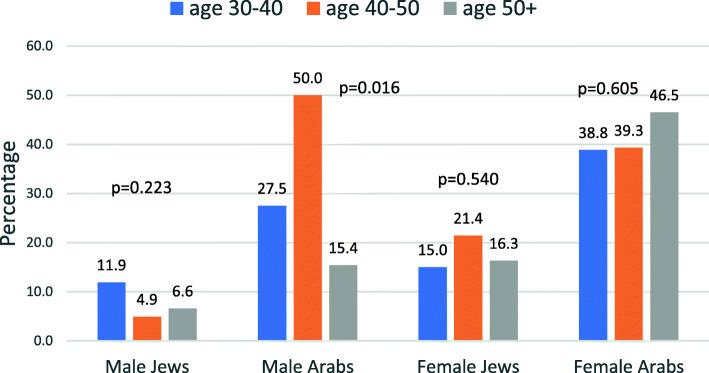
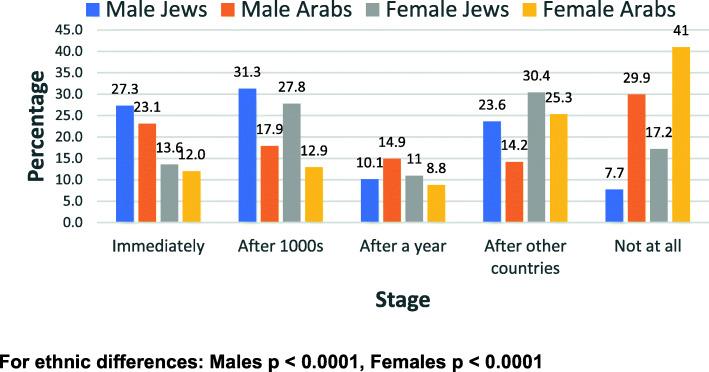
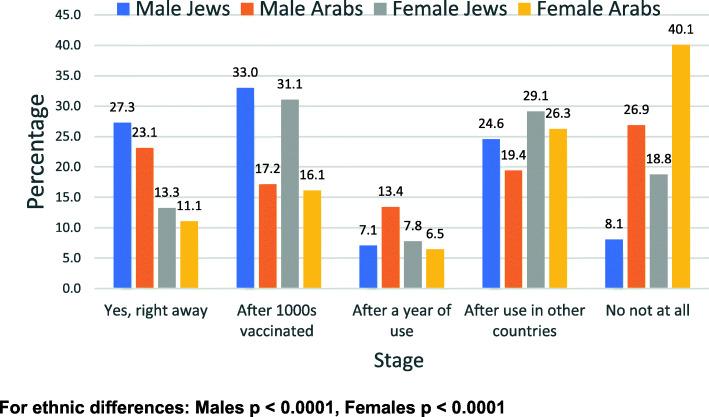
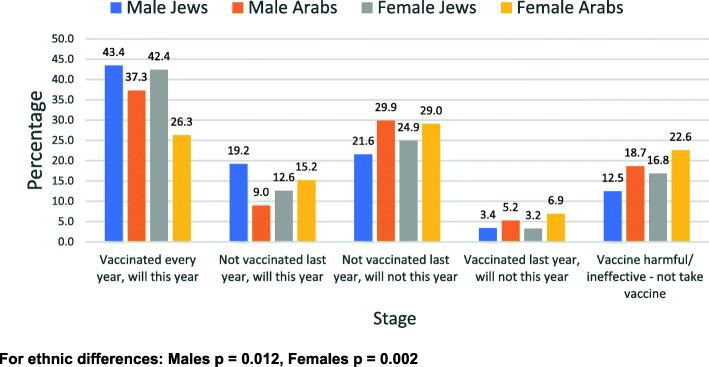
The sample of Arabs was younger than for the Jewish respondents. Among the men, 27.3% of the Jewish and 23.1% of the Arab respondents wanted to be vaccinated immediately, compared with only 13.6% of Jewish women and 12.0% of Arab women. An affirmative answer to the question as to whether they would refuse the vaccine at any stage was given by 7.7% of Jewish men and 29.9% of Arab men, and 17.2% of Jewish women and 41.0% of Arab women. Higher education was associated with less vaccine hesitancy. In multiple logistic regression analysis, the ethnic and gender differences persisted after controlling for age and education. Other factors associated with vaccine hesitancy were the belief that the government restrictions were too lenient and the frequency of socializing prior to the pandemic.
CONCLUSIONS
The study revealed a relatively high percentage reported would be reluctant to get vaccinated, prior to the introduction of the vaccine. This was more marked so for Arabs then Jews, and more so for women within the ethnic groups. While this was not a true random sample, the findings are consistent with the large ethnic differences in compliance with the vaccine, currently encountered and reinforce the policy implications for developing effective communication to increase vaccine adherence. Government policies directed at controlling the pandemic should include sector-specific information campaigns, which are tailored to ensure community engagement, using targeted messages to the suspected vaccine hesitant groups. Government ministries, health service providers and local authorities should join hands with civil society organizations to promote vaccine promotion campaigns.
背景
目前,COVID-19 疫苗已在以色列向公众提供。以色列各部门对疫苗的接种情况不同,阿拉伯人口的接种率明显低于犹太人口。
目的
评估以色列在推出 COVID-19 疫苗之前与人们对疫苗的态度相关的种族和社会人口学因素。
方法
2020 年 10 月,在以色列使用大约 10 万人的互联网小组进行了一项全国性横断面调查,同时还进行了雪球抽样。招募了 957 名年龄在 30 岁及以上的成年人,其中 606 名是犹太人(男性占 49%),351 名是阿拉伯人(男性占 38%)。
结果
阿拉伯人的样本比犹太人的样本年轻。在男性中,27.3%的犹太人和 23.1%的阿拉伯受访者表示希望立即接种疫苗,而只有 13.6%的犹太女性和 12.0%的阿拉伯女性希望立即接种疫苗。有 7.7%的犹太男性和 29.9%的阿拉伯男性以及 17.2%的犹太女性和 41.0%的阿拉伯女性表示,他们在任何阶段都可能拒绝接种疫苗。受教育程度越高,对疫苗的犹豫程度越低。在多因素逻辑回归分析中,在控制年龄和教育程度后,种族和性别差异仍然存在。与疫苗犹豫相关的其他因素包括政府限制过于宽松以及大流行前社交的频率。
结论
研究表明,在推出疫苗之前,报告表示不愿意接种疫苗的人相对较多。在阿拉伯人当中,这种情况比犹太人更为明显,在各个群体中的女性中更为明显。虽然这不是一个真正的随机样本,但这些发现与目前疫苗接种率方面存在的巨大种族差异一致,并加强了制定有效沟通策略以提高疫苗接种率的政策意义。政府控制大流行的政策应包括针对特定部门的信息宣传活动,这些活动应根据社区参与情况进行调整,向疑似疫苗犹豫群体发送有针对性的信息。政府部门、卫生服务提供者和地方当局应与民间社会组织携手合作,共同推动疫苗推广活动。
 Zotero 插件