
儿童急性胰腺炎的临床特征:中国西部单中心经验
Clinical characteristics of acute pancreatitis in children: a single-center experience in Western China.
作者信息
Zhong Rui, Tan Shali, Peng Yan, Xu Huan, Jiang Xin, Yan Yongfeng, Lv Muhan, Liu Li, Tang Xiaowei
机构信息
Department of Gastroenterology, The Affiliated Hospital of Southwest Medical University, Luzhou, 646000, China.
Department of Digestive Endoscopy, The First Affiliated Hospital With Nanjing Medical University, Nanjing, China.
出版信息
BMC Gastroenterol. 2021 Mar 9;21(1):116. doi: 10.1186/s12876-021-01706-8.
BACKGROUND
The diagnosis of pediatric pancreatitis has been increasing over the last 20 years. We aimed to compare the clinical characteristics for pediatric acute pancreatitis (AP) with adult AP, and investigate the risk factor for acute recurrent pancreatitis (ARP) in children.
METHOD
From June 2013 to June 2019, a total of 130 pediatric patients with AP at the inpatient database were enrolled. Univariate analysis and multivariate Cox regression analysis were performed to identify the risk factors for ARP in children.
RESULT
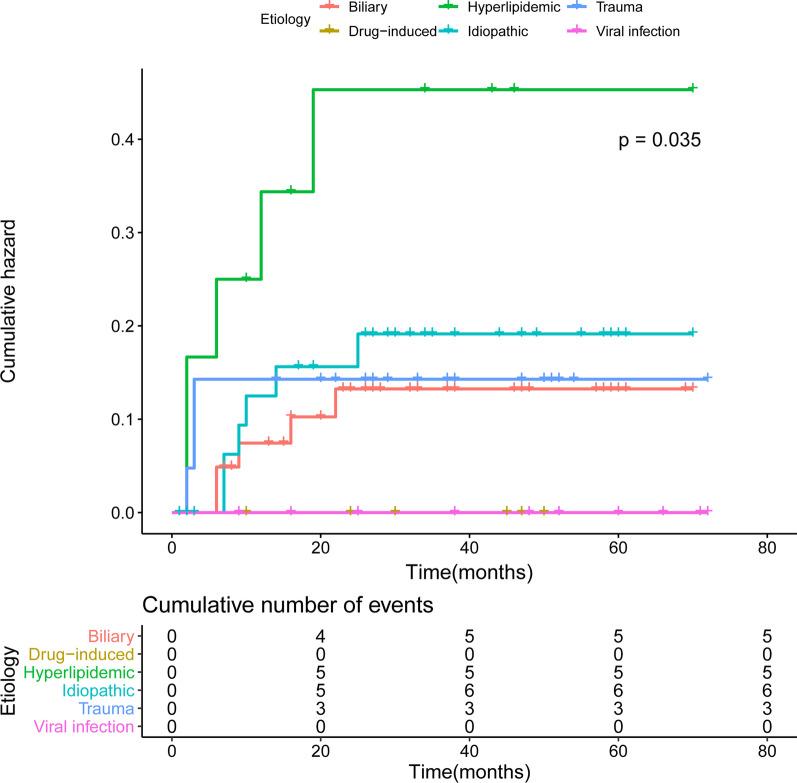
Major etiologic factors in 130 patients were biliary (31.5%), idiopathic (28.5%). The etiology of pancreatitis in children was markedly different from that in adults (p < 0.001). Compared with the adult patients, the pediatric patients had significantly lower severity (p = 0.018) and occurrence rate of pancreatic necrosis (p = 0.041), SIRS (p = 0.021), acute peripancreatic fluid collection (p = 0.014). Univariate and Multivariate Cox regression analysis showed that female (p = 0.020; OR 3.821; 95% CI 1.231-11.861), hypertriglyceridemia (p = 0.045; OR 3.111; 95% CI 1.024-9.447), pancreatic necrosis (p = 0.023; OR 5.768; 95% CI 1.278-26.034) were the independent risk factors of ARP. Hypertriglyceridemia AP had the highest risk of recurrence compared to other etiology (p = 0.035).
CONCLUSION
Biliary and idiopathic disease were the major etiologies of AP in children. Children have simpler conditions than adults. Female, hypertriglyceridemia, and pancreatic necrosis were associated with the onset of ARP.
背景
在过去20年中,小儿胰腺炎的诊断率一直在上升。我们旨在比较小儿急性胰腺炎(AP)与成人AP的临床特征,并调查儿童急性复发性胰腺炎(ARP)的危险因素。
方法
2013年6月至2019年6月,共纳入住院数据库中130例小儿AP患者。进行单因素分析和多因素Cox回归分析以确定儿童ARP的危险因素。
结果
130例患者的主要病因是胆源性(31.5%)、特发性(28.5%)。儿童胰腺炎的病因与成人明显不同(p<0.001)。与成人患者相比,小儿患者的严重程度(p=0.018)、胰腺坏死发生率(p=0.041)、全身炎症反应综合征(SIRS,p=0.021)、急性胰周液体积聚(p=0.014)明显更低。单因素和多因素Cox回归分析显示,女性(p=0.020;OR 3.821;95%CI 1.231-11.861)、高甘油三酯血症(p=0.045;OR 3.111;95%CI 1.024-9.447)、胰腺坏死(p=0.023;OR 5.768;95%CI 1.278-26.034)是ARP的独立危险因素。与其他病因相比,高甘油三酯血症性AP复发风险最高(p=0.035)。
结论
胆源性和特发性疾病是儿童AP的主要病因。儿童的病情比成人简单。女性、高甘油三酯血症和胰腺坏死与ARP的发病有关。
 Zotero 插件