
生长激素分泌型垂体腺瘤患者中 GNAS 突变与手术结果的相关性。
Associations of GNAS Mutations with Surgical Outcomes in Patients with Growth Hormone-Secreting Pituitary Adenoma.
机构信息
Division of Endocrinology, Department of Internal Medicine, Yonsei University College of Medicine, Seoul, Korea.
Department of Internal Medicine, Ewha Womans University School of Medicine, Seoul, Korea.
出版信息
Endocrinol Metab (Seoul). 2021 Apr;36(2):342-350. doi: 10.3803/EnM.2020.875. Epub 2021 Mar 23.
BACKGROUND
The guanine nucleotide-binding protein, alpha stimulating (GNAS) gene has been associated with growth hormone (GH)-secreting pituitary adenoma. We investigated the prevalence of GNAS mutations in Korean patients with acromegaly and assessed whether mutation status correlated with biochemical or clinical characteristics.
METHODS
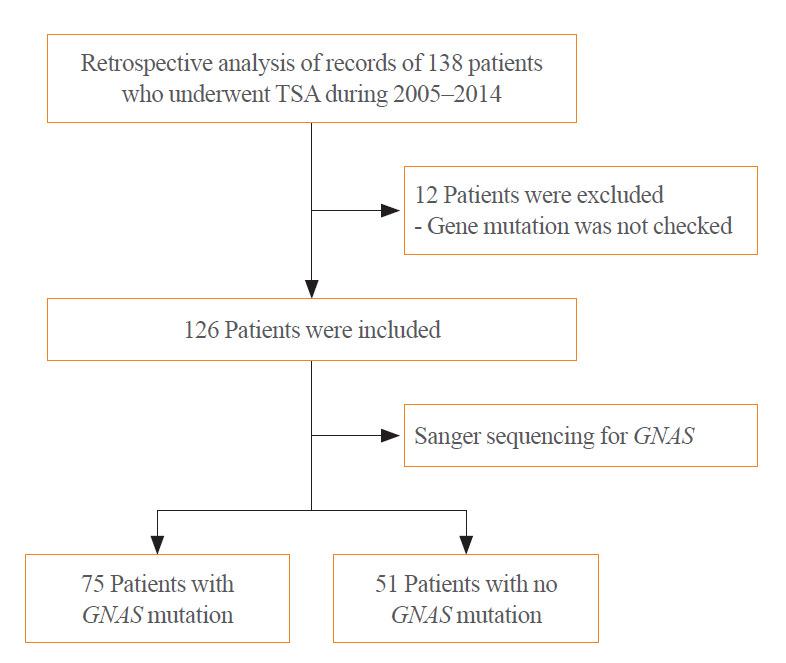
We studied 126 patients with acromegaly who underwent surgery between 2005 and 2014 at Severance Hospital. We performed GNAS gene analysis and evaluated age, sex, hormone levels, postoperative biochemical remission, and immunohistochemical staining results of the tumor.
RESULTS
GNAS mutations were present in 75 patients (59.5%). Patients with and without GNAS mutations showed similar age distribution and Knosp classification. The proportion of female patients was 76.5% and 48.0% in the GNAS-negative and GNAS-mutation groups, respectively (P=0.006). In immunohistochemical staining, the GNAS-mutation group showed higher GH expression in pituitary tumor tissues than the mutation-negative group (98.7% vs. 92.2%, P=0.015). Patients with GNAS mutations had higher preoperative insulin-like growth factor-1 levels (791.3 ng/mL vs. 697.0 ng/mL, P=0.045) and lower immediate postoperative basal (0.9 ng/mL vs. 1.0 ng/mL, P=0.191) and nadir GH levels (0.3 ng/mL vs. 0.6 ng/mL, P=0.012) in oral glucose tolerance tests. Finally, the GNAS-mutation group showed significantly higher surgical remission rates than the mutation-negative group, both at 1 week and 6 months after surgical resection (70.7% vs. 54.9%, P=0.011; 85.3% vs. 82.4%, P=0.007, respectively).
CONCLUSION
GNAS mutations in GH-secreting pituitary tumors are associated with higher preoperative insulin-like growth factor-1 levels and surgical remission rates and lower immediate postoperative nadir GH levels. Thus, GNAS mutation status can predict surgical responsiveness in patients with acromegaly.
背景
鸟苷酸结合蛋白,α 刺激物(GNAS)基因与生长激素(GH)分泌性垂体腺瘤有关。我们研究了 GNAS 突变在韩国肢端肥大症患者中的流行情况,并评估了突变状态是否与生化或临床特征相关。
方法
我们研究了 2005 年至 2014 年间在 Severance 医院接受手术的 126 例肢端肥大症患者。我们进行了 GNAS 基因分析,并评估了患者的年龄、性别、激素水平、术后生化缓解情况以及肿瘤的免疫组织化学染色结果。
结果
75 例(59.5%)患者存在 GNAS 突变。有和无 GNAS 突变的患者年龄分布和 Knosp 分级相似。女性患者的比例分别为 GNAS 阴性组和 GNAS 突变组的 48.0%和 76.5%(P=0.006)。在免疫组织化学染色中,突变组的垂体肿瘤组织中 GH 表达高于突变阴性组(98.7%比 92.2%,P=0.015)。有 GNAS 突变的患者术前胰岛素样生长因子-1 水平更高(791.3 ng/mL 比 697.0 ng/mL,P=0.045),术后即刻基础(0.9 ng/mL 比 1.0 ng/mL,P=0.191)和谷值 GH 水平(0.3 ng/mL 比 0.6 ng/mL,P=0.012)更低,口服葡萄糖耐量试验。最后,突变组的手术缓解率显著高于突变阴性组,术后 1 周和 6 个月时均如此(70.7%比 54.9%,P=0.011;85.3%比 82.4%,P=0.007)。
结论
GH 分泌性垂体腺瘤中的 GNAS 突变与术前胰岛素样生长因子-1 水平升高、手术缓解率升高和术后即刻谷值 GH 水平降低有关。因此,GNAS 突变状态可预测肢端肥大症患者的手术反应性。
 Zotero 插件