
吉西他滨与成纤维细胞生长因子受体抑制剂对胰腺癌细胞周期动力学和增殖的协同药效学作用。
Synergistic Pharmacodynamic Effects of Gemcitabine and Fibroblast Growth Factor Receptor Inhibitors on Pancreatic Cancer Cell Cycle Kinetics and Proliferation.
机构信息
Department of Pharmaceutical Sciences, University at Buffalo, State University of New York, Buffalo, New York (R.M.S.; Z.Q., W.J.J., D.E.M.); Departments of Cell Stress Biology (Q.L., R.M.S.) and Pharmacology and Therapeutics (R.M.S.), Roswell Park Comprehensive Cancer Center, Buffalo, New York; and Department of Medicine, Mayo Clinic, Rochester, Minnesota (W.W.M.).
Department of Pharmaceutical Sciences, University at Buffalo, State University of New York, Buffalo, New York (R.M.S.; Z.Q., W.J.J., D.E.M.); Departments of Cell Stress Biology (Q.L., R.M.S.) and Pharmacology and Therapeutics (R.M.S.), Roswell Park Comprehensive Cancer Center, Buffalo, New York; and Department of Medicine, Mayo Clinic, Rochester, Minnesota (W.W.M.)
出版信息
J Pharmacol Exp Ther. 2021 Jun;377(3):370-384. doi: 10.1124/jpet.120.000412. Epub 2021 Mar 22.
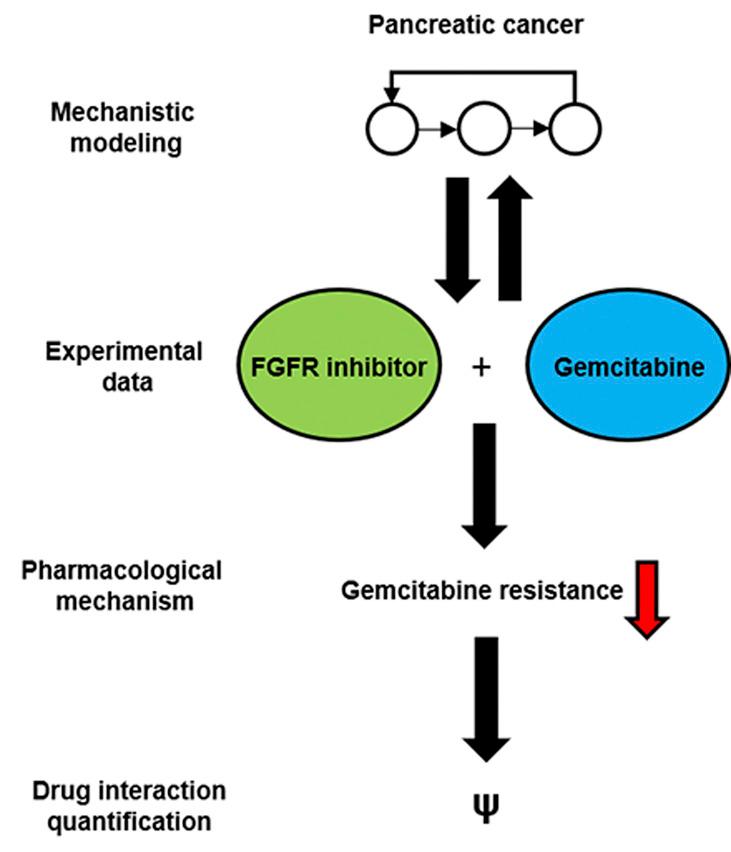
Median survival of pancreatic ductal adenocarcinoma cancer (PDAC) is 6 months, with 9% 5-year survival. Standard-of-care gemcitabine (Gem) provides only modest survival benefits, and combination therapies integrating novel targeted agents could improve outcomes. Fibroblast growth factor (FGF) receptors (FGFRs) play important roles in PDAC growth and invasion. Therefore, FGFR inhibitors (FGFRi) merit further investigation. Efficacy of Gem combined with NVP-BGJ398, a pan-FGFRi, was investigated in multiple PDAC cell lines exposed to the drugs alone and combined. Cell cycle distribution and cell numbers were quantified over time. Two pharmacodynamic models were developed to investigate Gem/BGJ398 interactions quantitatively: a drug-mediated cell proliferation/death model, and a drug-perturbed cell cycle progression model. The models captured temporal changes in cell numbers, cell cycle progression, and cell death during drug exposure. Simultaneous fitting of all data provided reasonable parameter estimates. Therapeutic efficacy was then evaluated in a PDAC mouse model. Compared with Gem alone, combined Gem + FGFRi significantly downregulated ribonucleotide-diphosphate reductase large subunit 1 (RRM1), a gemcitabine resistance (GemR) biomarker, suggesting the FGFRi inhibited GemR emergence. The cell proliferation/death pharmacodynamic model estimated the drug interaction coefficient = 0.798, suggesting synergistic effects. The mechanism-based cell cycle progression model estimated drug interaction coefficient = 0.647, also suggesting synergy. Thus, FGFR inhibition appears to synergize with Gem in PDAC cells and tumors by sensitizing cells to Gem-mediated inhibition of proliferation and cell cycle progression. SIGNIFICANCE STATEMENT: An integrated approach of quantitative modeling and experimentation was employed to investigate the nature of fibroblast growth factor receptor inhibitor (FGFRi)/gemcitabine (Gem) interaction, and to identify mechanisms by which FGFRi exposure reverses Gem resistance in pancreatic cancer cells. The results show that FGFRi interacts synergistically with Gem to sensitize pancreatic cancer cells and tumors to Gem-mediated inhibition of proliferation and cell cycle progression. Thus, addition of FGFRi to standard-of-care Gem treatment could be a clinically deployable approach to enhance therapeutic benefit to pancreatic cancer patients.
胰腺导管腺癌 (PDAC) 的中位生存期为 6 个月,5 年生存率为 9%。标准治疗药物吉西他滨 (Gem) 仅提供适度的生存获益,而整合新型靶向药物的联合治疗可能改善结局。成纤维细胞生长因子 (FGF) 受体 (FGFRs) 在 PDAC 的生长和侵袭中发挥重要作用。因此,FGFR 抑制剂 (FGFRi) 值得进一步研究。在单独和联合用药的情况下,研究了 Gem 与泛 FGFRi NVP-BGJ398 联合应用于多种 PDAC 细胞系的疗效。随着时间的推移,定量检测细胞周期分布和细胞数量。开发了两种药效动力学模型来定量研究 Gem/BGJ398 的相互作用:一个是药物介导的细胞增殖/死亡模型,另一个是药物干扰细胞周期进展模型。这些模型捕捉了药物暴露期间细胞数量、细胞周期进展和细胞死亡的时间变化。同时拟合所有数据提供了合理的参数估计。然后在 PDAC 小鼠模型中评估了治疗效果。与单独使用 Gem 相比,联合使用 Gem + FGFRi 可显著下调核糖核苷酸二磷酸还原酶大亚基 1 (RRM1),这是吉西他滨耐药 (GemR) 的生物标志物,表明 FGFRi 抑制了 GemR 的出现。细胞增殖/死亡药效动力学模型估计药物相互作用系数 = 0.798,表明存在协同作用。基于机制的细胞周期进展模型估计药物相互作用系数 = 0.647,也表明存在协同作用。因此,FGFR 抑制似乎通过使细胞对 Gem 介导的增殖和细胞周期进展抑制敏感,从而在 PDAC 细胞和肿瘤中与 Gem 协同作用。意义:采用定量建模和实验的综合方法研究了成纤维细胞生长因子受体抑制剂 (FGFRi)/吉西他滨 (Gem) 相互作用的性质,并确定了 FGFRi 暴露逆转胰腺癌细胞 Gem 耐药的机制。结果表明,FGFRi 与 Gem 协同作用,使胰腺癌细胞和肿瘤对 Gem 介导的增殖和细胞周期进展抑制敏感。因此,将 FGFRi 添加到标准护理 Gem 治疗中可能是一种临床上可部署的方法,以增强对胰腺癌患者的治疗获益。
 Zotero 插件