
急诊科降钙素原(PCT)水平可识别所有因疑似脓毒症接受治疗患者中的高危人群。
Procalcitonin (PCT) Level in the Emergency Department Identifies a High-Risk Cohort for All Patients Treated for Possible Sepsis.
作者信息
Lucas Georgia, Bartolf Angela, Kroll Nicholas, De Thabrew Agampodi-Umanda, Murtaza Zoya, Kumar Siddarth, Gani Abrar, Annoni Andrea, Parsons Marie, Pardoe Helen
机构信息
Princess Alexandra Hospital NHS Trust Harlow, United Kingdom.
出版信息
EJIFCC. 2021 Feb 28;32(1):20-26. eCollection 2021 Feb.
WHAT IS ALREADY KNOWN?: The benefits of measuring PCT in the Emergency Department (ED) are not yet fully characterised.PCT is widely used in the intensive care setting to guide antimicrobial prescribing.
WHAT THIS ADDS?: Measurement of PCT as a routine in the emergency department for all patients treated for possible sepsis identifies a high-risk cohort.
KEY IMPROVEMENT IN PATIENT CARE
A PCT measurement of >0.2ug/L in the Emergency Department identifies a patient at increased risk of deterioration and of in-hospital death.
BACKGROUND
Early recognition and management of sepsis in the Emergency Department (ED) is a clinical challenge. Our aim was to determine if measuring the biomarker PCT in patients with suspected sepsis enables the identification of patients at increased risk of deterioration or in-hospital death in the ED setting of a district general hospital in the United Kingdom.
METHODS
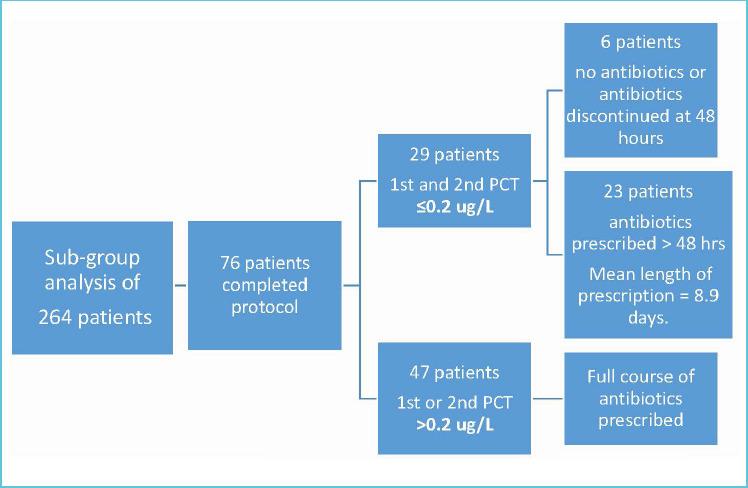
A prospective observational study was conducted on all patients aged 18 and over presenting to ED fulfilling NICE criteria for moderate to high risk of sepsis admitted to hospital. Patients had a PCT test alongside the sepsis six protocol. PCT was measured using Brahms's chemiluminescent micro particle assay (CMIA) for the quantitative determination of PCT in human serum and plasma on the Abbott Alinity I analytical platform. The cost per test was approximately 13 GBP.The analysis was performed on patients having a PCT in ED over a 7-month period, with in-depth scrutiny of an appropriate subgroup. A high level quality improvement (QI) approach was used in the study.
RESULTS
A total of 1242 patients were included in the study. Mean/median age was 67.9/72, (range 18-102). 88.7% of deaths occurred in patients over 65 years of age. 42.4% (n=532) had a PCT level in ED of >0.2 ug/L. This identified a high risk group with a 2.4 fold increase in mortality rate (7.7%:18.2% p value <0.001). The median length of stay (LOS) was 5 (IQR 9) and 8 days (IQR 11) in patients with a first PCT of ≤0.2 ug/L versus >0.2 ug/L respectively.
CONCLUSION
An immediate PCT on patients presenting to ED with signs of sepsis in a non-specialised acute trust identifies those patients at an increased risk of deterioration and in hospital death.
已知信息
在急诊科(ED)测量降钙素原(PCT)的益处尚未完全明确。PCT在重症监护环境中被广泛用于指导抗菌药物的处方。
新增内容
在急诊科对所有因可能的脓毒症接受治疗的患者进行常规PCT测量,可识别出高危人群。
患者护理的关键改进
急诊科PCT测量值>0.2μg/L可识别出病情恶化和院内死亡风险增加的患者。
背景
在急诊科(ED)早期识别和管理脓毒症是一项临床挑战。我们的目的是确定在英国一家地区综合医院的急诊科环境中,对疑似脓毒症患者测量生物标志物PCT是否能够识别出病情恶化或院内死亡风险增加的患者。
方法
对所有年龄在18岁及以上、因符合脓毒症中高风险的英国国家卫生与临床优化研究所(NICE)标准而入住医院的急诊科患者进行前瞻性观察研究。患者在接受脓毒症六项检查方案的同时进行PCT检测。使用Brahms化学发光微粒分析法(CMIA)在雅培Alinity I分析平台上对人血清和血浆中的PCT进行定量测定。每次检测成本约为13英镑。对在7个月内急诊科进行PCT检测的患者进行分析,并对一个合适的亚组进行深入审查。研究采用了高水平的质量改进(QI)方法。
结果
共有1242名患者纳入研究。平均/中位年龄为67.9/72岁(范围18 - 102岁)。88.7%的死亡发生在65岁以上的患者中。42.4%(n = 532)的患者在急诊科的PCT水平>0.2μg/L。这确定了一个高风险组,死亡率增加了2.4倍(7.7%:18.2%,p值<0.001)。首次PCT≤0.2μg/L与>0.2μg/L的患者中位住院时间(LOS)分别为5天(四分位间距9)和8天(四分位间距11)。
结论
在非专科急性信托医院的急诊科,对有脓毒症体征的患者立即进行PCT检测,可识别出病情恶化和院内死亡风险增加的患者。

 Zotero 插件