
社区综合中介护理(CIIC)服务模式以加强基于家庭的老年人长期护理:泰国一项整群随机对照试验方案
Community-Integrated Intermediary Care (CIIC) Service Model to Enhance Family-Based, Long-Term Care for Older People: Protocol for a Cluster Randomized Controlled Trial in Thailand.
作者信息
Aung Myo Nyein, Moolphate Saiyud, Yuasa Motoyuki, Aung Thin Nyein Nyein, Koyanagi Yuka, Supakankunti Siripen, Ahmad Ishtiaq, Kayano Ryoma, Ong Paul
机构信息
Advanced Research Institute for Health Sciences and Faculty of International Liberal Arts, Juntendo University, Tokyo, Japan.
Department of Public Health, Faculty of Science and Technology, Chiang Mai Rajabhat University, Chiang Mai, Thailand.
出版信息
JMIR Res Protoc. 2021 Mar 24;10(3):e20196. doi: 10.2196/20196.
BACKGROUND
Thailand is one of the most rapidly aging countries in Asia. Traditional family-based care, which has been the basis of most care for older people, is becoming unsustainable as families become smaller. In addition, women tend to be adversely affected as they still form the bulk of caregivers for older people, and many are likely to exit the labor market in order to provide care. Many family caregivers also have no or minimal training, and they may be called upon to provide quite complex care, increasing the proportion of older people receiving suboptimal care if they rely only on informal care that is provided by families and friends. Facing the increasing burden of noncommunicable diseases and age-related morbidity, Thai communities are increasingly in need of community-integrated care models for older persons that can link existing health systems and reduce the burden upon caring families. This need is common to many countries in the Association of Southeast Asian Nations (ASEAN).
OBJECTIVE
In this study, we aimed to assess the effectiveness of a community-integrated intermediary care (CIIC) model to enhance family-based care for older people.
METHODS
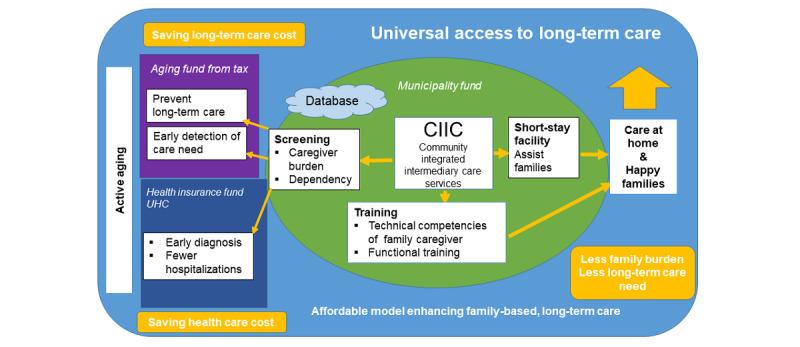
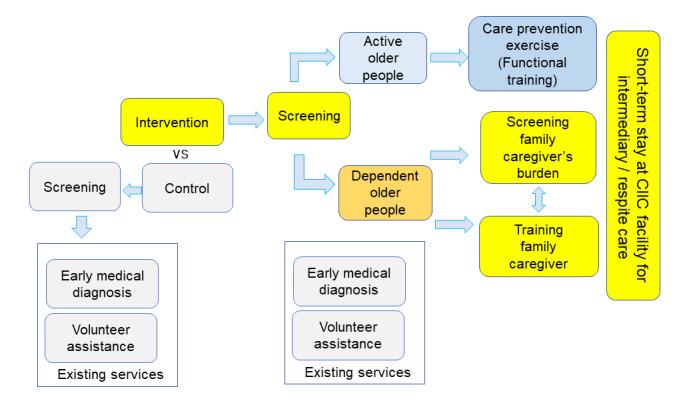
This paper describes a cluster randomized controlled trial comprised of 6 intervention clusters and 6 control clusters that aim to recruit 2000 participants in each arm. This research protocol has been approved by the World Health Organization Ethics Review Committee. The intervention clusters will receive an integrated model of care structured around (1) a community respite service, (2) the strengthening of family care capacity, and (3) an exercise program that aims to prevent entry into long-term care for older people. Control group clusters receive usual care (ie, the current system of long-term care common to all provinces in Thailand), consisting principally of a volunteer-assisted home care service. The trial will be conducted over a period of 2 years. The primary outcome is family caregiver burden measured at a 6-month follow-up, as measured by the Caregiver Burden Inventory. Secondary outcomes consist of biopsychosocial indicators including functional ability, as measured using an activity of daily living scale; depression, as measured by the Geriatric Depression Scale; and quality of life of older people, as measured by the EuroQol 5-dimensions 5-levels scale. Intention-to-treat analysis will be followed.
RESULTS
The CIIC facility has been established. Community care prevention programs have been launched at the intervention clusters. Family caregivers are receiving training and assistance. However, the COVID-19 pandemic delayed the intervention.
CONCLUSIONS
Since ASEAN and many Asian countries share similar traditional family-based, long-term care systems, the proposed CIIC model and the protocol for its implementation and evaluation may benefit other countries wishing to adopt similar community-integrated care models for older people at risk of needing long-term care.
TRIAL REGISTRATION
Thai Clinical Trials Registry TCTR20190412004; http://www.thaiclinicaltrials.org/.
INTERNATIONAL REGISTERED REPORT IDENTIFIER (IRRID): DERR1-10.2196/20196.
背景
泰国是亚洲老龄化速度最快的国家之一。传统的家庭照料一直是大多数老年人照料的基础,但随着家庭规模变小,这种方式正变得难以为继。此外,女性往往受到不利影响,因为她们仍然是老年人照料者的主体,许多女性可能会为了提供照料而退出劳动力市场。许多家庭照料者也没有接受过培训或接受的培训很少,而他们可能需要提供相当复杂的照料,如果老年人仅依赖家人和朋友提供的非正式照料,那么接受不充分照料的老年人比例就会增加。面对非传染性疾病和与年龄相关的发病率不断增加的负担,泰国社区越来越需要能够将现有卫生系统联系起来并减轻照料家庭负担的老年人社区综合照料模式。东南亚国家联盟(东盟)的许多国家都有这种需求。
目的
在本研究中,我们旨在评估社区综合中间照料(CIIC)模式增强家庭对老年人照料的有效性。
方法
本文描述了一项整群随机对照试验,包括6个干预组和6个对照组,每组旨在招募2000名参与者。本研究方案已获得世界卫生组织伦理审查委员会的批准。干预组将接受围绕以下方面构建的综合照料模式:(1)社区喘息服务;(2)增强家庭照料能力;(3)一项旨在防止老年人进入长期照料机构的锻炼计划。对照组接受常规照料(即泰国所有省份通用的现行长期照料系统),主要包括志愿者协助的居家照料服务。试验将持续2年。主要结局是在6个月随访时通过照料者负担量表测量的家庭照料者负担。次要结局包括生物心理社会指标,包括使用日常生活活动量表测量的功能能力;使用老年抑郁量表测量的抑郁;以及使用欧洲五维度五水平量表测量的老年人生活质量。将采用意向性分析。
结果
CIIC设施已建立。干预组已启动社区照料预防计划。家庭照料者正在接受培训和获得协助。然而,新冠疫情推迟了干预。
结论
由于东盟和许多亚洲国家有着类似的传统家庭式长期照料系统,所提议的CIIC模式及其实施和评估方案可能会使其他希望为有长期照料需求风险的老年人采用类似社区综合照料模式的国家受益。
试验注册
泰国临床试验注册中心TCTR20190412004;http://www.thaiclinicaltrials.org/。
国际注册报告识别码(IRRID):DERR1-10.2196/20196。


 Zotero 插件