
干预措施对减少痴呆患者抑郁症状的疗效比较:系统评价和网络荟萃分析。
Comparative efficacy of interventions for reducing symptoms of depression in people with dementia: systematic review and network meta-analysis.
机构信息
Knowledge Translation Program, Li Ka Shing Knowledge Institute, St Michael's Hospital, Toronto, ON, Canada
Division of Geriatric Medicine, Department of Medicine, University of Toronto, Toronto, ON, Canada.
出版信息
BMJ. 2021 Mar 24;372:n532. doi: 10.1136/bmj.n532.
OBJECTIVE
To describe the comparative efficacy of drug and non-drug interventions for reducing symptoms of depression in people with dementia who experience depression as a neuropsychiatric symptom of dementia or have a diagnosis of a major depressive disorder.
DESIGN
Systematic review and meta-analysis.
DATA SOURCES
Medline, Embase, the Cochrane Library, CINAHL, PsycINFO, and grey literature between inception and 15 October 2020.
ELIGIBILITY CRITERIA FOR STUDY SELECTION
Randomised trials comparing drug or non-drug interventions with usual care or any other intervention targeting symptoms of depression in people with dementia.
MAIN OUTCOME MEASURES
Pairs of reviewers screened studies, abstracted aggregate level data, and appraised risk of bias with the Cochrane risk of bias tool, which facilitated the derivation of standardised mean differences and back transformed mean differences (on the Cornell scale for depression in dementia) from bayesian random effects network meta-analyses and pairwise meta-analyses.
RESULTS
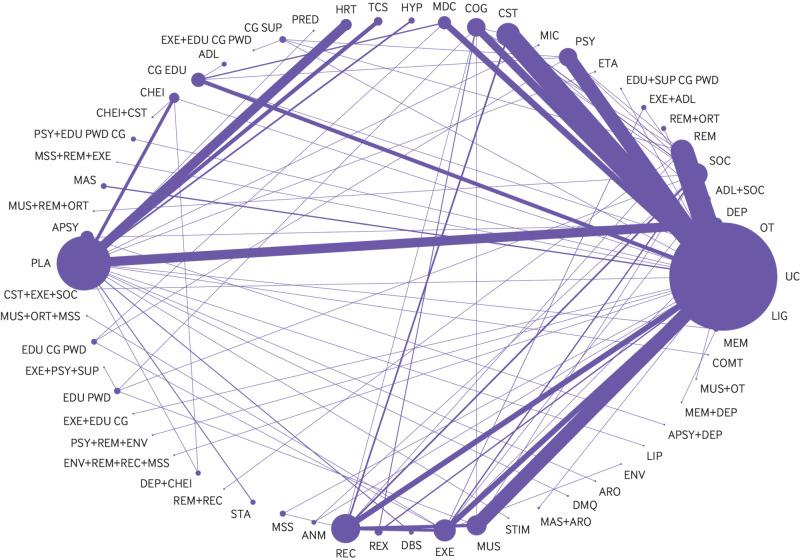
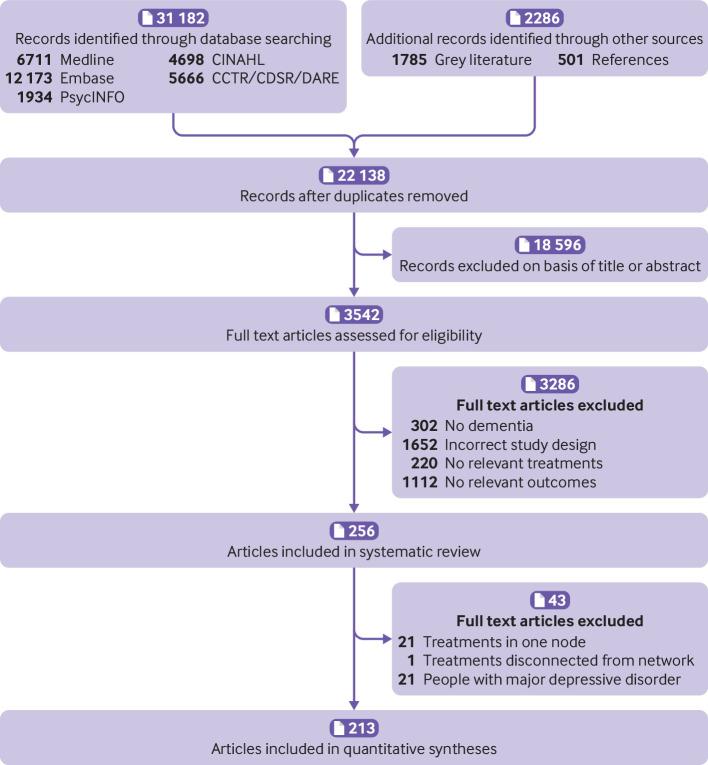
Of 22 138 citations screened, 256 studies (28 483 people with dementia) were included. Missing data posed the greatest risk to review findings. In the network meta-analysis of studies including people with dementia without a diagnosis of a major depressive disorder who were experiencing symptoms of depression (213 studies; 25 177 people with dementia; between study variance 0.23), seven interventions were associated with a greater reduction in symptoms of depression compared with usual care: cognitive stimulation (mean difference -2.93, 95% credible interval -4.35 to -1.52), cognitive stimulation combined with a cholinesterase inhibitor (-11.39, -18.38 to -3.93), massage and touch therapy (-9.03, -12.28 to -5.88), multidisciplinary care (-1.98, -3.80 to -0.16), occupational therapy (-2.59, -4.70 to -0.40), exercise combined with social interaction and cognitive stimulation (-12.37, -19.01 to -5.36), and reminiscence therapy (-2.30, -3.68 to -0.93). Except for massage and touch therapy, cognitive stimulation combined with a cholinesterase inhibitor, and cognitive stimulation combined with exercise and social interaction, which were more efficacious than some drug interventions, no statistically significant difference was found in the comparative efficacy of drug and non-drug interventions for reducing symptoms of depression in people with dementia without a diagnosis of a major depressive disorder. Clinical and methodological heterogeneity precluded network meta-analysis of studies comparing the efficacy of interventions specifically for reducing symptoms of depression in people with dementia and a major depressive disorder (22 studies; 1829 patients).
CONCLUSIONS
In this systematic review, non-drug interventions were found to be more efficacious than drug interventions for reducing symptoms of depression in people with dementia without a major depressive disorder.
SYSTEMATIC REVIEW REGISTRATION
PROSPERO CRD42017050130.
目的
描述药物和非药物干预措施在减轻痴呆患者抑郁症状方面的比较疗效,这些患者的抑郁症状是痴呆的神经精神症状,或患有重度抑郁症。
设计
系统评价和荟萃分析。
数据来源
从建库到 2020 年 10 月 15 日,在 Medline、Embase、Cochrane 图书馆、CINAHL、PsycINFO 和灰色文献中检索。
纳入研究的标准
比较药物或非药物干预与常规护理或任何其他针对痴呆患者抑郁症状的干预措施的疗效的随机试验。
主要观察指标
使用 Cochrane 偏倚风险工具对研究进行双盲筛选、提取汇总水平数据,并评估偏倚风险,这有助于从贝叶斯随机效应网络荟萃分析和成对荟萃分析中得出标准化均数差值和逆转换均数差值(在康奈尔痴呆抑郁量表上)。
结果
从 22138 条筛选的引文来看,共有 256 项研究(28483 名痴呆患者)被纳入。数据缺失对综述结果的风险最大。在包括没有重度抑郁症诊断但出现抑郁症状的痴呆患者的研究的网络荟萃分析中(213 项研究;25177 名痴呆患者;研究间方差为 0.23),与常规护理相比,七种干预措施与抑郁症状的减轻相关:认知刺激(平均差异-2.93,95%可信区间-4.35 至-1.52),认知刺激联合胆碱酯酶抑制剂(-11.39,-18.38 至-3.93),按摩和触摸疗法(-9.03,-12.28 至-5.88),多学科护理(-1.98,-3.80 至-0.16),职业疗法(-2.59,-4.70 至-0.40),锻炼联合社交互动和认知刺激(-12.37,-19.01 至-5.36),以及怀旧疗法(-2.30,-3.68 至-0.93)。除了按摩和触摸疗法、认知刺激联合胆碱酯酶抑制剂以及认知刺激联合锻炼和社交互动之外,这些干预措施比一些药物干预措施更有效,在没有重度抑郁症诊断的痴呆患者中,药物和非药物干预措施减轻抑郁症状的疗效没有统计学差异。临床和方法学的异质性排除了专门比较减轻痴呆和重度抑郁症患者抑郁症状的干预措施疗效的网络荟萃分析(22 项研究;1829 名患者)。
结论
在这项系统评价中,与药物干预相比,非药物干预措施更能有效减轻无重度抑郁症诊断的痴呆患者的抑郁症状。
系统评价注册
PROSPERO CRD42017050130。

 Zotero 插件