
无回报的腐生兰花中的贝氏拟态。
Batesian mimicry in the nonrewarding saprophytic orchid .
作者信息
Luo Huolin, Xiao Hanwen, Liang Yuelong, Liu Nannan, Turner Cassidy, Tan Shaolin, Chen Xinghui, Xiong Dongjin, Yang Boyun
机构信息
Jiangxi Key Laboratory of Plant Resources School of Life Science Nanchang University Nanchang China.
Jiangxi Jiulianshan National Nature Reserve Ganzhou China.
出版信息
Ecol Evol. 2021 Mar 3;11(6):2524-2534. doi: 10.1002/ece3.7193. eCollection 2021 Mar.
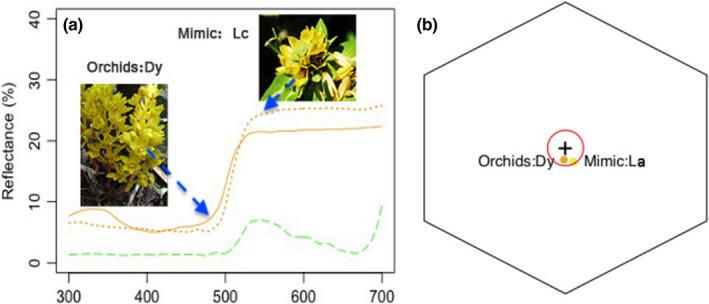
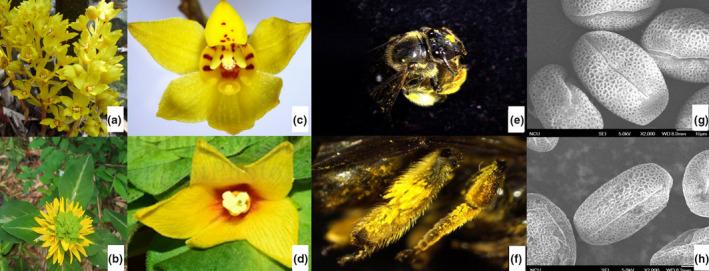
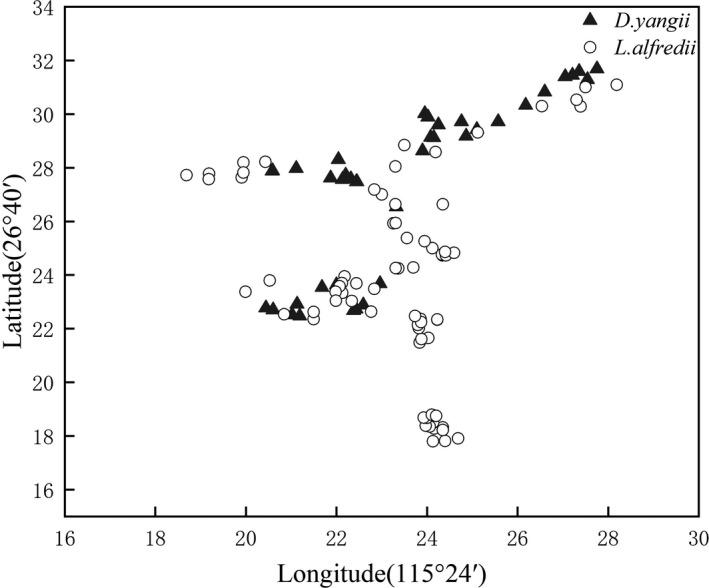
Batesian mimicry, a type of deceptive pollination, is a complicated strategy used by nonrewarding plants to attract pollinators, but some hypotheses concerning this have not been systematically verified. In order to show in detail a case of Batesian mimicry on saprophytic orchid , the ecological relationship between , and spp. was explored. could provide a reward to sp., whereas not. The floral morphology and geographical distribution of these two plants were highly overlapping, and the fruit set rate of was significantly positively correlated with the number of nearby individuals. In a glass cylinder experiment, and attracted spp. through visual signals, but the insect could not distinguish between flowers of the two plants before landing on flowers. The ultraviolet reflection spectra of flowers between the two plant species were highly similar. In the hexagonal color models constructed according to the visual characteristics of bees, the flower color signals of these two plant species highly overlap, indicating that the visual signals of the flowers of the two plants to the pollinator were greatly similar. All of these results provided evidence that simulated the visual signals of through Batesian mimicry, thereby deceptively attracting spp.
贝氏拟态是一种欺骗性传粉方式,是无回报植物用来吸引传粉者的复杂策略,但关于此的一些假说尚未得到系统验证。为了详细展示腐生兰花的贝氏拟态案例,探究了[植物A]、[植物B]和[传粉者物种]之间的生态关系。[植物A]能为[传粉者物种]提供回报,而[植物B]不能。这两种植物的花形态和地理分布高度重叠,[植物B]的坐果率与附近[植物A]个体数量显著正相关。在玻璃圆筒实验中,[植物A]和[植物B]通过视觉信号吸引[传粉者物种],但昆虫在落到花上之前无法区分这两种植物的花。这两个植物物种花的紫外反射光谱高度相似。在根据蜜蜂视觉特征构建的六边形颜色模型中,这两个植物物种的花色信号高度重叠,表明这两种植物的花对传粉者的视觉信号极为相似。所有这些结果都证明[植物B]通过贝氏拟态模拟了[植物A]的视觉信号,从而欺骗性地吸引了[传粉者物种]。

 Zotero 插件