
检测甲状腺乳头状癌低发生率种系启动子突变的新进展。
Advances in Detecting Low Prevalence Somatic Promoter Mutations in Papillary Thyroid Carcinoma.
机构信息
Genetic Bases of Thyroid Tumors Laboratory, Department of Morphology and Genetics, Division of Genetics, Universidade Federal de São Paulo, São Paulo, Brazil.
Repare DNA Laboratory, Biomedical Sciences Institute, Universidade de São Paulo, São Paulo, Brazil.
出版信息
Front Endocrinol (Lausanne). 2021 Mar 12;12:643151. doi: 10.3389/fendo.2021.643151. eCollection 2021.
BACKGROUND
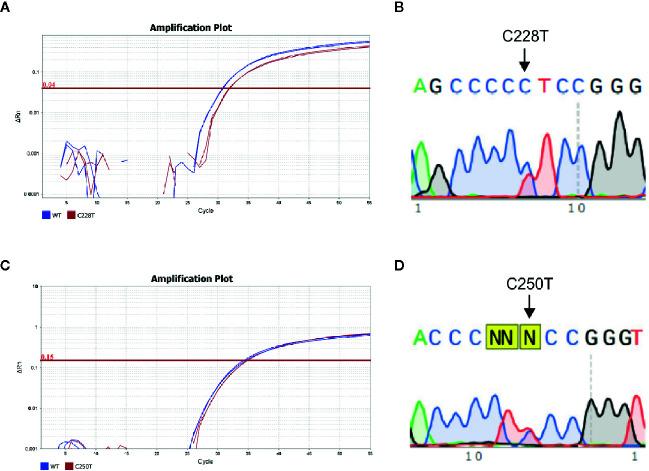
Two recurrent (telomerase reverse transcriptase) promoter mutations, C228T and C250T, have been reported in thyroid carcinomas and were correlated with high-risk clinicopathological features and a worse prognosis. Although far more frequent in the poorly differentiated and undifferentiated thyroid cancer, the promoter mutations play a significant role on PTC recurrence and disease-specific mortality. However, the prevalence varies considerably through studies and it is uncertain if these differences are due to population variation or the methodology used to detect mutations. In this study we aim to compare three different strategies to detect promoter mutations in PTC.
METHODS
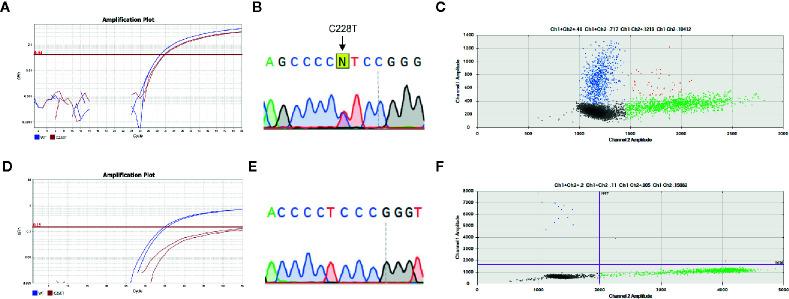
DNA was isolated from formalin-fixed paraffin-embedded (FFPE) specimens from 89 PTC and 40 paired lymph node metastases. The prevalence of the hot spot C228T and C250T mutations was assessed in FFPE samples using TaqMan SNP genotyping assays. Random samples were tested by Sanger Sequencing and droplet digital PCR (ddPCR).
RESULTS
In general, 16 out of 89 (18%) PTC samples and 14 out of 40 (35%) lymph node metastases harbored promoter mutations by TaqMan assay. Sanger sequencing, performed in random selected samples, failed to detect mutations in four samples that were positive by TaqMan SNP genotyping assay. Remarkably, ddPCR assay allowed detection of promoter mutations in six samples that harbor very low mutant allele frequency (≤ 2%) and were negative by both genotype assay and Sanger Sequencing.
CONCLUSION
This study observed a good concordance among the methodologies used to detect promoter mutations when a high percentage of mutated alleles was present. Sanger analysis demonstrated a limit of detection for mutated alleles. Therefore, the prevalence of promoter mutations in PTC may be higher than previously reported, since most studies have conventionally used Sanger sequencing. The efficient characterization of genetic alterations that are used as preoperative or postoperative diagnostic, risk stratification of the patient and individualized treatment decisions, mainly in highly heterogeneous tumors, require highly sensitive and specific approaches.
背景
已报道甲状腺癌中存在两个常见的(端粒酶逆转录酶)启动子突变,C228T 和 C250T,它们与高危临床病理特征和较差的预后相关。尽管在低分化和未分化甲状腺癌中更为常见,但启动子突变在 PTC 的复发和疾病特异性死亡率方面起着重要作用。然而,通过研究发现其患病率差异很大,目前尚不确定这些差异是由于人群变异还是用于检测突变的方法不同。在这项研究中,我们旨在比较三种不同的策略来检测 PTC 中的启动子突变。
方法
从 89 例 PTC 和 40 例配对的淋巴结转移的福尔马林固定石蜡包埋(FFPE)标本中提取 DNA。使用 TaqMan SNP 基因分型检测在 FFPE 样本中评估热点 C228T 和 C250T 突变的患病率。随机样本通过 Sanger 测序和液滴数字 PCR(ddPCR)进行测试。
结果
总体而言,TaqMan 检测到 89 例 PTC 样本中的 16 例(18%)和 40 例淋巴结转移中的 14 例(35%)存在启动子突变。在随机选择的样本中进行的 Sanger 测序未能检测到 TaqMan SNP 基因分型检测呈阳性的四个样本中的突变。值得注意的是,ddPCR 检测法能够检测到六个样本中的启动子突变,这些样本中的突变等位基因频率非常低(≤2%),并且 TaqMan 基因分型检测和 Sanger 测序均为阴性。
结论
当存在大量突变等位基因时,本研究观察到用于检测启动子突变的方法之间具有良好的一致性。Sanger 分析显示突变等位基因的检测限。因此,由于大多数研究通常使用 Sanger 测序,因此 PTC 中启动子突变的患病率可能高于先前报道的。遗传改变的有效特征,这些改变被用作术前或术后诊断、患者风险分层和个体化治疗决策,主要是在高度异质肿瘤中,需要高度敏感和特异的方法。

 Zotero 插件