
《25 岁的民主南非——青少年健康的社会和结构性决定因素的概念框架和叙事综述》
Democratic South Africa at 25 - a conceptual framework and narrative review of the social and structural determinants of adolescent health.
机构信息
School of Public Health, University of the Western Cape, Bellville, South Africa.
出版信息
Global Health. 2021 Mar 29;17(1):35. doi: 10.1186/s12992-021-00679-3.
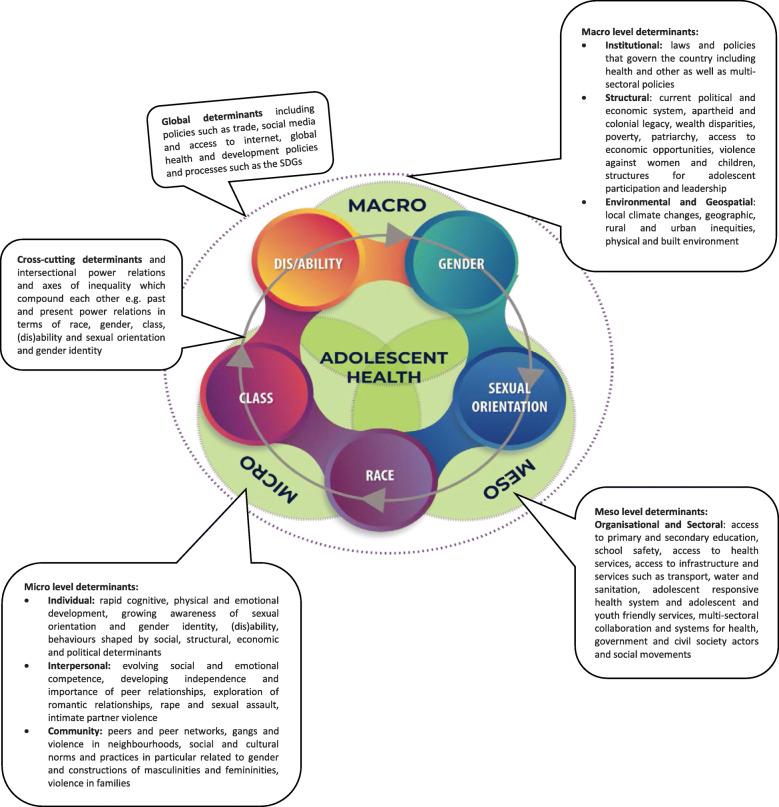
Twenty-five years into South Africa's constitutional democracy provides an opportunity to take stock of the social and structural determinants of adolescent health. Those born in democratic South Africa, commonly known as the 'Born Frees', are perceived to be able to realise equal rights and opportunities, yet many factors constrain their lives. In bringing together approaches to understanding context in health policy and systems research and the social determinants of health, the paper develops a conceptual framework to guide the narrative review examining the key contextual social and structural determinants of adolescent health in South Africa. Illustrative examples drawing from 65 papers from public health and the social sciences describe and link these determinants across micro, meso and macro levels of society, their global determinants, and their intersections with compounding axes of power and inequality.At a micro level individual adolescent sexual and gender identities are expressed through multiple and evolving forms, while they experience growing autonomy and agency, they do so within a broader context characterised by regressive social norms, gender inequality and other intersecting power relationships. At the meso level, organisational and sectoral determinants shape adolescents health and rights, both in being supportive, but they also replicate the biases and inequalities that characterise South African society. In addition, the macro level national and global determinants, such as the structural colonial and apartheid legacies, shape adolescents' health. Despite constitutional and other legislative rights, these determinants and compound economic, geographic, gender and other intersecting inequalities.A key finding is that current experiences and health of adolescents is shaped by past social and structural determinants and power relations, with apartheid inequalities still echoing in the lives of the adolescents, 25 years into democracy. More research and work is needed to provide insights into determinants of adolescent health beyond just the micro level, but also at the interrelated and dynamic meso and macro levels, nested in global determinants. The findings raise critical considerations and implications for understanding the social and structural determinants in the South African context and what this means for adolescent health in the SDG era.
二十五年来,南非的宪法民主为评估青少年健康的社会和结构决定因素提供了机会。那些在民主南非出生的人,通常被称为“自由人”,被认为能够实现平等的权利和机会,但许多因素限制了他们的生活。本文将健康政策和系统研究中的理解背景的方法以及健康的社会决定因素结合起来,提出了一个概念框架,以指导对南非青少年健康的主要背景社会和结构决定因素的叙述性评论。从公共卫生和社会科学的 65 篇论文中提取的说明性示例描述并在微观、中观和宏观社会层面、其全球决定因素以及与权力和不平等交织的轴的交叉点上联系了这些决定因素。在微观层面上,青少年的个人性别认同通过多种不断发展的形式表现出来,而他们在体验到更大的自主权和能动性的同时,也是在一个以倒退的社会规范、性别不平等和其他权力关系交织为特征的更广泛背景下进行的。在中观层面上,组织和部门决定因素影响青少年的健康和权利,既有支持性的,也有复制南非社会特征的偏见和不平等。此外,宏观层面的国家和全球决定因素,如结构上的殖民和种族隔离遗产,也影响着青少年的健康。尽管有宪法和其他立法权利,但这些决定因素和复杂的经济、地理、性别和其他交织的不平等现象仍然影响着青少年的健康。一个关键的发现是,当前青少年的经历和健康状况受到过去的社会和结构决定因素和权力关系的影响,种族隔离的不平等现象在民主 25 年后仍在青少年的生活中回响。需要更多的研究和工作来深入了解青少年健康的决定因素,不仅要了解微观层面,还要了解相互关联和动态的中观和宏观层面,并将其嵌套在全球决定因素中。这些发现提出了一些关键的考虑因素和启示,有助于理解南非背景下的社会和结构决定因素,以及这对可持续发展目标时代的青少年健康意味着什么。
 Zotero 插件