
谁(以及谁没有)在 COVID-19 大流行期间接受远程医疗护理。
Who Is (and Is Not) Receiving Telemedicine Care During the COVID-19 Pandemic.
机构信息
RAND Corporation, Santa Monica, California.
RAND Corporation, Boston, Massachusetts.
出版信息
Am J Prev Med. 2021 Sep;61(3):434-438. doi: 10.1016/j.amepre.2021.01.030. Epub 2021 Mar 6.
INTRODUCTION
The COVID-19 pandemic has forced telehealth to be the primary means through which patients interact with their providers. There is a concern that the pandemic will exacerbate the existing disparities in overall healthcare utilization and telehealth utilization. Few national studies have examined the changes in telehealth use during the COVID-19 pandemic.
METHODS
Data on 6.8 and 6.4 million employer-based health plan beneficiaries in 2020 and 2019, respectively, were collected in 2020. Unadjusted rates were compared both before and after the week of the declaration of the COVID-19 pandemic as a national emergency. Trends in weekly utilization were also examined using a difference-in-differences regression framework to quantify the changes in telemedicine and office-based care utilization while controlling for the patient's demographic and county-level sociodemographic measures. All analyses were conducted in 2020.
RESULTS
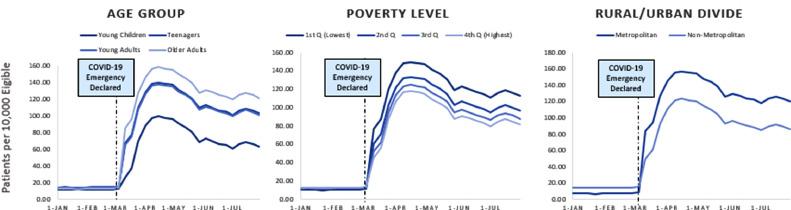
More than a 20-fold increase in the incidence of telemedicine utilization after March 13, 2020 was observed. Conversely, the incidence of office-based encounters declined by almost 50% and was not fully offset by the increase in telemedicine. The increase in telemedicine was greatest among patients in counties with low poverty levels (β=31.70, 95% CI=15.17, 48.23), among patients in metropolitan areas (β=40.60, 95% CI=30.86, 50.34), and among adults than among children aged 0-12 years (β=57.91, 95% CI=50.32, 65.49).
CONCLUSIONS
The COVID-19 pandemic has affected telehealth utilization disproportionately on the basis of patient age and both the county-level poverty rate and urbanicity.
简介
COVID-19 大流行迫使远程医疗成为患者与医疗服务提供者互动的主要方式。人们担心大流行将加剧整体医疗保健利用和远程医疗利用方面现有的差异。很少有全国性研究调查 COVID-19 大流行期间远程医疗使用的变化。
方法
2020 年收集了 2020 年和 2019 年分别有 680 万和 640 万雇主健康计划受益人的数据。在宣布 COVID-19 大流行成为全国紧急状态前后,分别比较了未经调整的使用率。使用差异中的差异回归框架检查了每周利用情况的趋势,以量化远程医疗和基于办公室的护理利用的变化,同时控制患者的人口统计学和县级社会人口统计学措施。所有分析均于 2020 年进行。
结果
观察到 2020 年 3 月 13 日之后远程医疗利用率的发生率增加了 20 多倍。相反,基于办公室的就诊次数下降了近 50%,并且没有被远程医疗的增加完全抵消。在贫困水平低的县(β=31.70,95%CI=15.17,48.23),大都市地区(β=40.60,95%CI=30.86,50.34)的患者以及成年人中,远程医疗的增加最大,而不是 0-12 岁的儿童(β=57.91,95%CI=50.32,65.49)。
结论
COVID-19 大流行根据患者年龄以及县贫困率和城市化程度,对远程医疗的利用产生了不成比例的影响。
 Zotero 插件