
肺保护性机械通气用于行腹部腹腔镜手术的患者:一项随机对照试验。
Lung-protective mechanical ventilation for patients undergoing abdominal laparoscopic surgeries: a randomized controlled trial.
机构信息
Center of Emergency, Critical Care Medicine and Clinical Toxicology, 103 Military Hospital, Vietnam Military Medical University, 261 Phung Hung road, Ha Dong District, Hanoi City, Vietnam.
Critical Care Unit, National Burn Hospital, Vietnam Military Medical University, Hanoi, Vietnam.
出版信息
BMC Anesthesiol. 2021 Mar 30;21(1):95. doi: 10.1186/s12871-021-01318-5.
BACKGROUND
Pneumoperitoneum and Trendelenburg position in laparoscopic surgeries could contribute to postoperative pulmonary dysfunction. In recent years, intraoperative lung-protective mechanical ventilation (LPV) has been reportedly able to attenuate ventilator-induced lung injuries (VILI). Our objectives were to test the hypothesis that LPV could improve intraoperative oxygenation function, pulmonary mechanics and early postoperative atelectasis in laparoscopic surgeries.
METHODS
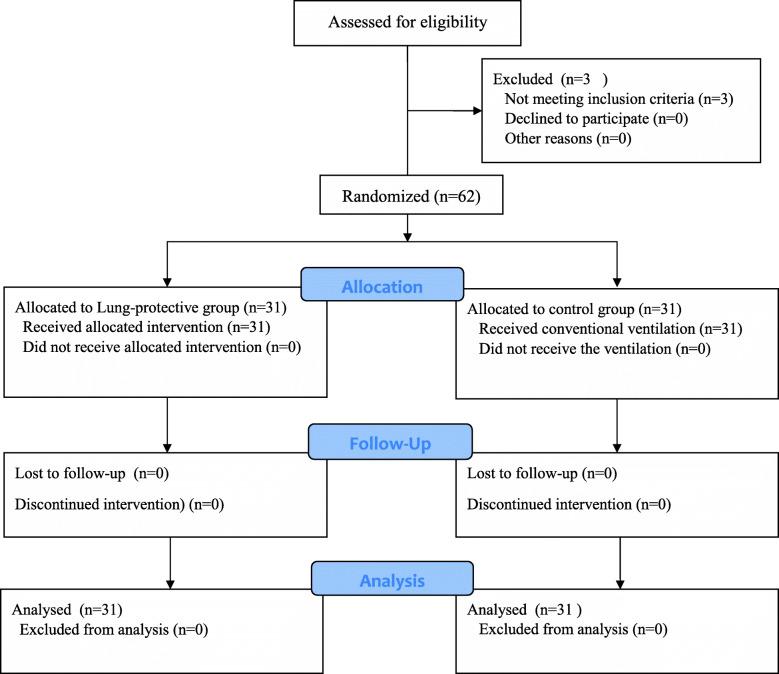
In this randomized controlled clinical trial, 62 patients indicated for elective abdominal laparoscopic surgeries with an expected duration of greater than 2 h were randomly assigned to receive either lung-protective ventilation (LPV) with a tidal volume (Vt) of 7 ml kg ideal body weight (IBW), 10 cmHO positive end-expiratory pressure (PEEP) combined with regular recruitment maneuvers (RMs) or conventional ventilation (CV) with a Vt of 10 ml kg IBW, 0 cmHO in PEEP and no RMs. The primary endpoints were the changes in the ratio of PaO to FiO (P/F). The secondary endpoints were the differences between the two groups in PaO, alveolar-arterial oxygen gradient (A-aO), intraoperative pulmonary mechanics and the incidence of atelectasis detected on chest x-ray on the first postoperative day.
RESULTS
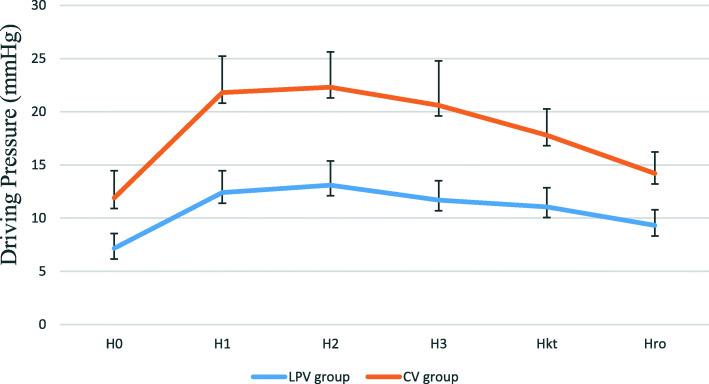
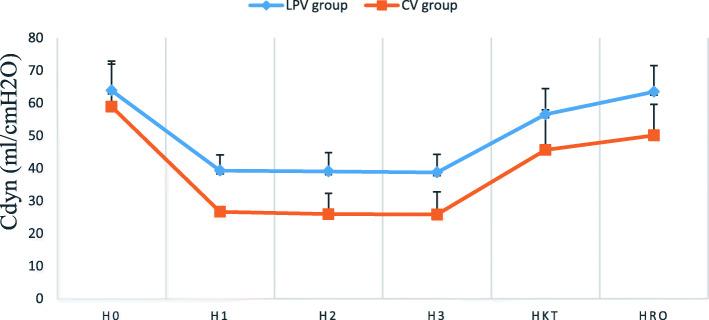
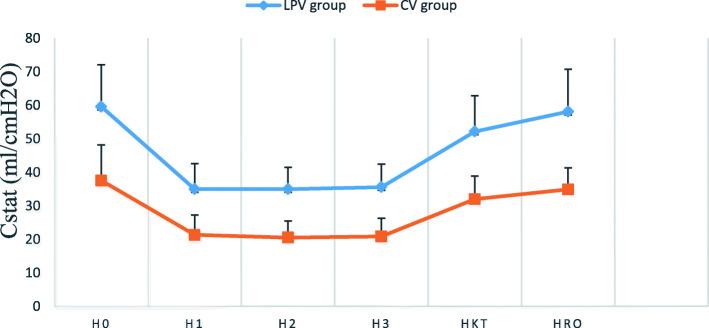
In comparison to CV group, the intraoperative P/F and PaO in LPV group were significantly higher while the intraoperative A-aO was clearly lower. C and C at all the intraoperative time points in LPV group were significantly higher compared to CV group (p < 0.05). There were no differences in the incidence of atelectasis on day one after surgery between the two groups.
CONCLUSIONS
Lung protective mechanical ventilation significantly improved intraoperative pulmonary oxygenation function and pulmonary compliance in patients experiencing various abdominal laparoscopic surgeries, but it could not ameliorate early postoperative atelectasis and oxygenation function on the first day after surgery.
TRIAL REGISTRATION
https://www.clinicaltrials.gov/identifier: NCT04546932 (09/05/2020).
背景
腹腔镜手术中的气腹和头低位可能导致术后肺功能障碍。近年来,术中肺保护性机械通气(LPV)据称能够减轻呼吸机引起的肺损伤(VILI)。我们的目的是验证 LPV 能够改善腹腔镜手术中的术中氧合功能、肺力学和术后早期肺不张的假设。
方法
在这项随机对照临床试验中,将 62 名接受择期腹部腹腔镜手术的患者,预计手术时间超过 2 小时,随机分为肺保护性通气(LPV)组,潮气量(Vt)为 7ml/kg 理想体重(IBW),10cmH2O 呼气末正压(PEEP),并结合常规复张手法(RM),或常规通气(CV)组,Vt 为 10ml/kg IBW,PEEP 为 0cmH2O,无 RM。主要终点是 PaO 与 FiO 的比值(P/F)的变化。次要终点是两组间 PaO、肺泡-动脉氧梯度(A-aO)、术中肺力学以及术后第一天胸部 X 线片上肺不张的发生率的差异。
结果
与 CV 组相比,LPV 组术中 P/F 和 PaO 明显升高,而 A-aO 明显降低。LPV 组在所有术中时间点的 C 和 C 均明显高于 CV 组(p<0.05)。两组术后第一天肺不张的发生率无差异。
结论
肺保护性机械通气可显著改善接受各种腹部腹腔镜手术患者的术中肺氧合功能和肺顺应性,但不能改善术后第一天的早期肺不张和氧合功能。
试验注册
https://www.clinicaltrials.gov/identifier:NCT04546932(2020 年 9 月 5 日)。

 Zotero 插件