
足底跟痛管理:基于系统评价、专家临床推理和患者价值观的最佳实践指南。
Management of plantar heel pain: a best practice guide informed by a systematic review, expert clinical reasoning and patient values.
机构信息
Sports and Exercise Medicine, William Harvey Research Institute, Queen Mary University of London, London, UK
Physiotherapy Department, Barts Health NHS Trust, London, UK.
出版信息
Br J Sports Med. 2021 Oct;55(19):1106-1118. doi: 10.1136/bjsports-2019-101970. Epub 2021 Mar 30.
OBJECTIVE
To develop a best practice guide for managing people with plantar heel pain (PHP).
METHODS
Mixed-methods design including systematic review, expert interviews and patient survey.
DATA SOURCES
Medline, Embase, CINAHL, SPORTDiscus, Cochrane Central Register of Controlled Trials, trial registries, reference lists and citation tracking. Semi-structured interviews with world experts and a patient survey.
ELIGIBILITY CRITERIA
Randomised controlled trials (RCTs) evaluating any intervention for people with PHP in any language were included subject to strict quality criteria. Trials with a sample size greater than n=38 were considered for proof of efficacy. International experts were interviewed using a semi-structured approach and people with PHP were surveyed online.
RESULTS
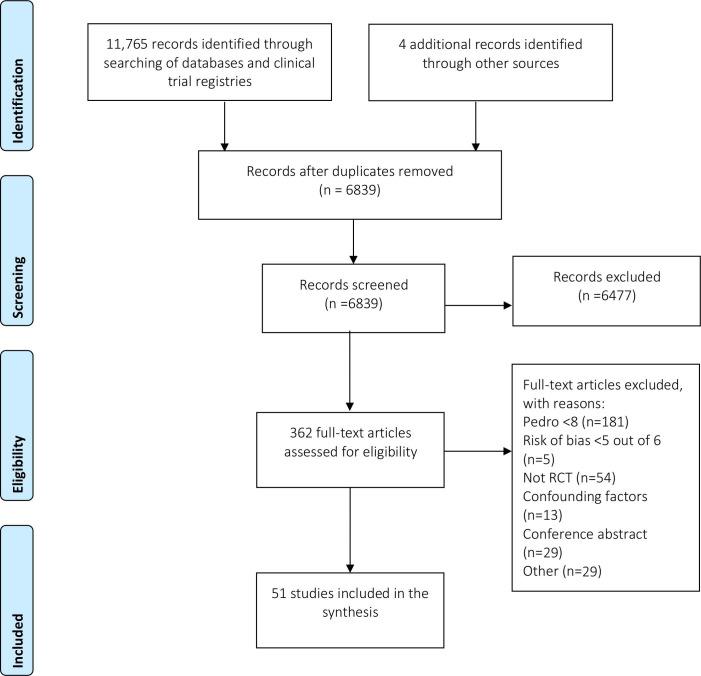
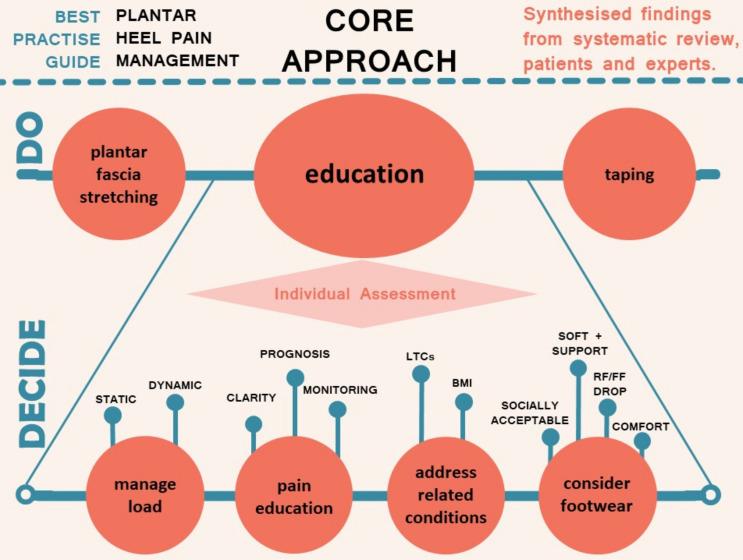
Fifty-one eligible trials enrolled 4351 participants, with 9 RCTs suitable to determine proof of efficacy for 10 interventions. Forty people with PHP completed the online survey and 14 experts were interviewed resulting in 7 themes and 38 subthemes. There was good agreement between the systematic review findings and interview data about taping (SMD: 0.47, 95% CI 0.05 to 0.88) and plantar fascia stretching (SMD: 1.21, 95% CI 0.78 to 1.63) for first step pain in the short term. Clinical reasoning advocated combining these interventions with education and footwear advice as the core self-management approach. There was good expert agreement with systematic review findings recommending stepped care management with focused shockwave for first step pain in the short-term (OR: 1.89, 95% CI 1.18 to 3.04), medium-term (SMD 1.31, 95% CI 0.61 to 2.01) and long-term (SMD 1.67, 95% CI 0.88 to 2.45) and radial shockwave for first step pain in the short term (OR: 1.66, 95% CI 1.00 to 2.76) and long term (OR: 1.78, 95% CI 1.07 to 2.96). We found good agreement to 'step care' using custom foot orthoses for general pain in the short term (SMD: 0.41, 95% CI 0.07 to 0.74) and medium term (SMD: 0.55, 95% CI 0.09 to 1.02).
CONCLUSION
Best practice from a mixed-methods study synthesising systematic review with expert opinion and patient feedback suggests core treatment for people with PHP should include taping, stretching and individualised education. Patients who do not optimally improve may be offered shockwave therapy, followed by custom orthoses.
目的
制定管理足底筋膜炎患者的最佳实践指南。
方法
采用系统评价、专家访谈和患者调查相结合的混合方法设计。
数据来源
Medline、Embase、CINAHL、SPORTDiscus、Cochrane 对照试验中心注册库、试验注册库、参考文献列表和引文追踪。对世界专家进行半结构化访谈,并对足底筋膜炎患者进行在线调查。
入选标准
纳入任何语言评估足底筋膜炎患者任何干预措施的随机对照试验(RCT),但须符合严格的质量标准。对于样本量大于 n=38 的试验,考虑进行疗效证明。采用半结构化方法对国际专家进行访谈,并对足底筋膜炎患者进行在线调查。
结果
51 项符合条件的试验纳入了 4351 名参与者,其中 9 项 RCT 适合确定 10 项干预措施的疗效证明。40 名足底筋膜炎患者完成了在线调查,14 名专家接受了访谈,共产生 7 个主题和 38 个子主题。系统评价结果与访谈数据在短期第一阶段疼痛的贴扎(SMD:0.47,95%CI 0.05 至 0.88)和足底筋膜拉伸(SMD:1.21,95%CI 0.78 至 1.63)方面具有良好的一致性。临床推理主张将这些干预措施与教育和鞋类建议相结合,作为核心自我管理方法。系统评价结果与专家共识一致,推荐对短期第一阶段疼痛进行阶梯式护理管理,使用聚焦式冲击波(OR:1.89,95%CI 1.18 至 3.04)、中期(SMD 1.31,95%CI 0.61 至 2.01)和长期(SMD 1.67,95%CI 0.88 至 2.45)以及短期(OR:1.66,95%CI 1.00 至 2.76)和长期(OR:1.78,95%CI 1.07 至 2.96)使用径向冲击波。我们发现使用定制足矫形器对短期(SMD:0.41,95%CI 0.07 至 0.74)和中期(SMD:0.55,95%CI 0.09 至 1.02)一般疼痛进行“阶梯式护理”有良好的一致性。
结论
从系统评价与专家意见和患者反馈相结合的混合方法研究中得出的最佳实践建议,对于足底筋膜炎患者的核心治疗应包括贴扎、拉伸和个体化教育。如果患者不能得到最佳改善,可以考虑采用冲击波治疗,然后使用定制矫形器。

 Zotero 插件