
COVID-19 患者机械通气撤机后吸气肌训练:一项前瞻性对照临床研究。
Inspiratory muscle training for recovered COVID-19 patients after weaning from mechanical ventilation: A pilot control clinical study.
机构信息
Department of Surgery, College of Medicine, Prince Sattam Bin Abdulaziz University, Al-Kharj, Saudi Arabia.
Department of Anesthesia and Intensive Care, Faculty of Medicine, Al-Azhar University, Cairo, Egypt.
出版信息
Medicine (Baltimore). 2021 Apr 2;100(13):e25339. doi: 10.1097/MD.0000000000025339.
BACKGROUND
To the best of our knowledge, no studies have evaluated the effects of inspiratory muscle training (IMT) on recovered COVID-19 patients after weaning from mechanical ventilation. Therefore, this study assessed the efficacy of IMT on recovered COVID-19 patients following mechanical ventilation.
METHODS
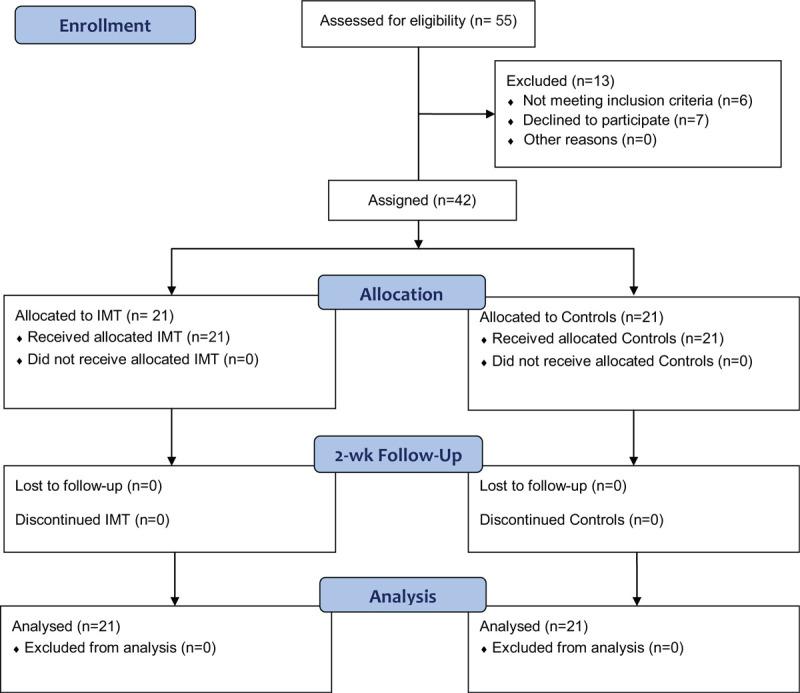
Forty-two recovered COVID-19 patients (33 men and 9 women) weaned from mechanical ventilation with a mean age of 48.05 ± 8.85 years were enrolled in this pilot control clinical study. Twenty-one patients were equipped to 2-week IMT (IMT group) and 21 matched peers were recruited as a control (control group). Forced vital capacity (FVC%), forced expiratory volume in 1 second (FEV1%), dyspnea severity index (DSI), quality of life (QOL), and six-minute walk test (6-MWT) were assessed initially before starting the study intervention and immediately after intervention.
RESULTS
Significant interaction effects were observed in the IMT when compared to control group, FVC% (F = 5.31, P = .041, ηP2 = 0.13), FEV1% (F = 4.91, P = .043, ηP2 = 0.12), DSI (F = 4.56, P = .032, ηP2 = 0.15), QOL (F = 6.14, P = .021, ηP2 = 0.17), and 6-MWT (F = 9.34, P = .028, ηP2 = 0.16). Within-group analysis showed a significant improvement in the IMT group (FVC%, P = .047, FEV1%, P = .039, DSI, P = .001, QOL, P < .001, and 6-MWT, P < .001), whereas the control group displayed nonsignificant changes (P > .05).
CONCLUSIONS
A 2-week IMT improves pulmonary functions, dyspnea, functional performance, and QOL in recovered intensive care unit (ICU) COVID-19 patients after consecutive weaning from mechanical ventilation. IMT program should be encouraged in the COVID-19 management protocol, specifically with ICU patients.
背景
据我们所知,尚无研究评估吸气肌训练(IMT)对机械通气撤机后的 COVID-19 康复患者的影响。因此,本研究评估了 IMT 对机械通气撤机后的 COVID-19 康复患者的疗效。
方法
本研究纳入了 42 例因 COVID-19 接受机械通气治疗后康复并撤机的患者(33 名男性和 9 名女性),平均年龄为 48.05±8.85 岁。其中 21 例患者接受了为期 2 周的 IMT(IMT 组),21 例匹配的患者作为对照组。在开始研究干预之前和干预后立即评估用力肺活量(FVC%)、1 秒用力呼气量(FEV1%)、呼吸困难严重指数(DSI)、生活质量(QOL)和 6 分钟步行试验(6-MWT)。
结果
与对照组相比,IMT 组出现了显著的交互效应,FVC%(F=5.31,P=0.041,ηP2=0.13)、FEV1%(F=4.91,P=0.043,ηP2=0.12)、DSI(F=4.56,P=0.032,ηP2=0.15)、QOL(F=6.14,P=0.021,ηP2=0.17)和 6-MWT(F=9.34,P=0.028,ηP2=0.16)。组内分析显示 IMT 组有显著改善(FVC%,P=0.047,FEV1%,P=0.039,DSI,P=0.001,QOL,P<0.001,6-MWT,P<0.001),而对照组无显著变化(P>0.05)。
结论
2 周的 IMT 可改善机械通气撤机后连续康复的 ICU COVID-19 患者的肺功能、呼吸困难、功能表现和生活质量。应在 COVID-19 管理方案中鼓励实施 IMT 方案,特别是对 ICU 患者。
 Zotero 插件