
采用改良 Delphi 法在成本效益模型中达成共识的相关对照:前列腺癌筛查的应用。
Using a Modified Delphi Approach to Gain Consensus on Relevant Comparators in a Cost-Effectiveness Model: Application to Prostate Cancer Screening.
机构信息
Health Economics Bristol (HEB), Population Health Sciences, Bristol Medical School, University of Bristol, 1-5 Whiteladies Road, Bristol, BS8 1NU, UK.
National Institute for Health Research (NIHR) Biomedical Research Centre at University Hospitals Bristol NHS Foundation Trust and the University of Bristol, Bristol, UK.
出版信息
Pharmacoeconomics. 2021 May;39(5):589-600. doi: 10.1007/s40273-021-01009-6. Epub 2021 Apr 2.
OBJECTIVE
Challenges can exist when framing the decision question in a cost-effectiveness analysis, particularly when there is disagreement among experts on relevant comparators. Using prostate cancer screening and recent developments in risk stratification, early-detection biomarkers, and diagnostic technologies as a case study, we report a modified Delphi approach to handle decision-question uncertainty.
METHODS
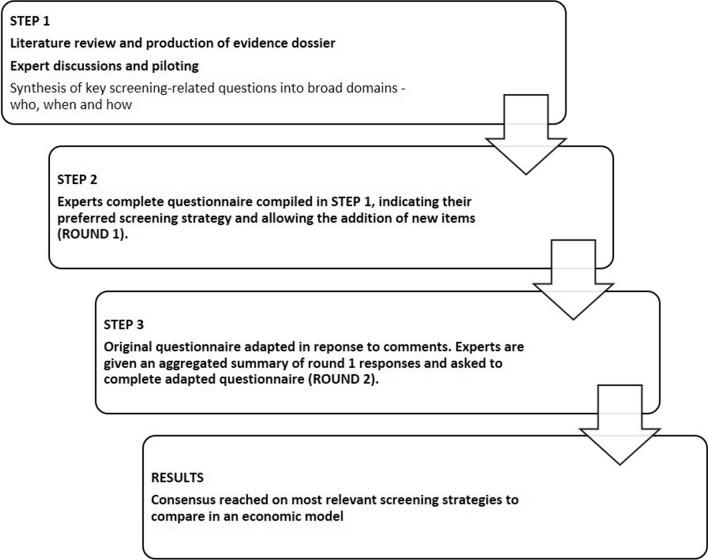
The study involved two rounds of anonymous online questionnaires to identify the prostate cancer screening strategies that international researchers, clinicians and decision makers felt important to consider in a cost-effectiveness model. Both purposive and snowball sampling were used to recruit experts. The questionnaire was based on a review of the literature and was piloted for language, comprehension and ease of use prior to dissemination. In Round 1, respondents indicated their preferred screening strategy (including no screening) through a series of multiple-choice questions. The responses informed a set of 13 consensus statements, which respondents ranked their agreement with on a 9-point Likert scale (Round 2). Consensus was considered reached if > 70% of participants indicated agreement and < 15% indicated disagreement.
RESULTS
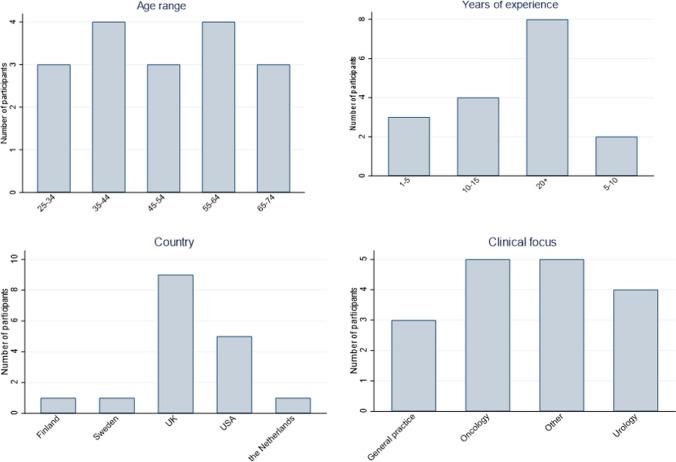
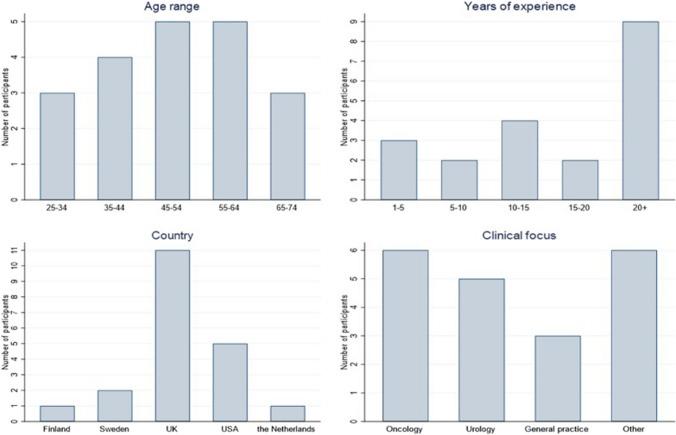
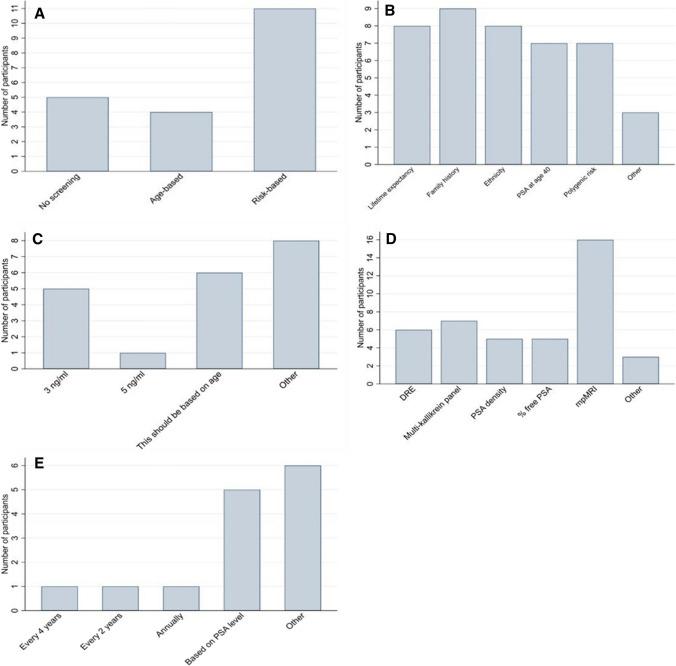
Twenty participants completed Round 1 and 17 completed Round 2. Consensus was shown towards comparing no formal screening, age-based, and risk-based strategies. The risk-based approaches included screening only higher-risk men, using shorter screening intervals for higher-risk men, screening higher-risk men at an earlier age, and tailoring screening intervals based on prostate-specific antigen (PSA) level at a previous test. There was agreement that inclusion of MRI in the pathway should be considered, but disagreement on the inclusion of new biomarkers.
CONCLUSION
In disease areas where technologies are rapidly evolving, a modified Delphi approach provides a useful tool to identify relevant comparators in an economic evaluation.
目的
在成本效益分析中构建决策问题时可能会存在挑战,尤其是在相关对照物方面存在专家意见分歧时。以前列腺癌筛查以及风险分层、早期检测生物标志物和诊断技术的最新进展为例,我们报告了一种修改后的德尔菲法来处理决策问题的不确定性。
方法
本研究共进行了两轮匿名在线问卷调查,以确定国际研究人员、临床医生和决策者认为在成本效益模型中需要考虑的前列腺癌筛查策略。采用有针对性和滚雪球抽样方法招募专家。该问卷基于文献综述,并在传播之前进行了语言、理解和易用性的试点测试。在第一轮中,通过一系列多项选择题,受访者表示他们首选的筛查策略(包括不筛查)。这些回答为一组 13 个共识声明提供了信息,受访者对这些声明的同意程度进行了 9 分李克特量表评分(第二轮)。如果>70%的参与者表示同意,<15%的参与者表示不同意,则认为达成了共识。
结果
20 名参与者完成了第一轮,17 名参与者完成了第二轮。对不进行正式筛查、基于年龄和基于风险的策略进行比较达成了共识。基于风险的方法包括仅对高风险男性进行筛查、对高风险男性缩短筛查间隔、对高风险男性更早进行筛查、以及根据前一次检测的前列腺特异性抗原(PSA)水平调整筛查间隔。有共识认为应考虑将 MRI 纳入该路径,但对纳入新的生物标志物存在分歧。
结论
在技术快速发展的疾病领域,修改后的德尔菲法为在经济评估中确定相关对照物提供了有用的工具。
 Zotero 插件