
含酮盐与不含酮盐的生酮饮食与低脂饮食的比较:超重成年人的肝脏脂肪反应
Comparison of Ketogenic Diets with and without Ketone Salts versus a Low-Fat Diet: Liver Fat Responses in Overweight Adults.
作者信息
Crabtree Christopher D, Kackley Madison L, Buga Alexandru, Fell Brandon, LaFountain Richard A, Hyde Parker N, Sapper Teryn N, Kraemer William J, Scandling Debbie, Simonetti Orlando P, Volek Jeff S
机构信息
Department of Human Sciences, The Ohio State University, Columbus, OH 43201, USA.
Dorothy M. Davis Heart & Lung Research Institute, The Ohio State University, Columbus, OH 43210, USA.
出版信息
Nutrients. 2021 Mar 17;13(3):966. doi: 10.3390/nu13030966.
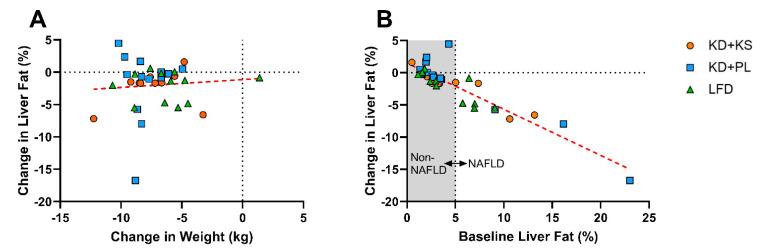
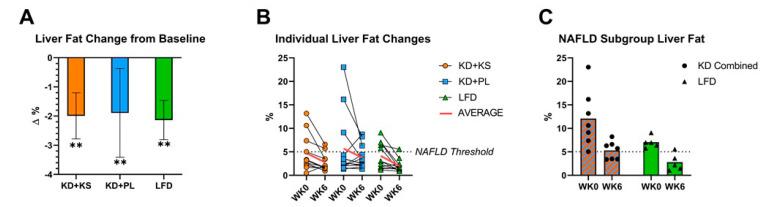
Ketogenic diets (KDs) often contain high levels of saturated fat, which may increase liver fat, but the lower carbohydrate intake may have the opposite effect. Using a controlled feeding design, we compared liver fat responses to a hypocaloric KD with a placebo (PL) versus an energy-matched low-fat diet (LFD) in overweight adults. We also examined the added effect of a ketone supplement (KS). Overweight adults were randomized to a 6-week KD (KD + PL) or a KD with KS (KD + KS); an LFD group was recruited separately. All diets were estimated to provide 75% of energy expenditure. Weight loss was similar between groups ( > 0.05). Liver fat assessed by magnetic resonance imaging decreased after 6 week ( = 0.004) with no group differences ( > 0.05). A subset with nonalcoholic fatty liver disease (NAFLD) (liver fat > 5%, = 12) showed a greater reduction in liver fat, but no group differences. In KD participants with NAFLD, 92% of the variability in change in liver fat was explained by baseline liver fat ( < 0.001). A short-term hypocaloric KD high in saturated fat does not adversely impact liver health and is not impacted by exogenous ketones. Hypocaloric low-fat and KDs can both be used in the short-term to significantly reduce liver fat in individuals with NAFLD.
生酮饮食(KDs)通常含有高水平的饱和脂肪,这可能会增加肝脏脂肪,但较低的碳水化合物摄入量可能会产生相反的效果。我们采用对照喂养设计,比较了超重成年人对低热量生酮饮食加安慰剂(PL)与能量匹配的低脂饮食(LFD)的肝脏脂肪反应。我们还研究了酮补充剂(KS)的附加作用。超重成年人被随机分为6周生酮饮食组(KD + PL)或生酮饮食加KS组(KD + KS);单独招募了一个低脂饮食组。所有饮食估计提供75%的能量消耗。各组之间体重减轻情况相似(P>0.05)。通过磁共振成像评估的肝脏脂肪在6周后下降(P = 0.004),且无组间差异(P>0.05)。患有非酒精性脂肪性肝病(NAFLD)(肝脏脂肪>5%,n = 12)的亚组肝脏脂肪减少幅度更大,但无组间差异。在患有NAFLD的生酮饮食参与者中,肝脏脂肪变化的92%的变异性可由基线肝脏脂肪解释(P<0.001)。短期的低热量、高饱和脂肪的生酮饮食不会对肝脏健康产生不利影响,也不受外源性酮的影响。低热量低脂饮食和生酮饮食在短期内均可用于显著降低NAFLD个体的肝脏脂肪。
 Zotero 插件