
药物性肝损伤(DILI)中的氧化应激:从机制到临床实践中使用的生物标志物
Oxidative Stress in Drug-Induced Liver Injury (DILI): From Mechanisms to Biomarkers for Use in Clinical Practice.
作者信息
Villanueva-Paz Marina, Morán Laura, López-Alcántara Nuria, Freixo Cristiana, Andrade Raúl J, Lucena M Isabel, Cubero Francisco Javier
机构信息
Unidad de Gestión Clínica de Gastroenterología, Servicio de Farmacología Clínica, Instituto de Investigación Biomédica de Málaga-IBIMA, Hospital Universitario Virgen de la Victoria, Universidad de Málaga, CIBERehd, 29071 Málaga, Spain.
Department of Immunology, Ophthalmology and ENT, Complutense University School of Medicine, 28040 Madrid, Spain.
出版信息
Antioxidants (Basel). 2021 Mar 5;10(3):390. doi: 10.3390/antiox10030390.
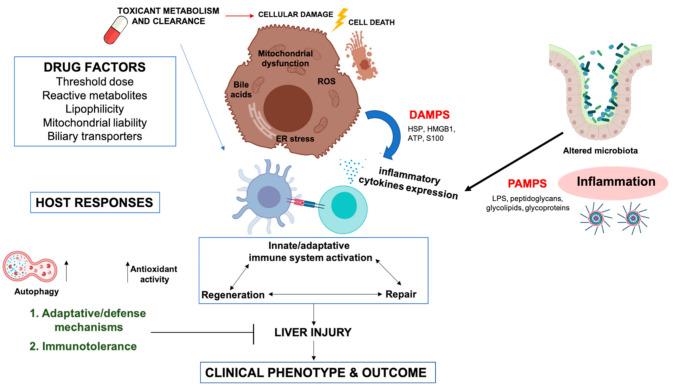
Idiosyncratic drug-induced liver injury (DILI) is a type of hepatic injury caused by an uncommon drug adverse reaction that can develop to conditions spanning from asymptomatic liver laboratory abnormalities to acute liver failure (ALF) and death. The cellular and molecular mechanisms involved in DILI are poorly understood. Hepatocyte damage can be caused by the metabolic activation of chemically active intermediate metabolites that covalently bind to macromolecules (e.g., proteins, DNA), forming protein adducts-neoantigens-that lead to the generation of oxidative stress, mitochondrial dysfunction, and endoplasmic reticulum (ER) stress, which can eventually lead to cell death. In parallel, damage-associated molecular patterns (DAMPs) stimulate the immune response, whereby inflammasomes play a pivotal role, and neoantigen presentation on specific human leukocyte antigen (HLA) molecules trigger the adaptive immune response. A wide array of antioxidant mechanisms exists to counterbalance the effect of oxidants, including glutathione (GSH), superoxide dismutase (SOD), catalase, and glutathione peroxidase (GPX), which are pivotal in detoxification. These get compromised during DILI, triggering an imbalance between oxidants and antioxidants defense systems, generating oxidative stress. As a result of exacerbated oxidative stress, several danger signals, including mitochondrial damage, cell death, and inflammatory markers, and microRNAs (miRNAs) related to extracellular vesicles (EVs) have already been reported as mechanistic biomarkers. Here, the status quo and the future directions in DILI are thoroughly discussed, with a special focus on the role of oxidative stress and the development of new biomarkers.
特异质性药物性肝损伤(DILI)是一种由罕见药物不良反应引起的肝损伤类型,其病情发展范围从无症状的肝脏实验室指标异常到急性肝衰竭(ALF)甚至死亡。目前对DILI所涉及的细胞和分子机制了解甚少。化学活性中间代谢产物的代谢活化可导致肝细胞损伤,这些代谢产物与大分子(如蛋白质、DNA)共价结合,形成蛋白质加合物——新抗原,进而导致氧化应激、线粒体功能障碍和内质网(ER)应激的产生,最终可能导致细胞死亡。与此同时,损伤相关分子模式(DAMPs)刺激免疫反应,其中炎性小体起关键作用,新抗原在特定人类白细胞抗原(HLA)分子上的呈递触发适应性免疫反应。存在多种抗氧化机制来抵消氧化剂的作用,包括谷胱甘肽(GSH)、超氧化物歧化酶(SOD)、过氧化氢酶和谷胱甘肽过氧化物酶(GPX),它们在解毒过程中起关键作用。在DILI过程中这些机制会受到损害,引发氧化剂和抗氧化剂防御系统之间的失衡,产生氧化应激。由于氧化应激加剧,一些危险信号,包括线粒体损伤、细胞死亡、炎症标志物以及与细胞外囊泡(EVs)相关的微小RNA(miRNAs)已被报道为机制性生物标志物。在此,将全面讨论DILI的现状和未来方向,特别关注氧化应激的作用以及新生物标志物的开发。
 Zotero 插件