
c-Cbl 基因敲除尽管不能完全阻断受体泛素化,但会减缓 EGFR 的内吞运输并增强 EGFR 信号。
Knockout of c-Cbl slows EGFR endocytic trafficking and enhances EGFR signaling despite incompletely blocking receptor ubiquitylation.
机构信息
Department of Pharmacology and Toxicology, University of Louisville, Louisville, KY, USA.
Department of Visual Science, University of Louisville, Louisville, KY, USA.
出版信息
Pharmacol Res Perspect. 2021 Apr;9(2):e00756. doi: 10.1002/prp2.756.
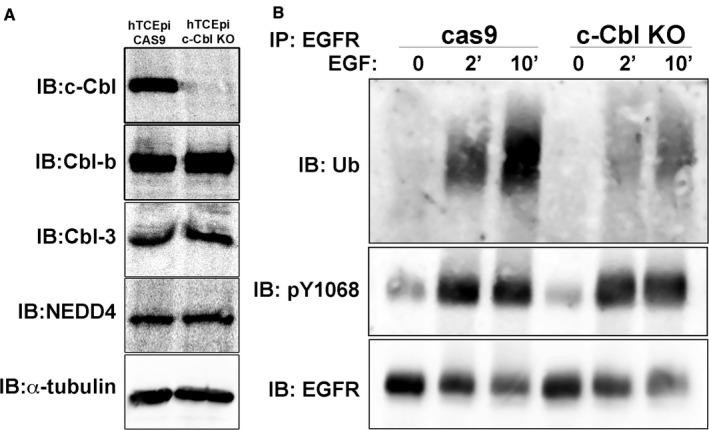
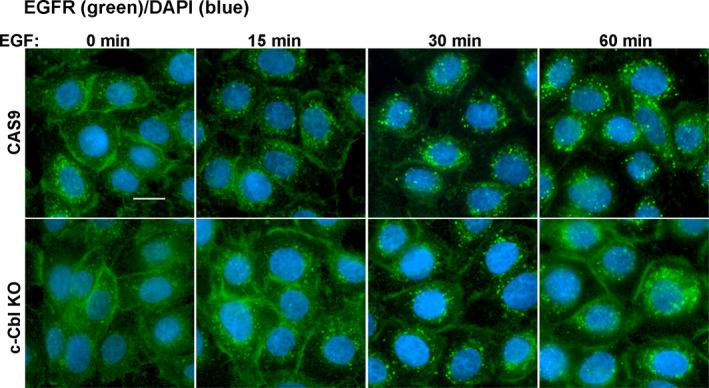
Epidermal growth factor receptor (EGFR) activity is necessary and sufficient for corneal epithelial homeostasis. However, the addition of exogenous Epidermal Growth Factor (EGF) does not reliably restore the corneal epithelium when wounded. This is likely due to high levels of endogenous EGF in tear fluid as well as desensitization of the EGFR following ligand stimulation. We hypothesize that preventing receptor downregulation is an alternative mechanism to enhance EGFR signaling and promote the restoration of compromised corneas. Ligand-dependent EGFR ubiquitylation is associated with the targeted degradation of the receptor. In this manuscript, we determine whether knockout of c-Cbl, an E3 ubiquitin ligase that ubiquitylates the EGFR, is sufficient to prolong EGFR phosphorylation and sustain signaling. Using CRISPR/Cas9 gene editing, we generated immortalized human corneal epithelial (hTCEpi) cells lacking c-Cbl. Knockout (KO) cells expressed the other E3 ligases at the same levels as the control cells, indicating other E3 ligases were not up-regulated. As compared to the control cells, EGF-stimulated EGFR ubiquitylation was reduced in KO cells, but not completely abolished. Similarly, EGF:EGFR trafficking was slowed, with a 35% decrease in the rate of endocytosis and a twofold increase in the receptor half-life. This resulted in a twofold increase in the magnitude of EGFR phosphorylation, with no change in duration. Conversely, Mitogen Activating Protein Kinase (MAPK) phosphorylation did not increase in magnitude but was sustained for 2-3 h as compared to control cells. We propose antagonizing c-Cbl will partially alter receptor ubiquitylation and endocytic trafficking but this is sufficient to enhance downstream signaling.
表皮生长因子受体(EGFR)的活性对于角膜上皮的稳态是必需且充分的。然而,当角膜上皮受到损伤时,外源性表皮生长因子(EGF)的添加并不能可靠地恢复角膜上皮。这可能是由于泪液中存在高水平的内源性 EGF 以及配体刺激后 EGFR 的脱敏。我们假设,阻止受体下调是一种增强 EGFR 信号转导并促进受损角膜修复的替代机制。配体依赖性 EGFR 泛素化与受体的靶向降解有关。在本手稿中,我们确定了 E3 泛素连接酶 c-Cbl 的敲除是否足以延长 EGFR 磷酸化并维持信号转导。使用 CRISPR/Cas9 基因编辑,我们生成了缺乏 c-Cbl 的永生化人角膜上皮(hTCEpi)细胞。KO 细胞表达的其他 E3 连接酶水平与对照细胞相同,表明其他 E3 连接酶没有上调。与对照细胞相比,EGF 刺激的 EGFR 泛素化在 KO 细胞中减少,但并未完全消除。同样,EGF:EGFR 运输也减慢,内吞作用的速度降低了 35%,受体半衰期增加了两倍。这导致 EGFR 磷酸化幅度增加了两倍,而持续时间没有变化。相反,丝裂原活化蛋白激酶(MAPK)磷酸化的幅度没有增加,但与对照细胞相比,持续了 2-3 小时。我们提出拮抗 c-Cbl 将部分改变受体泛素化和内吞作用,但这足以增强下游信号转导。




 Zotero 插件