
临床前和临床口服 MET 抑制剂替泊替尼数据的转化药代动力学-药效学模型研究,以确定推荐的 II 期剂量。
Translational pharmacokinetic-pharmacodynamic modeling of preclinical and clinical data of the oral MET inhibitor tepotinib to determine the recommended phase II dose.
机构信息
Merck Institute of Pharmacokinetics (an affiliate of Merck KGaA, Darmstadt, Germany), Lausanne, Switzerland.
Merck KGaA, Darmstadt, Germany.
出版信息
CPT Pharmacometrics Syst Pharmacol. 2021 May;10(5):428-440. doi: 10.1002/psp4.12602. Epub 2021 May 1.
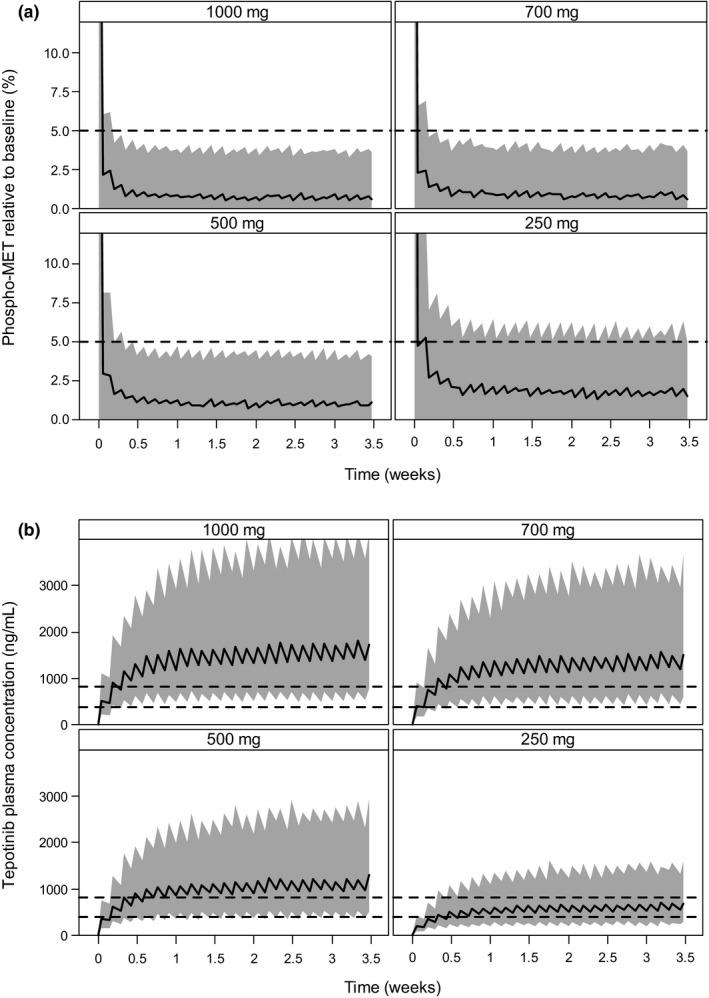
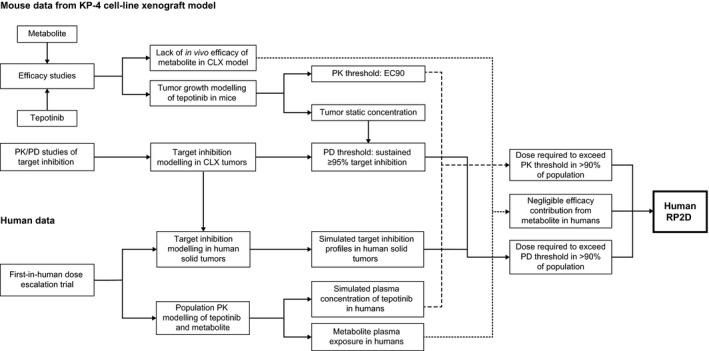
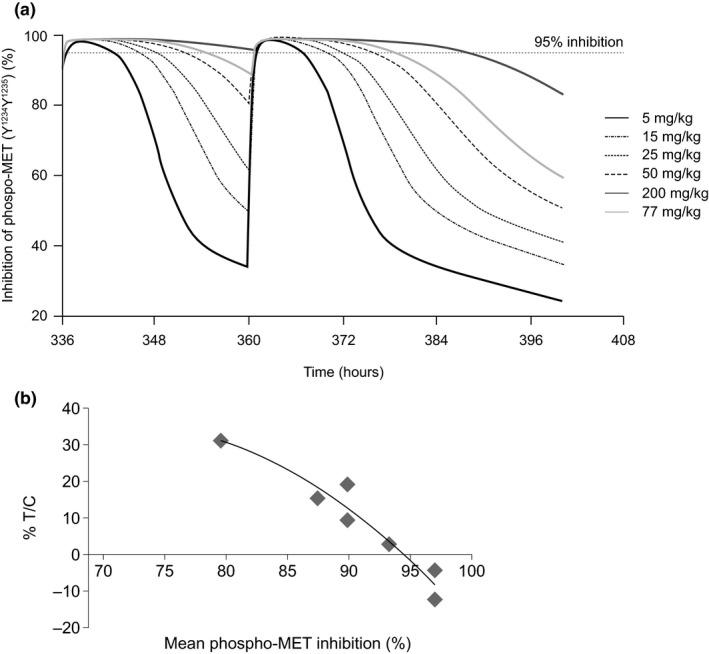
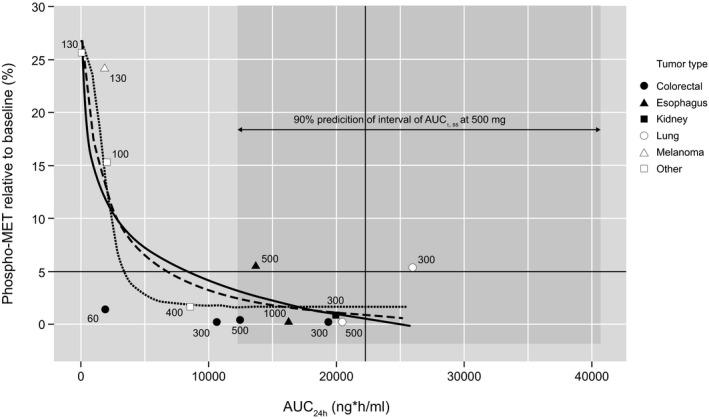
Tepotinib is a highly selective and potent MET inhibitor in development for the treatment of patients with solid tumors. Given the favorable tolerability and safety profiles up to the maximum tested dose in the first-in-human (FIH) trial, an efficacy-driven translational modeling approach was proposed to establish the recommended phase II dose (RP2D). To study the in vivo pharmacokinetics (PKs)/target inhibition/tumor growth inhibition relationship, a subcutaneous KP-4 pancreatic cell-line xenograft model in mice with sensitivity to MET pathway inhibition was selected as a surrogate tumor model. Further clinical PK and target inhibition data (derived from predose and postdose paired tumor biopsies) from a FIH study were integrated with the longitudinal PKs and target inhibition profiles from the mouse xenograft study to establish a translational PK/pharmacodynamic (PD) model. Preclinical data showed that tumor regression with tepotinib treatment in KP-4 xenograft tumors corresponded to 95% target inhibition. We therefore concluded that a PD criterion of sustained, near-to-complete (>95%) phospho-MET inhibition in tumors should be targeted for tepotinib to be effective. Simulations of dose-dependent target inhibition profiles in human tumors that exceeded the PD threshold in more than 90% of patients established an RP2D of tepotinib 500 mg once daily. This translational mathematical modeling approach supports an efficacy-driven rationale for tepotinib phase II dose selection of 500 mg once daily. Tepotinib at this dose has obtained regulatory approval for the treatment of patients with non-small cell lung cancer harboring MET exon 14 skipping.
特泊替尼是一种高度选择性和有效的 MET 抑制剂,目前正在开发用于治疗实体瘤患者。鉴于在首次人体(FIH)试验中直至最大测试剂量的良好耐受性和安全性特征,提出了一种基于疗效的转化建模方法来确定推荐的 II 期剂量(RP2D)。为了研究体内药代动力学(PKs)/靶标抑制/肿瘤生长抑制关系,选择对 MET 通路抑制敏感的皮下 KP-4 胰腺细胞系异种移植模型作为替代肿瘤模型。进一步整合来自 FIH 研究的临床 PK 和靶标抑制数据(源自预剂量和后剂量配对的肿瘤活检)和来自小鼠异种移植研究的纵向 PKs 和靶标抑制谱,建立转化 PK/药效学(PD)模型。临床前数据表明,在 KP-4 异种移植肿瘤中,特泊替尼治疗导致肿瘤消退,与 95%的靶标抑制相对应。因此,我们得出结论,应该以肿瘤中持续的、接近完全的(>95%)磷酸化 MET 抑制为 PD 标准,以使特泊替尼有效。在人类肿瘤中,模拟剂量依赖性靶标抑制谱,超过 90%的患者超过 PD 阈值,确定特泊替尼 500mg 每日一次的 RP2D。这种转化的数学建模方法支持了特泊替尼 500mg 每日一次的 II 期剂量选择的疗效驱动原理。特泊替尼在该剂量下已获得监管部门批准,用于治疗携带 MET 外显子 14 跳跃的非小细胞肺癌患者。

 Zotero 插件