
电子健康 老年人防跌倒的站立式 Tall 平衡练习:一项为期两年的随机对照试验结果。
E-health StandingTall balance exercise for fall prevention in older people: results of a two year randomised controlled trial.
机构信息
Falls, Balance and Injury Research Centre, Neuroscience Research Australia, Randwick, NSW, Australia
School of Population Health, University of New South Wales, Kensington, NSW, Australia.
出版信息
BMJ. 2021 Apr 6;373:n740. doi: 10.1136/bmj.n740.
OBJECTIVE
To test whether StandingTall, a home based, e-health balance exercise programme delivered through an app, could provide an effective, self-managed fall prevention programme for community dwelling older people.
DESIGN
Assessor blinded, randomised controlled trial.
SETTING
Older people living independently in the community in Sydney, Australia.
PARTICIPANTS
503 people aged 70 years and older who were independent in activities of daily living, without cognitive impairment, progressive neurological disease, or any other unstable or acute medical condition precluding exercise.
INTERVENTIONS
Participants were block randomised to an intervention group (two hours of StandingTall per week and health education; n=254) or a control group (health education; n=249) for two years.
MAIN OUTCOME MEASURES
The primary outcomes were the rate of falls (number of falls per person year) and the proportion of people who had a fall over 12 months. Secondary outcomes were the number of people who had a fall and the number who had an injurious fall (resulting in any injury or requiring medical care), adherence, mood, health related quality of life, and activity levels over 24 months; and balance and mobility outcomes over 12 months.
RESULTS
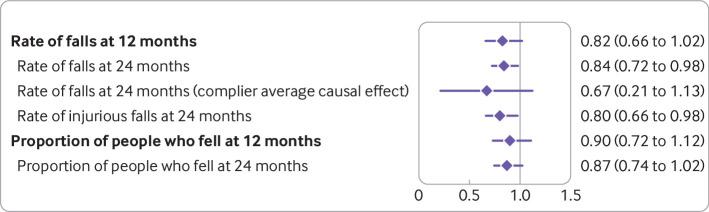
The fall rates were not statistically different in the two groups after the first 12 months (0.60 falls per year (standard deviation 1.05) in the intervention group; 0.76 (1.25) in the control group; incidence rate ratio 0.84, 95% confidence interval 0.62 to 1.13, P=0.071). Additionally, the proportion of people who fell was not statistically different at 12 months (34.6% in intervention group, 40.2% in control group; relative risk 0.90, 95% confidence interval 0.67 to 1.20, P=0.461). However, the intervention group had a 16% lower rate of falls over 24 months compared with the control group (incidence rate ratio 0.84, 95% confidence interval 0.72 to 0.98, P=0.027). Both groups had a similar proportion of people who fell over 24 months (relative risk 0.87, 95% confidence interval 0.68 to 1.10, P=0.239), but the proportion of people who had an injurious fall over 24 months was 20% lower in the intervention group compared with the control group (relative risk 0.80, 95% confidence interval 0.66 to 0.98, P=0.031). In the intervention group, 68.1% and 52.0% of participants exercised for a median of 114.0 min/week (interquartile range 53.5) after 12 months and 120.4 min/week (38.6) after 24 months, respectively. Groups remained similar in mood and activity levels. The intervention group had a 0.03 (95% confidence interval 0.01 to 0.06) improvement on the EQ-5D-5L (EuroQol five dimension five level) utility score at six months, and an improvement in standing balance of 11 s (95% confidence interval 2 to 19 s) at six months and 10 s (1 to 19 s) at 12 months. No serious training related adverse events occurred.
CONCLUSIONS
The StandingTall balance exercise programme did not significantly affect the primary outcomes of this study. However, the programme significantly reduced the rate of falls and the number of injurious falls over two years, with similar but not statistically significant effects at 12 months. E-health exercise programmes could provide promising scalable fall prevention strategies.
TRIAL REGISTRATION
ACTRN12615000138583.
目的
测试 StandingTall 是否可以为社区居住的老年人提供有效的、自我管理的防跌倒方案。StandingTall 是一种基于家庭的、通过应用程序提供的电子健康平衡运动计划。
设计
评估者设盲,随机对照试验。
地点
澳大利亚悉尼的独立生活在社区的老年人。
参与者
503 名年龄在 70 岁及以上、日常生活活动能力独立、无认知障碍、进行性神经疾病或任何其他不稳定或急性医学状况而不能运动的人。
干预措施
参与者按块随机分为干预组(每周进行两小时的 StandingTall 和健康教育;n=254)或对照组(健康教育;n=249),为期两年。
主要观察指标
主要结局是跌倒率(每人每年跌倒次数)和 12 个月内跌倒人数的比例。次要结局是跌倒人数和跌倒人数(导致任何伤害或需要医疗护理)、依从性、情绪、健康相关生活质量和 24 个月内的活动水平;以及 12 个月内的平衡和移动能力结果。
结果
在最初的 12 个月后,两组的跌倒率没有统计学上的差异(干预组每年 0.60 次跌倒(标准差 1.05);对照组每年 0.76 次(1.25);发病率比 0.84,95%置信区间 0.62 至 1.13,P=0.071)。此外,12 个月时跌倒人数的比例也没有统计学差异(干预组 34.6%,对照组 40.2%;相对风险 0.90,95%置信区间 0.67 至 1.20,P=0.461)。然而,与对照组相比,干预组在 24 个月内的跌倒率降低了 16%(发病率比 0.84,95%置信区间 0.72 至 0.98,P=0.027)。两组在 24 个月内跌倒人数的比例相似(相对风险 0.87,95%置信区间 0.68 至 1.10,P=0.239),但干预组 24 个月内受伤跌倒人数比例比对照组低 20%(相对风险 0.80,95%置信区间 0.66 至 0.98,P=0.031)。在干预组中,68.1%和 52.0%的参与者在 12 个月后分别每周锻炼中位数为 114.0 分钟(四分位距 53.5)和 120.4 分钟(38.6),24 个月后分别为 114.0 分钟(四分位距 53.5)和 120.4 分钟(38.6)。两组在情绪和活动水平上仍然相似。干预组在 6 个月时的 EQ-5D-5L(欧洲五维健康量表)效用评分提高了 0.03(95%置信区间 0.01 至 0.06),6 个月和 12 个月时站立平衡分别提高了 11 秒(95%置信区间 2 至 19 秒)和 10 秒(1 至 19 秒)。没有发生严重的与训练相关的不良事件。
结论
StandingTall 平衡运动计划并没有显著影响本研究的主要结局。然而,该方案显著降低了两年内的跌倒率和受伤跌倒人数,12 个月时的效果相似但无统计学意义。电子健康运动方案可能提供有前景的、可扩展的防跌倒策略。
试验注册
ACTRN12615000138583。

 Zotero 插件