
基于试验的经济评估的卫生经济学分析计划(HEAPs)内容:专家德尔菲共识调查。
Content of Health Economics Analysis Plans (HEAPs) for Trial-Based Economic Evaluations: Expert Delphi Consensus Survey.
机构信息
Population Health Sciences, Bristol Medical School, University of Bristol, Bristol, UK.
Population Health Sciences, Bristol Medical School, University of Bristol, Bristol, UK.
出版信息
Value Health. 2021 Apr;24(4):539-547. doi: 10.1016/j.jval.2020.10.002. Epub 2020 Nov 28.
OBJECTIVES
Health economics analysis plans (HEAPs) currently lack consistency, with uncertainty surrounding appropriate content. We aimed to develop a list of essential items that should be included in HEAPs for economic evaluations conducted alongside randomized trials.
METHODS
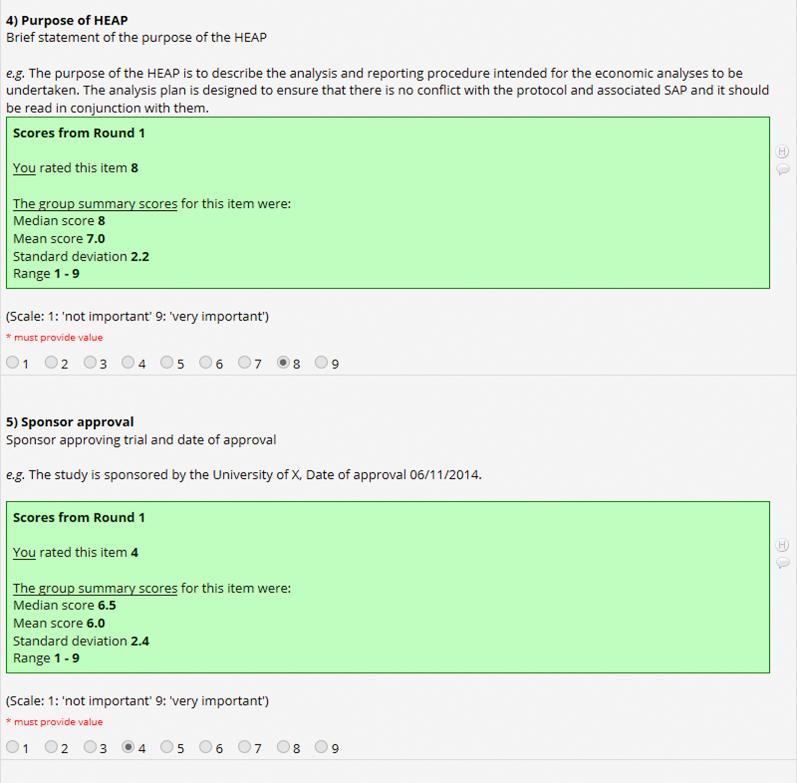
A list of potential items for inclusion was developed by examining existing HEAPs. An electronic Delphi survey was conducted among professional health economists. Respondents were asked to rate potential items from 1 (least important) to 9 (most important), suggest additional items, and comment on proposed items (round 1). A second survey (round 2) was emailed to participants, including the participant's own scores from round 1 along with summary results from the whole panel; participants were asked to rerate each item. Consensus criteria for inclusion in the final list were predefined as >70% of participants rating an item 7-9 and <15% rating it 1-3 after round 2. A final item selection meeting was held to scrutinize the results and adjudicate on items lacking consensus.
RESULTS
62 participants completed round 1 of the survey. The initial list included 72 potential items; all 72 were carried forward to round 2, and no new items were added. 48 round 1 respondents (77.4%) completed round 2 and reached consensus on 53 items. At the final meeting, the expert panel (n = 9) agreed that 58 items should be included in the essential list, moved 9 items to an optional list, and dropped 5 items.
CONCLUSIONS
Via expert consensus opinion, this study identified 58 items that are considered essential in a HEAP.
目的
健康经济学分析计划(HEAPs)目前缺乏一致性,其内容也存在不确定性。我们旨在制定一份应包含在与随机试验同时进行的经济评估的 HEAP 中的基本项目清单。
方法
通过检查现有的 HEAP,制定了一份潜在项目清单。对专业健康经济学家进行了电子德尔菲调查。要求受访者对潜在项目进行 1(最不重要)到 9(最重要)的评分,提出其他项目,并对提出的项目进行评论(第一轮)。第二轮向参与者发送电子邮件,其中包括参与者第一轮的个人得分以及整个小组的总结结果;要求参与者重新对每个项目进行评分。纳入最终清单的共识标准预先定义为 >70%的参与者对项目进行 7-9 评分,<15%的参与者对项目进行 1-3 评分。举行了最后一次项目选择会议,仔细审查结果并对缺乏共识的项目进行裁决。
结果
62 名参与者完成了第一轮调查。初始清单包括 72 个潜在项目;第二轮全部保留了 72 个项目,没有添加新项目。第一轮的 48 名受访者(77.4%)完成了第二轮,有 53 个项目达成共识。在最后一次会议上,专家组(n=9)同意将 58 个项目列入基本清单,将 9 个项目移至可选清单,并删除 5 个项目。
结论
通过专家的共识意见,本研究确定了 HEAP 中 58 个被认为是必不可少的项目。

 Zotero 插件