
在阿尔茨海默病神经影像倡议参与者中检测β-淀粉样蛋白阳性,并结合人口统计学、认知、磁共振成像和血浆生物标志物进行分析。
Detection of β-amyloid positivity in Alzheimer's Disease Neuroimaging Initiative participants with demographics, cognition, MRI and plasma biomarkers.
作者信息
Tosun Duygu, Veitch Dallas, Aisen Paul, Jack Clifford R, Jagust William J, Petersen Ronald C, Saykin Andrew J, Bollinger James, Ovod Vitaliy, Mawuenyega Kwasi G, Bateman Randall J, Shaw Leslie M, Trojanowski John Q, Blennow Kaj, Zetterberg Henrik, Weiner Michael W
机构信息
San Francisco Veterans Affairs Medical Center, San Francisco, CA, USA.
Department of Radiology and Biomedical Imaging, University of California San Francisco, San Francisco, CA, USA.
出版信息
Brain Commun. 2021 Feb 2;3(2):fcab008. doi: 10.1093/braincomms/fcab008. eCollection 2021.
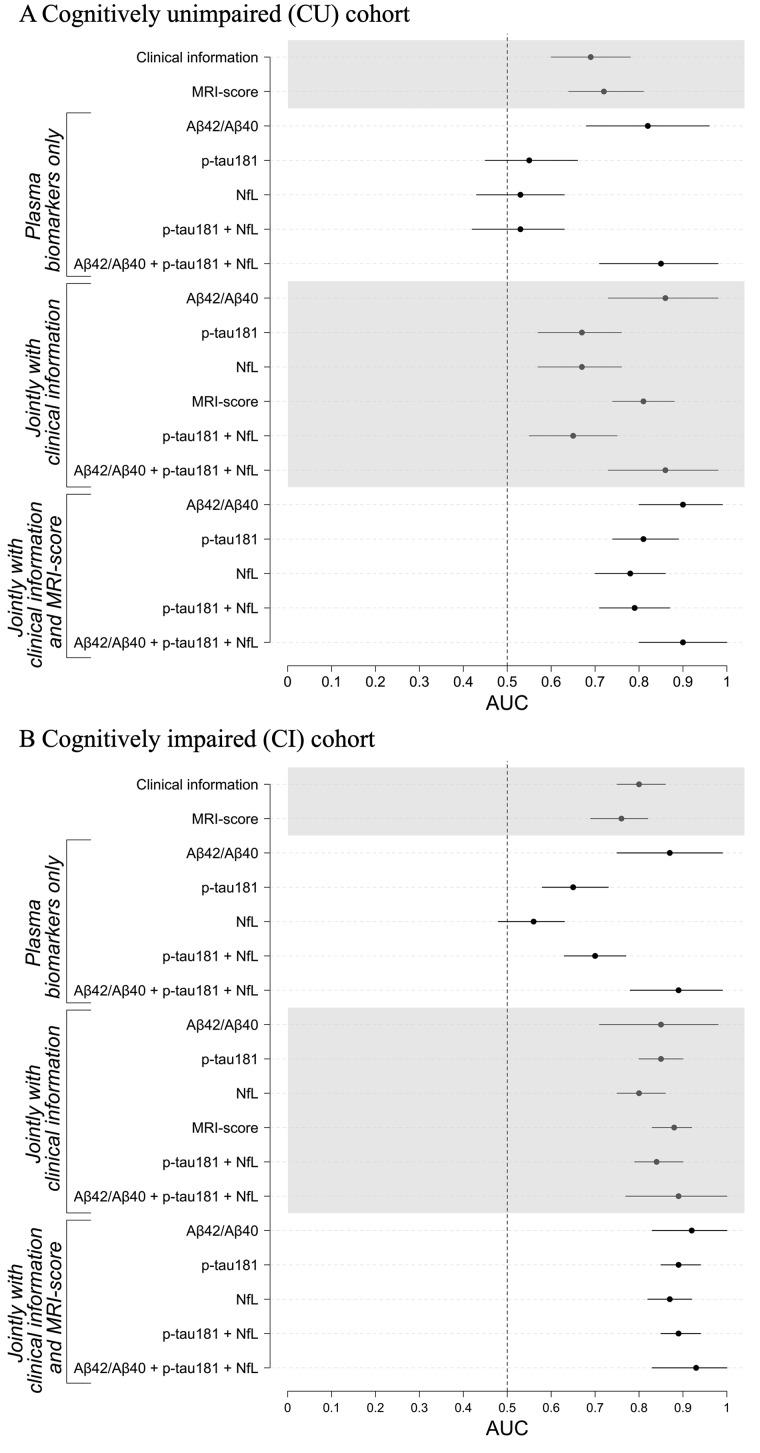
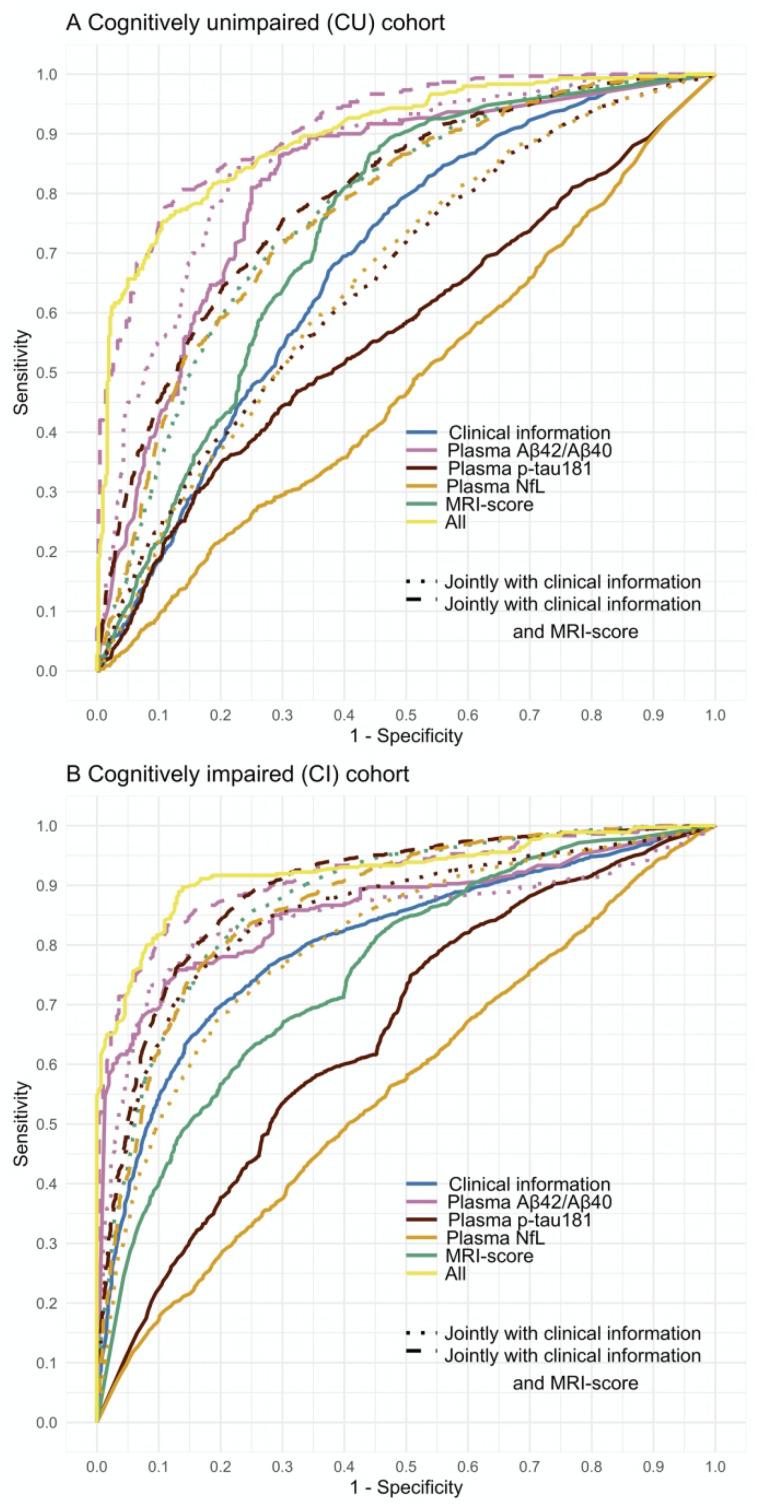
gold standard for the ante-mortem assessment of brain β-amyloid pathology is currently β-amyloid positron emission tomography or cerebrospinal fluid measures of β-amyloid or the β-amyloid/β-amyloid ratio. The widespread acceptance of a biomarker classification scheme for the Alzheimer's disease continuum has ignited interest in more affordable and accessible approaches to detect Alzheimer's disease β-amyloid pathology, a process that often slows down the recruitment into, and adds to the cost of, clinical trials. Recently, there has been considerable excitement concerning the value of blood biomarkers. Leveraging multidisciplinary data from cognitively unimpaired participants and participants with mild cognitive impairment recruited by the multisite biomarker study of Alzheimer's Disease Neuroimaging Initiative, here we assessed to what extent plasma β-amyloid/β-amyloid, neurofilament light and phosphorylated-tau at threonine-181 biomarkers detect the presence of β-amyloid pathology, and to what extent the addition of clinical information such as demographic data, genotype, cognitive assessments and MRI can assist plasma biomarkers in detecting β-amyloid-positivity. Our results confirm plasma β-amyloid/β-amyloid as a robust biomarker of brain β-amyloid-positivity (area under curve, 0.80-0.87). Plasma phosphorylated-tau at threonine-181 detected β-amyloid-positivity only in the cognitively impaired with a moderate area under curve of 0.67, whereas plasma neurofilament light did not detect β-amyloid-positivity in either group of participants. Clinical information as well as MRI-score independently detected positron emission tomography β-amyloid-positivity in both cognitively unimpaired and impaired (area under curve, 0.69-0.81). Clinical information, particularly ε4 status, enhanced the performance of plasma biomarkers in the detection of positron emission tomography β-amyloid-positivity by 0.06-0.14 units of area under curve for cognitively unimpaired, and by 0.21-0.25 units for cognitively impaired; and further enhancement of these models with an MRI-score of β-amyloid-positivity yielded an additional improvement of 0.04-0.11 units of area under curve for cognitively unimpaired and 0.05-0.09 units for cognitively impaired. Taken together, these multi-disciplinary results suggest that when combined with clinical information, plasma phosphorylated-tau at threonine-181 and neurofilament light biomarkers, and an MRI-score could effectively identify β-amyloid+ cognitively unimpaired and impaired (area under curve, 0.80-0.90). Yet, when the MRI-score is considered in combination with clinical information, plasma phosphorylated-tau at threonine-181 and plasma neurofilament light have minimal added value for detecting β-amyloid-positivity. Our systematic comparison of β-amyloid-positivity detection models identified effective combinations of demographics, , global cognition, MRI and plasma biomarkers. Promising minimally invasive and low-cost predictors such as plasma biomarkers of β-amyloid/β-amyloid may be improved by age and genotype.
目前,脑β-淀粉样蛋白病理学生前评估的金标准是β-淀粉样蛋白正电子发射断层扫描或脑脊液中β-淀粉样蛋白测量值或β-淀粉样蛋白/β-淀粉样蛋白比率。阿尔茨海默病连续体生物标志物分类方案的广泛接受引发了人们对更经济实惠且易于获取的方法来检测阿尔茨海默病β-淀粉样蛋白病理学的兴趣,这一过程常常减缓临床试验的招募速度并增加成本。最近,血液生物标志物的价值引发了相当大的关注。利用来自阿尔茨海默病神经影像倡议多中心生物标志物研究招募的认知未受损参与者和轻度认知障碍参与者的多学科数据,我们在此评估血浆β-淀粉样蛋白/β-淀粉样蛋白、神经丝轻链和苏氨酸181位点磷酸化tau蛋白生物标志物在多大程度上能检测出β-淀粉样蛋白病理学的存在,以及添加人口统计学数据、基因型、认知评估和磁共振成像等临床信息在多大程度上能协助血浆生物标志物检测β-淀粉样蛋白阳性。我们的结果证实血浆β-淀粉样蛋白/β-淀粉样蛋白是脑β-淀粉样蛋白阳性的可靠生物标志物(曲线下面积为0.80 - 0.87)。苏氨酸181位点血浆磷酸化tau蛋白仅在认知受损者中检测到β-淀粉样蛋白阳性,曲线下面积中等,为0.67,而血浆神经丝轻链在两组参与者中均未检测到β-淀粉样蛋白阳性。临床信息以及磁共振成像评分在认知未受损和受损者中均能独立检测出正电子发射断层扫描β-淀粉样蛋白阳性(曲线下面积为0.69 - 0.81)。临床信息,尤其是ε4状态,在认知未受损者中使血浆生物标志物检测正电子发射断层扫描β-淀粉样蛋白阳性的性能提高了曲线下面积0.06 - 0.14单位,在认知受损者中提高了0.21 - 0.25单位;用β-淀粉样蛋白阳性的磁共振成像评分进一步优化这些模型,在认知未受损者中曲线下面积额外提高了0.04 - 0.11单位,在认知受损者中提高了0.05 - 0.09单位。综上所述,这些多学科结果表明,当与临床信息相结合时,苏氨酸181位点血浆磷酸化tau蛋白和神经丝轻链生物标志物以及磁共振成像评分能够有效识别β-淀粉样蛋白阳性的认知未受损和受损者(曲线下面积为0.80 - 0.90)。然而,当将磁共振成像评分与临床信息结合考虑时,苏氨酸181位点血浆磷酸化tau蛋白和血浆神经丝轻链在检测β-淀粉样蛋白阳性方面的附加值最小。我们对β-淀粉样蛋白阳性检测模型的系统比较确定了人口统计学、整体认知、磁共振成像和血浆生物标志物的有效组合。有前景的微创且低成本预测指标,如血浆β-淀粉样蛋白/β-淀粉样蛋白生物标志物,可能会因年龄和基因型而得到改善。


 Zotero 插件