
一个将平衡石位置与生长素运输联系起来的植物向重力性综合模型。
An Integrative Model of Plant Gravitropism Linking Statoliths Position and Auxin Transport.
作者信息
Levernier Nicolas, Pouliquen Olivier, Forterre Yoël
机构信息
Aix Marseille University, CNRS, IUSTI, Marseille, France.
出版信息
Front Plant Sci. 2021 Mar 29;12:651928. doi: 10.3389/fpls.2021.651928. eCollection 2021.
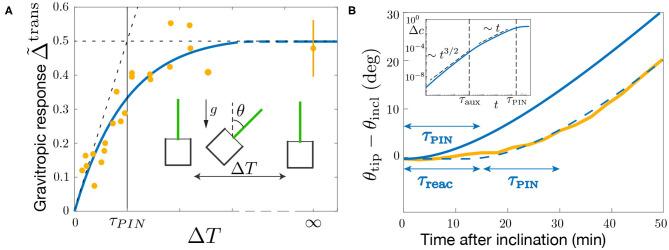
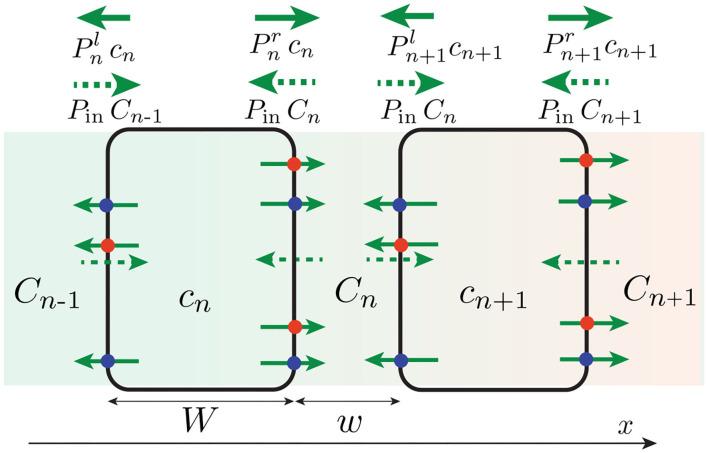
Gravity is a major cue for the proper growth and development of plants. The response of plants to gravity implies starch-filled plastids, the statoliths, which sediments at the bottom of the gravisensing cells, the statocytes. Statoliths are assumed to modify the transport of the growth hormone, auxin, by acting on specific auxin transporters, PIN proteins. However, the complete gravitropic signaling pathway from the intracellular signal associated to statoliths to the plant bending is still not well-understood. In this article, we build on recent experimental results showing that statoliths do not act as gravitational force sensor, but as position sensor, to develop a bottom-up theory of plant gravitropism. The main hypothesis of the model is that the presence of statoliths modifies PIN trafficking close to the cell membrane. This basic assumption, coupled with auxin transport and growth in an idealized tissue made of a one-dimensional array of cells, recovers several major features of the gravitropic response of plants. First, the model provides a new interpretation for the response of a plant to a steady stimulus, the so-called sine-law of plant gravitropism. Second, it predicts the existence of a gravity-independent memory process as observed recently in experiments studying the response to transient stimulus. The model suggests that the timescale of this process is associated to PIN turnover, calling for new experimental studies.
重力是植物正常生长和发育的主要线索。植物对重力的反应涉及充满淀粉的质体——平衡石,其沉积在重力感应细胞(平衡细胞)的底部。人们认为平衡石通过作用于特定的生长素转运蛋白PIN蛋白来改变生长激素生长素的运输。然而,从与平衡石相关的细胞内信号到植物弯曲的完整重力信号传导途径仍未得到很好的理解。在本文中,我们基于最近的实验结果展开研究,这些结果表明平衡石并非作为重力传感器,而是作为位置传感器,以此来建立一种自下而上的植物向重力性理论。该模型的主要假设是平衡石的存在会改变靠近细胞膜的PIN蛋白运输。这一基本假设,再结合生长素在由一维细胞阵列构成的理想化组织中的运输和生长情况,重现了植物向重力性反应的几个主要特征。首先,该模型为植物对稳定刺激的反应,即所谓的植物向重力性正弦定律,提供了一种新的解释。其次,它预测了在研究对瞬时刺激反应的实验中最近观察到的重力无关记忆过程的存在。该模型表明这个过程的时间尺度与PIN蛋白的周转有关,这需要新的实验研究。





 Zotero 插件