
病蝙蝠独自在家:当面临免疫挑战时,果蝠会实行社交隔离。
Sick bats stay home alone: fruit bats practice social distancing when faced with an immunological challenge.
机构信息
Department of Zoology, Tel Aviv University, Tel Aviv, Israel.
Department of Agriculture, University of Naples Federico II, Naples, Italy.
出版信息
Ann N Y Acad Sci. 2021 Dec;1505(1):178-190. doi: 10.1111/nyas.14600. Epub 2021 Apr 19.
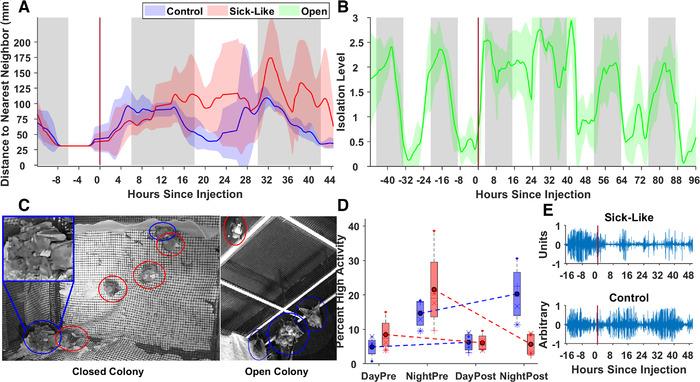
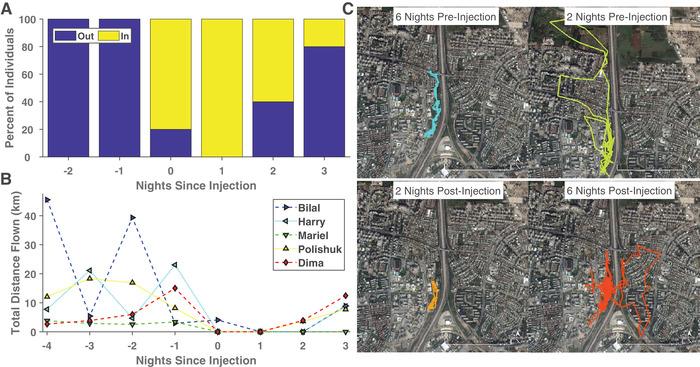
Along with its many advantages, social roosting imposes a major risk of pathogen transmission. How social animals reduce this risk is poorly documented. We used lipopolysaccharide challenge to imitate bacterial infection in both a captive and a free-living colony of an extremely social, long-lived mammal-the Egyptian fruit bat. We monitored behavioral and physiological responses using an arsenal of methods, including onboard GPS to track foraging, acceleration sensors to monitor movement, infrared video to record social behavior, and blood samples to measure immune markers. Sick-like (immune-challenged) bats exhibited an increased immune response, as well as classic illness symptoms, including fever, weight loss, anorexia, and lethargy. Notably, the bats also exhibited behaviors that would reduce pathogen transfer. They perched alone and appeared to voluntarily isolate themselves from the group by leaving the social cluster, which is extremely atypical for this species. The sick-like individuals in the open colony ceased foraging outdoors for at least two nights, thus reducing transmission to neighboring colonies. Together, these sickness behaviors demonstrate a strong, integrative immune response that promotes recovery of infected individuals while reducing pathogen transmission inside and outside the roost, including spillover events to other species, such as humans.
除了诸多优势外,群居还会带来病原体传播的重大风险。群居动物如何降低这种风险,目前还缺乏相关记录。我们利用脂多糖(LPS)刺激来模拟细菌感染,分别对一个人工饲养和一个自由生活的群居物种——埃及果蝠群体进行了实验。我们利用包括 GPS 追踪觅食、加速度传感器监测运动、红外线视频记录社交行为和采集血样检测免疫标志物等多种方法,监测了蝙蝠的行为和生理反应。患病(免疫挑战)蝙蝠的免疫反应增强,出现了典型的疾病症状,包括发热、体重减轻、厌食和嗜睡。值得注意的是,蝙蝠还表现出了降低病原体传播的行为。它们独自栖息,并通过离开社会群体,主动将自己与群体隔离,这在该物种中是极不寻常的。在开放群体中,患病个体至少有两个晚上停止在户外觅食,从而减少了对邻近群体的传播。这些疾病行为共同表明,蝙蝠具有强烈的、综合的免疫反应,有助于受感染个体的恢复,同时减少了在栖息地内外的病原体传播,包括向其他物种(如人类)的溢出事件。


 Zotero 插件