
瑞士苯二氮䓬类药物和Z类药物的使用情况:患病率、处方模式及与不良医疗结局的关联
Benzodiazepine and Z-Drug Use in Switzerland: Prevalence, Prescription Patterns and Association with Adverse Healthcare Outcomes.
作者信息
Landolt Salome, Rosemann Thomas, Blozik Eva, Brüngger Beat, Huber Carola A
机构信息
Institute of Primary Care, University of Zürich, University Hospital Zürich, Zürich, Switzerland.
Department of Health Sciences, Helsana Insurance Group, Zürich, Switzerland.
出版信息
Neuropsychiatr Dis Treat. 2021 Apr 12;17:1021-1034. doi: 10.2147/NDT.S290104. eCollection 2021.
PURPOSE
This study aimed to give a nationwide comprehensive picture of the prevalence and prescription patterns of benzodiazepines (BZ) and Z-drugs (ZD) in Switzerland and to analyze the association with adverse health care outcomes.
PATIENTS AND METHODS
A population-based, cross-sectional study was conducted, using a large health insurance database in Switzerland. Records from all adult patients with ≥1 prescription for a benzodiazepine and/or a Z-drug in 2018 were included. We calculated the prevalence of BZ and ZD user (extrapolated to the Swiss general population), the number of prescriptions and the type of provider (among each BZ and ZD only user). Multivariate logistic regression models were performed to estimate the association between drug prescription and the risk of hospitalization in different healthcare settings.
RESULTS
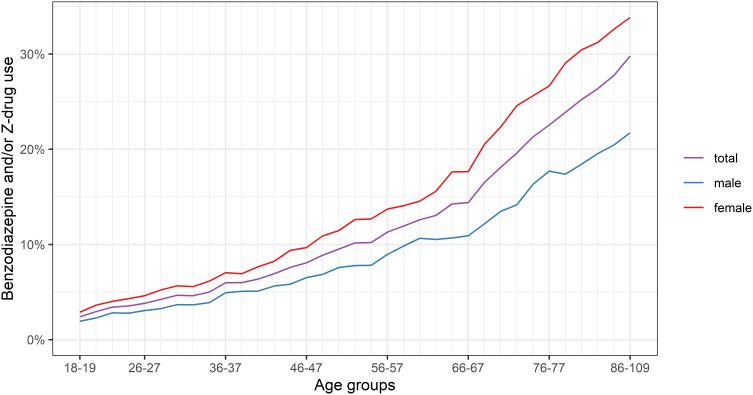
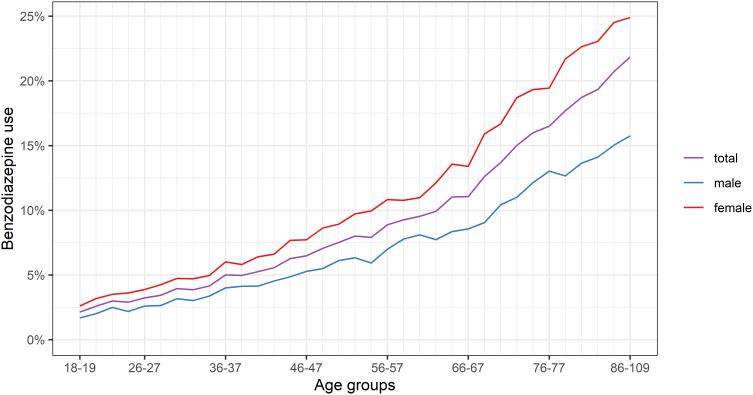
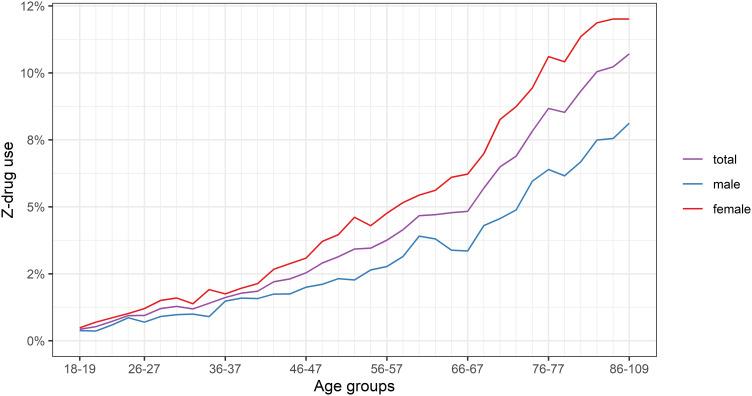
Of a total of 844'692 patients, 95'179 had ≥1 BZ and/or ZD prescription in 2018. The extrapolated one-year prevalence for the general Swiss population was 8.1% for a BZ prescription, 3.5% for a ZD prescription, and 10.5% for a BZ and/or ZD prescription, and continuously increased with age. The majority of the elderly (over 65 years) had ≥1 prescription (BZ: 51.9%; ZD: 56.9%; BZ and/or ZD: 53.5). The proportion of patients with ≥6 prescriptions per year was 23.1% for BZ only user and 35.2% for ZD only user. Most patients had ≥1 prescription from a general practitioner. Regression models showed a higher likelihood to be admitted to acute care, psychiatry, rehabilitation, or nursing home with ≥1 prescription for a benzodiazepine and/or a Z-drug.
CONCLUSION
This study is the first to give a nationwide overview of the current use of benzodiazepines and Z-drugs in Switzerland based on health insurance claims data. The results revealed a remarkably high prevalence among the general Swiss population, especially in older generations. The negative consequences of heavy BZ and ZD use are a crucial public health problem, that should be addressed.
目的
本研究旨在全面呈现瑞士苯二氮䓬类药物(BZ)和Z类药物(ZD)的使用情况及处方模式,并分析其与不良医疗保健结果之间的关联。
患者与方法
利用瑞士一个大型医疗保险数据库进行了一项基于人群的横断面研究。纳入了2018年所有开具过≥1次苯二氮䓬类药物和/或Z类药物处方的成年患者记录。我们计算了BZ和ZD使用者的患病率(推算至瑞士普通人群)、处方数量以及处方提供者类型(仅针对BZ和ZD各自的使用者)。采用多变量逻辑回归模型来估计药物处方与不同医疗环境下住院风险之间的关联。
结果
在总共844,692名患者中,95,179人在2018年开具过≥1次BZ和/或ZD处方。瑞士普通人群的推算一年患病率为:BZ处方8.1%,ZD处方3.5%,BZ和/或ZD处方10.5%,且随年龄持续上升。大多数老年人(65岁以上)开具过≥1次处方(BZ:51.9%;ZD:56.9%;BZ和/或ZD:53.5%)。仅使用BZ的患者中,每年开具≥6次处方的比例为23.1%,仅使用ZD的患者为35.2%。大多数患者有≥1次来自全科医生的处方。回归模型显示,开具过≥1次苯二氮䓬类药物和/或Z类药物处方的患者更有可能入住急性护理、精神病科、康复机构或养老院。
结论
本研究首次基于医疗保险理赔数据对瑞士苯二氮䓬类药物和Z类药物的当前使用情况进行了全国性概述。结果显示瑞士普通人群中患病率极高,尤其是在老年人群体中。大量使用BZ和ZD的负面后果是一个关键的公共卫生问题,应予以解决。
 Zotero 插件