
微生物组调控——迈向更好地理解植物微生物组对微生物接种剂的反应
Microbiome Modulation-Toward a Better Understanding of Plant Microbiome Response to Microbial Inoculants.
作者信息
Berg Gabriele, Kusstatscher Peter, Abdelfattah Ahmed, Cernava Tomislav, Smalla Kornelia
机构信息
Institute of Environmental Biotechnology, Graz University of Technology, Graz, Austria.
Julius Kühn Institute (JKI) Federal Research Centre for Cultivated Plants, Institute for Epidemiology and Pathogen Diagnostics, Braunschweig, Germany.
出版信息
Front Microbiol. 2021 Apr 8;12:650610. doi: 10.3389/fmicb.2021.650610. eCollection 2021.
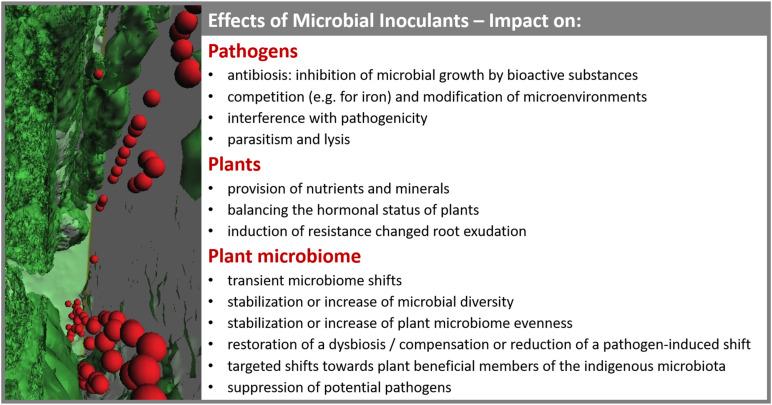
Plant-associated microorganisms are involved in important functions related to growth, performance and health of their hosts. Understanding their modes of action is important for the design of promising microbial inoculants for sustainable agriculture. Plant-associated microorganisms are able to interact with their hosts and often exert specific functions toward potential pathogens; the underlying interactions are well studied. In contrast, effects of inoculants, and especially their impact on the plant indigenous microbiome was mostly neglected so far. Recently, microbiome research has revolutionized our understanding of plants as coevolved holobionts but also of indigenous microbiome-inoculant interactions. Here we disentangle the effects of microbial inoculants on the indigenous plant microbiome and point out the following types of plant microbiome modulations: (i) transient microbiome shifts, (ii) stabilization or increase of microbial diversity, (iii) stabilization or increase of plant microbiome evenness, (iv) restoration of a dysbiosis/compensation or reduction of a pathogen-induced shift, (v) targeted shifts toward plant beneficial members of the indigenous microbiota, and (vi) suppression of potential pathogens. Therefore, we suggest microbiome modulations as novel and efficient mode of action for microbial inoculants that can also be mediated the plant.
与植物相关的微生物参与了与其宿主生长、性能和健康相关的重要功能。了解它们的作用方式对于设计用于可持续农业的有前景的微生物接种剂至关重要。与植物相关的微生物能够与宿主相互作用,并常常对潜在病原体发挥特定功能;其潜在的相互作用已得到充分研究。相比之下,接种剂的效果,尤其是它们对植物原生微生物群的影响,到目前为止大多被忽视了。最近,微生物群研究彻底改变了我们对植物作为共同进化的整体生物的理解,也改变了我们对原生微生物群 - 接种剂相互作用的理解。在这里,我们剖析了微生物接种剂对植物原生微生物群的影响,并指出了以下几种植物微生物群调节类型:(i)短暂的微生物群转移,(ii)微生物多样性的稳定或增加,(iii)植物微生物群均匀度的稳定或增加,(iv)恢复失调/补偿或减少病原体诱导的转移,(v)向植物原生微生物群中有益成员的靶向转移,以及(vi)抑制潜在病原体。因此,我们建议将微生物群调节作为微生物接种剂的一种新的有效作用方式,这种方式也可以由植物介导。

 Zotero 插件